Register

Technique

Briefing: January 2015

The loss of SpaceShipTwo during a test flight in November wont shut down Virgin Galactics space-tourism project, according to CEO Richard Branson. Branson also said he still plans to be aboard the first commercial passenger flight. NTSB staffers said their investigation wont be complete for about a year, but in the first few days after the accident, they found that the aircrafts feather mechanism — a rotating tail boom intended to slow the aircraft on descent from high altitudes — was prematurely deployed, and initiated the breakup of the aircraft at about 50,000 feet. Pilot Peter Siebold was injured but survived, and co-pilot Michael Alsbury was killed. A second spaceship is already under construction and is expected to launch in 2015.
Read More »

What Is Minimum Fuel?

Fuel-management procedures are entwined into every aspect of flight, from planning to a periodic scan of the gauges while youre zipping along at cruise. But even the best-laid plans can easily fall victim to diversion, delays and even overly-optimistic thinking.

Read More »

When Low Fuel Becomes No Fuel

One of the most famous and tragic of fuel-exhaustion crashes occurred on Jan. 25, 1990. Upon arrival in the New York area after a flight from Bogot, the 707 was placed into a hold for an hour and 27 minutes due to fog at JFK. The pilots were not native English speakers and never used the actual word emergency in describing their fuel situation to ATC, using only minimum fuel instead and never stating their fuel state in minutes. During that time, they burned away all the fuel they needed to make Boston, their alternate.

Read More »

Mastering Cruise Descents

Lets fire up the Wayback machine and set it for high school physics class. As an aircraft climbs, it burns fuel (and by extension, money) to provide kinetic energy. That energy is used for climb performance and airspeed (countering that demon drag in the process). Once the aircraft is tucked away at a cruise altitude, some of that formerly-kinetic energy is available as potential energy due to the force of gravity acting on the aircraft. Potential energy can be converted back into kinetic energy by initiating a descent, which you can observe as increasing airspeed (all else remaining equal).

Read More »

The Old Conundrum: Time vs. Money

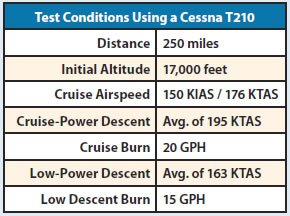
When comparing a high-speed, cruise-power descent against a cruise-speed, reduced-power descent, there are a surprisingly large number of variables in the equation, all pulling in different directions.

Read More »

Practice Bore-Sight IFR for Descents on the Angles

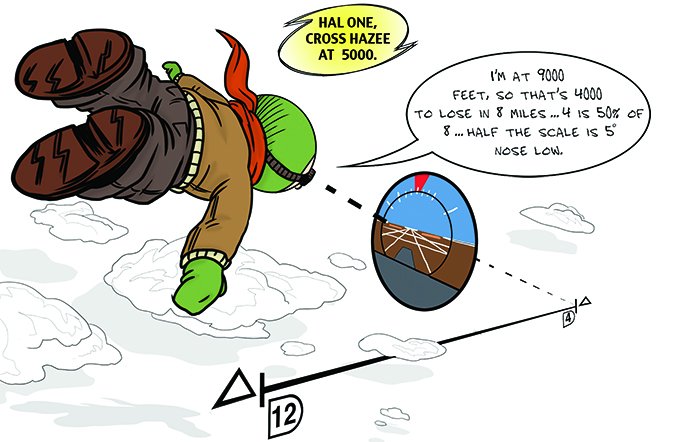
Classic descent planning usually includes a time/distance/rate algorithm worthy of space shuttle re-entry or a that-looks-about-right guess. The latter often results in a screaming, idle path that ends with, Ahhh, Center, were gonna have a little trouble crossing STING at 3000.

Read More »

Briefing: February 2010

We now have approved technical and operational standards for ADS-B equipment-but dont get too excited. This really means (among other things) that manufacturers can now move forward to develop conforming ADS-B hardware. The FAAs final rule on what will be required for GA equipage to fly in controlled airspace isnt due until April of this year. Compliance isnt required for another decade-provided the system is up and running by then.

Read More »

Man, Did He Ever Get Fat

Maybe its the looming specter of my 25th high-school reunion thats got me worrying about getting fat and sloppy. Living in the land where donuts and coffee are staple foods, Ive been passing on the former while muttering renewed resolutions about spending more time at the gym.

Read More »

Readback: March 2010

I have a question that people have been asking me and I dont know the answer.The G1000 has two GPS receivers: GPS 1 is the default choice and automatically switches to GPS 2 if there is a problem. Or you can manually select GPS 2.My question is: Why can only one be used at a time? For example, one GPS could be the primary navigator with the flight plan and the other could indicate final destination or a waypoint on the side of the track or even an alternate.

Read More »

Hocus Focus in Vermont

Tucked in a seam between the Green and Taconic Mountains, with the Adirondacks just to the west across the Champlain Valley, Rutland-Southern Vermont Regional Airport (KRUT) serves a variety of aircraft from biz jets to homebuilts. The appeal of Vermont scenery and skiing tempts vacationers into Rutland despite the surrounding hills.

Read More »
Pilot in aircraft
Sign-up for newsletters & special offers!

Get the latest stories & special offers delivered directly to your inbox.

SUBSCRIBE