













Register

Practice Bore-Sight IFR for Descents on the Angles

Classic descent planning usually includes a time/distance/rate algorithm worthy of space shuttle re-entry or a that-looks-about-right guess. The latter often results in a screaming, idle path that ends with, Ahhh, Center, were gonna have a little trouble crossing STING at 3000.

Gemini Sparkle

Key Takeaways:

  • The article introduces a "Flying Tigers gun sight" method for descent planning, advocating the use of the attitude indicator (AI) as a simple protractor to visually set descent angles, rather than complex algorithms or rough estimates.
  • For a standard 3-degree descent, pilots can calculate the required distance by tripling the altitude to lose, then set their pitch 3 degrees nose low on the AI, verifying the descent rate by halving their groundspeed and adding a zero.
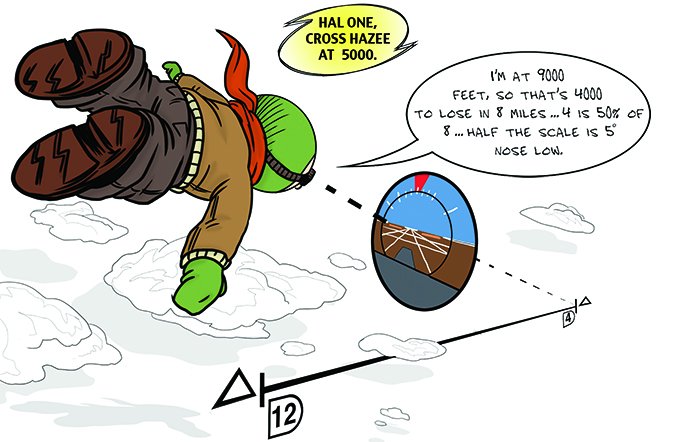
  • For scenarios requiring different descent angles, the AI can be used to set a pitch by relating the altitude to lose to the distance (e.g., 50% of the 10-degree scale for 4000 feet in 8 miles equals 5 degrees nose low).
See a mistake? Contact us.

Classic descent planning usually includes a time/distance/rate algorithm worthy of space shuttle re-entry or a that-looks-about-right guess. The latter often results in a screaming, idle path that ends with, “Ahhh, Center, we’re gonna have a little trouble crossing STING at 3000.”

Wouldn’t it be neat if you had a ring-and-bead gun sight like the old Flying Tigers P-40s to point the nose and smoke your descent target? In a way, you do.


Ready to Sell Your Aircraft?

List your airplane on AircraftForSale.com and reach qualified buyers.

List Your Aircraft
AircraftForSale Logo | FLYING Logo
Pilot in aircraft
Sign-up for newsletters & special offers!

Get the latest stories & special offers delivered directly to your inbox.

SUBSCRIBE