Register

Technique

Readback: January 2010

Any dummy can figure that one needs a Direct entry when approaching the holding fix on the hemisphere containing the racetrack. The head scratcher is whether, from the other hemisphere, to do a teardrop or a parallel entry to the hold.

Read More »

Just Do Nothing

Some years back I was enjoying a chat with a former B-52 commander about emergencies, and he told me something about his training that has stuck. They had a mechanical clock in the cockpit, and they were trained that at the first sign of all but the most critical emergencies they should wind the clock.

Read More »

Into Uncontrolled Air

As instrument pilots on IFR clearances, the types and differences of the airspace we fly in dont seem to matter much. But it turns out that there are some nuances that do matter and can cause hassle, hazard or even a certificate action if we ignore them.

Read More »

Launching Without Control

Unless there is a departure procedure (DP) or obstacle departure procedure (ODP), pilots departing from an airport located in Class G airspace are on their own for navigation. But then, unless the clearance includes a departure procedure, pilots are always responsible for their navigation from the pavement into the en route structure until they are radar identified and on an active vector. Take it from us, if there is a DP, especially an ODP, use it. ODPs exist because there are hard objects somewhere in your potential departure path.

Read More »

Flying High and Visual

The forecast said that deep, moist convection was likely for your afternoon flight. On your drive to the airport, you second-guess the 10,000-foot altitude you filed. Should you have filed for the low to mid teens? Perhaps you should have filed a much lower altitude to try and stay below the clouds?

Read More »

Mastering Short-Haul IFR

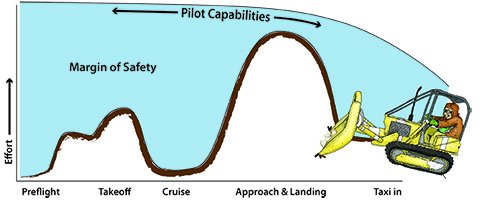
Picture one of those ubiquitous human factors graphs that show pilot workload during a flight. The x-axis shows startup through shutdown. On the y axis, is a scale of pilot workload: relatively low during taxi, a significant spike during takeoff and departure, a long, low flat line for cruise, an even bigger spike for approach and landing and an anti-climactic taper-off for taxi in. At the top of the graph, theres an additional line that starts high and arcs slowly down representing the pilots capabilities.

Read More »

Briefing: November 2010

The FAA handed over another $356 million to Lockheed Martin along with a three-year contract extension for running our automated flight service system. Lockheed Martin took over the AFSS function in 2005 and says the net result of the changes over the past five years is better, more efficient service, despite slashing the number of flight service stations and staff. Said Jim Derr, Lockheed Martin Flight Service Program Director, We are excited to have the opportunity to continue providing the most accurate and reliable flight service briefings available. We noted he didnt say, useful.

Read More »

Readback: December 2014

During a flight originating in Allegheny County, ATC amended our flight plan on a VOR/DME-equipped (no GPS, at least not in the equipment suffix) aircraft: KAGC AGC073 HOMEE JST300 JST SEG…The change is easy to execute-depart, intercept AGC073 which leads to HOMEE, then fly JST300 to JST-but came a bit as a surprise, because the system would not accept a flight plan that includes intercepting radials (the AGC073 and JST300 components) instead of radial and DME fixes. In talking to FSS their and our assumption was that the AGC073 component was a local ATC operational addition to route us out of busy airspace more precisely.We were wondering if there is a way (or trick) to include such intercept element when filing a flight plan.

Read More »

Get Your Mask On

On September 5, 2014 the chairman of the TBM Owners and Pilots Association, Larry Glazer and his wife, Jane were on board a Socata TBM 900 single-engine turboprop that crashed into the ocean off the coast of Jamaica. According to the NTSB preliminary report, about an hour and a half into the flight from Rochester, New York to Naples, Florida, the pilot became unresponsive after reporting an indication that is not correct in the plane. The fighter jet pilots who escorted the aircraft to the Cuban airspace border suspected possible hypoxia.


Read More »
Pilot in aircraft
Sign-up for newsletters & special offers!

Get the latest stories & special offers delivered directly to your inbox.

SUBSCRIBE