













Register

Icing Gear

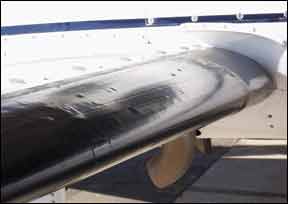
Each anti- or de-icing technology has benefits and drawbacks. If you’re flying with boots, use them early and often.

Gemini Sparkle

Key Takeaways:

  • Aircraft ice protection systems are categorized as de-icing (removing accumulated ice) or anti-icing (preventing ice formation), highlighting that even early equipped planes struggled with severe icing.
  • Various technologies exist to combat ice, including pneumatic de-icing boots, fluid-based "weeping wing" (TKS) systems, electrothermal heaters, and turbine engine bleed-air systems for jets.
  • All anti-icing and de-icing systems have distinct benefits and drawbacks, are often expensive, and are primarily designed to help aircraft escape icing conditions rather than operate indefinitely within them, emphasizing their limitations.
See a mistake? Contact us.

Anyone who’s read Ernest K. Gann’s Fate Is The Hunter will recall the author’s experience in an ice-laden DC-2 over the Eastern Seaboard. After departing Nashville for New York, Gann and his captain, Hughen, encounter severe icing and attempt to return to Nashville, only to find it below minimums. They are forced to divert to Cincinnati, barely making it, thunking down the airplane on the runway after an 8+50 odyssey exhausted altitude, fuel and ideas.Their DC-2 was equipped with de-icing boots, alcohol for the props and windshield, and even a heating duct to defrost the cockpit windows. None of it could keep up with the ice accumulation or shed what turned out to be up to four inches of the stuff, providing an early demonstration that there’s no such thing as an airplane immune to icing.

288


Ready to Sell Your Aircraft?

List your airplane on AircraftForSale.com and reach qualified buyers.

List Your Aircraft
AircraftForSale Logo | FLYING Logo
Pilot in aircraft
Sign-up for newsletters & special offers!

Get the latest stories & special offers delivered directly to your inbox.

SUBSCRIBE