Unicom

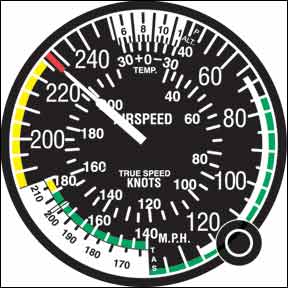
Never Exceed Speed

The article “Slow Down, You Move Too Fast” (January 2011) was enlightening. While Mr. Gibbs statements are logical, it would be helpful to have a reference describing this in more detail. Would you please provide a reference that explains the aerodynamic theory or aircraft certification process that substantiates Mr. Gibbs explanation? Although I find Aviation Safety very useful, I cannot use it as a sole reference when providing instruction.
Read More »

Lining Up

I was just reading Luca F. Bencini-Tibos letter to the editor (Unicom, December 2010) and wanted to correct what I perceive to be some misunderstanding. First, changing to ICAO weather abbreviations was and is for the purpose of international standardization, and not to benefit any one group. Second, airspace can have more than one designation, even under ICAO: The TRSA around Oklahomas Altus AFB, exhibits Class D, Class E, and TRSA simultaneously. Third, it was not luck, but study and much debate that caused ICAO in 1952 to streamline the then-internationally accepted French, Spanish and English into the current single language. The overall effort involved linguists and psychologists, not luck.

Read More »

Right-Seaters

I appreciated your article and will endeavor to be more conscious of dealing when pilots are in the right seat (“Right Seat Tips,” October 2010) in the future. Several years ago, in a rented 172, while on final for Runway 27 at Oshkosh, Wis., to attend EAAs AirVenture, and after controllers directed a turn to base sooner than I would have done, I let a presumed more-experienced pilot in the right seat take the controls to demonstrate a slideslip. I will not do that again.

Read More »

Feedback

I just read your editorial (“Assuming The Position,” October) about “position and hold,” which is now “line up and wait,” which I last heard in fourth grade. It reminded me of when I first began flying in May 1981. In Riverside County, Calif., I learned of a vortac named March; not the month, the air force base. Its still there. A great big you-cant-miss-it vortac everyone knows about, next to March Air Force Base. I hadnt been flying long when the FAA renamed the vortac, in its eminent wisdom, to Homeland. I pondered: Why in the world would the FAA-which obviously had way too much time on its hands-rename the Vortac from a well-known feature, March Air Force Base, to an obscure name, Homeland? No one knew.

Read More »

Yaw, Revisited

I just got around to reading the July 2010 issues “Yaw Adversity.” I never write to magazines, but Mark Hutchins response to Tom Turners article made me grab my “pen.” In response, I would argue rudder is a primary and aileron is a secondary yaw-correcting control. Most pilots never experience crosswind landings in a plane that really cares, like a Cub, Taylorcraft or Citabria. In such a plane, in a crosswind on takeoff or short final, I wouldnt advise the pilot to focus on secondary correction effects to put the nose where they want it.

Read More »

Weapons Of Math Destruction

I just finished reading John Goldmanfs letter to the editor in Septemberfs issue regarding Mayfs “When the Sparks Stop” article and your response that the author had not made the errors, but your editors did. Then, I read Tom Turnerfs article, “From Denial to Final, II”, where this equation is presented for best glide speed: ((W1/WG) x V), where W1 = Current Weight, WG = Maximum gross weight & V = Published V-Speed. This equation is in error.

Read More »

Critiques

First of all, I have subscribed to your magazine for years and enjoy it a lot. It usually gets read from cover to cover by my wife and me (both pilots). However, in the May issue (which Im just getting around to reading) the article on electrical failures wasnt up to your standards, in my opinion. It seemed to make things more complex than necessary, wasnt as clearly written as it could have been, but most importantly, had several important errors. Even the title-“When the Sparks Stop”-was misleading. The only sparks that should occur in an airplane are in the spark plugs.

Read More »

When To Flap

Since such an approach will be completed at a relatively long runway, the landing configuration should be set up at the final approach fix (FAF). I do not recommend changing this configuration on short final while close to the ground due to the possibility of a large pitch change. Of course, if the approach is a non-precision approach or if the precision approach ends up breaking out at 500-600 feet above the ground, go ahead and use full flaps as needed.

Read More »

Going To Extremes

Absolutely excellent article (“Extreme-Altitude Hazards”) by Jim Lockridge in the May issue summarizing issues that confront pilots in the high-altitude environment. I cant recall ever seeing a better or more thorough summary of the topic, and Ive been reading aviation publications for a long time. This subject has been of particular interest to me for over 30 years, after I flew a sailplane to 41,000 feet in a mountain wave west of Boulder, Colo.

Read More »

Will They? Or Wont They?

Terrific article about what to do in the event of an alternator failure (“When The Sparks Stop,” May 2010), right up to the part where the author says, “if you dont feel like its an absolute emergency, dont declare one.” He then goes on to say ATC will realize the seriousness of your situation, and provide extra help.

Read More »
Pilot in aircraft
Sign-up for newsletters & special offers!

Get the latest stories & special offers delivered directly to your inbox.

SUBSCRIBE