Aviation Safety

A Classic Case

I remember the first time I flew in less-than-VFR conditions. I had a very fresh private pilot certificate and was en route in a Skyhawk, probably at 3500 feet msl. There was a shower between me and my destination, dropping visibility to less than three miles. My heading would take me under it and through the rain shaft. There was no traffic around.I could almost see what was on the other side before entering it, so I kept on going. For the experience, of course. I had ground contact throughout, and there was clear air 90 degrees and 15 seconds to my right. Coincidentally, I wasnt far from this months accident site.

Read More »

Why A PBF Is Different from Your Last Cross-Country

Its one thing to load up family and friends who have flown with you before and launch for the beach, but its quite another to board strangers with no knowledge of personal aircraft, whats about to happen or the additional risk present compared to a flight on scheduled airliner. Some tips:

Read More »

Public Benefit Flying Safety

Donating your time, skill and aircraft (rented or owned) as a volunteer pilot supporting a public benefit organization can be the most rewarding flying you ever do. Whether its medical transport (by far the largest segment), environmental and conservation support, search and rescue, emergency response, pet transport or one of the many other types of public benefit flying, you can help others doing something you love while clearly demonstrating the value and capabilities of general aviation.

Read More »

Get Some Air Under You

Since we usually cant see unlit objects at night, theres an increased risk of controlled flight into terrain, CFIT, and the plain, old-fashioned collision with an obstacle. One way to help minimize the risk of CFIT at night is simple: fly higher. And one way to do that is use IFR minimum altitudes even when VFR.

Read More »

Cockpit Lighting Choices

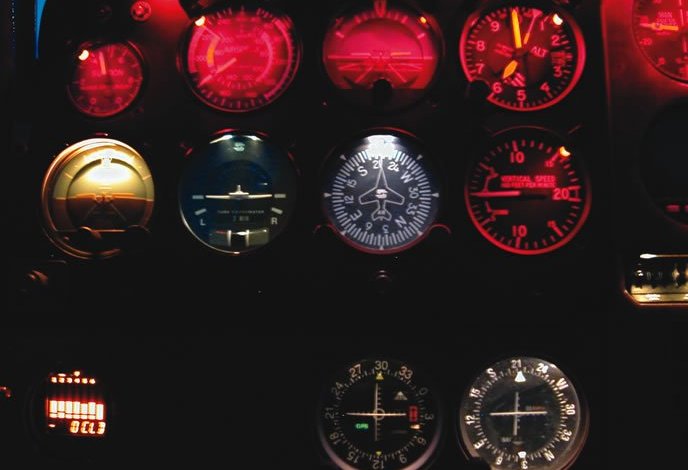
In recent years, theres been a move away from using red-colored lighting to illuminate cockpits, often in favor of low-intensity greenish-blue light. The reasons are numerous, but boil down to the fact rods in our retinas are most sensitive to that green/blue wavelength. But thats not the whole story.

Read More »

Up At Night

Night flying can be the most rewarding kind available to mere mortals. Twinkling stars above, perhaps a full moon in close formation, and well-lit ground features can be wondrous. Too, the air generally is smoother and theres less traffic. The frequency is quieter and ATC can give you more attention, while what traffic there is can be easier to spot. And an aircraft will perform better in cooler air. Humans will, too, but thats about the only benefit we realize at night.

Read More »

Looking For Anything Special?

Breaking out of an approach can be a high-workload situation, in which were dividing our attention between flying the airplane and looking for the runway environment. At that point, FAR 91.175(c) tells us there are three requirements we need to meet before descending below the DA/DH or MDA:

Read More »

Five Things To Get Right On Your Next Flight

It is said a pilot cannot conduct a flight without violating at least one FAA regulation somewhere along the way. Advocates look no farther than FAR 91.103, which requires a pilot to become familiar with all available information (emphasis added) pertaining to a flight before taking off, which simply isnt possible these days. If one equates FAR compliance with safety, that means at some point during the flight, were unsafe. We dont buy that, and can think of many situations where at least bending a FAR can be the safer action, and when violating one really should be the least of our worries.

Read More »

Flight Service Changes

Saying it is responding to a shift in users preferences for automated services, the FAA in August announced it will discontinue the so-called Flight Watch radio service, also known as En Route Flight Advisory Service, or EFAS, available nationwide on 122.0 MHz. Flight Watch will be discontinued about the time you read this, on September 24, 2015, although the frequency will be monitored for an additional six months, presumably to tell pilots trying to use it to do a better job of preflight planning.

Read More »
Pilot in aircraft
Sign-up for newsletters & special offers!

Get the latest stories & special offers delivered directly to your inbox.

SUBSCRIBE