











Aviation Safety

Light Business Aircraft
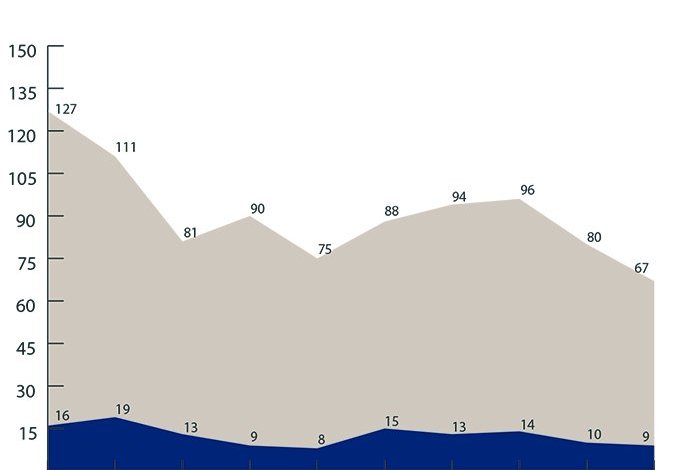
since both the FAA and the NTSB define this category precisely in terms of the crew consisting of a single non-professional pilot who operates the aircraft as an incidental duty to the pilot’s business. Source: FAAüThis chart is from a presentation by NTSB Member Earl F. Weener delivered at the NBAA’s Single Pilot Safety Standdown in November 2015. It highlights how the business aviation segment fatal accident rate
Emergencies Are Analog
Over the years, Ive had my share of urgent situations, events that were abnormal and required ending a flight in a fashion other than was planned or performing a checklist from the flight manuals emergencies section. These events never really turned into full-fledged emergencies, but emergency is defined by the person experiencing it. Most of us have experienced such episodes-peaking oil temperature, a rough-running engine, an unsafe landing gear indication. The outcome is more likely to be frustrated phone calls from unfamiliar airports, plus unscheduled underwear changes, than an accident report.
Climbing On Top
The day of my departure, I had one good sign. The area forecast predicted tops at between 12,000-14,000 feet. Thats a familiar forecast for the time of year, and I find it enjoyable to fly over a cotton-like cloud deck. It was also well within my airplanes capability, and I had a four-place oxygen bottle that had been recently topped off. Looking at the satellite data, Metars and TAFs at my destination, it appeared to be clear on the far end of my route.
Pegging Performance
Remember when you were a primary student, learning to land? When you were abeam the runway numbers on downwind, your instructor probably taught you to pull the power off to begin slowing down. Then you deployed flaps and began the descent, nailing the desired airspeeds and following the pattern to the runway. If you did it right, made your turns at the correct points and reduced power to the optimal setting, you wouldnt need to touch the throttle again until flaring over the runway.

Download the Full January 2017 Issue PDF
Until recently, the constituency comprising LBA operations was paid little attention by the major aviation organizations. Most general aviation pilots affiliated themselves with either the Aircraft Owners and Pilots Association (AOPA) or the Experimental Aircraft Association (EAA). Most of those organizations members, especially in EAA, often do not fly for personal or business transportation purposes. The heavy-iron two-pilot corporate jets already were well represented by the NBAA.
No Noticeable Damage
I read your magazine every month and have never written a letter on an article in my life, but will now. In the December 2016 issue, the first NTSB report involved a Vans RV-6 Experimental. The report states the commercial pilot and passenger were fatally injured; the airplane was destroyed…there was no noticeable damage to the fields corn stalks. Really? Someone should care about the corn stalks? Everything else was destroyed, including lives, but the corn stalks made it!

Is See-And-Avoid Dead?
The NTSBs recent Safety Alert suggests pilots should consider increased use of technological solutions to help prevent midair collisions. The NTSB is encouraging pilots and aircraft owners to adopt and use capabilities like ADS-B Ins free traffic information service, otherwise known as TIS-B. Ive been flying with TIS-B for a couple of years now and theres no question it identifies nearby traffic. When I recently installed an L-3 Lynx NGT-9000 ADS-B In/Out transponder in my airplane, having TIS-B front and center was a key reason I had the shop mount the new box high in the avionics stack instead of at the bottom where my previous transponder lived.

Wired
During a routine inspection, the technician noted the strobe lights would remain on after the switch was selected off. Troubleshooting revealed the switch to be defective. Removing and disassembling the switch revealed the solder joint holding the braided wire had broken and welded itself to the line post. Switch was replaced IAW AD 2008-13-17 in May 2009.
Aviation Safety 2016 Editorial Index
Catastrophic FailureAugustClassic CFITMayCloak Of InvincibilityDecemberFifteen MilesJuneMinimum EquipmentMarchMissing Flight PlanOctoberMostly MundaneJanuaryRunning The ScudAprilSpin Recovery FailureSeptemberThe Impossible TurnFebruaryToo Much Automation?NovemberUnsecured CargoJuly
