Features

Glass Cockpit Partial Panel

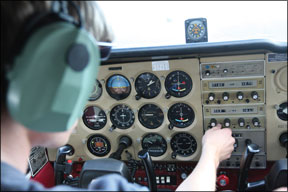
Most turbine airplanes have three-screen panels, with a PFD for both front seats. In the event the pilots-side PFD dies he/she is expected to continue using the PFD on the other side of the airplane, although the option of manually selecting PFD information on the center screen always exists as well. Pilots brought up flying traditional round-gauge IFR might not even consider the reversionary mode to be “partial panel” at all. This valuable feature makes partial panel flying easy…if the partial panel results from failure of the PFD hardware. Because it is an important advance in ease of flight in the case of primary flight instrument failure (i.e., those directly in front of the pilot), it gets top billing as a safety advantage of glass cockpit airplanes. Except for a little parallax (viewing the instrument from the side, not head-on) everything is exactly as it normally appears for the partial-panel flyer, and all functions (including the autopilot) remain fully operable. The biggest difference is that large-scale moving map, engine and fuel management, checklists, charts and other functions are relegated to a small window in the corner of the most recent-model MFDs when in reversionary mode, and are not available at all in some earlier installations. Pilots who grow too dependent on these functions, or who eschew paper checklists and navigational charts in favor of electronic versions on the “big screen” will find themselves outside their comfort zones in the event of a PFD hardware failure.
Read More »

Runway Considerations

According to Darwinian Theory, species that do more than survive and actually thrive tend to be the ones best able to adapt to their circumstances. Transferring that perspective from biology to aviation, we can see a direct parallel: The best pilots adapt to their situation-or conditions-depending on the circumstance. Got a forecast for Level 4 or 5 weather along the route? We adapt by making a decision, maybe go around the turmoil, maybe wait for a better day. Runways are a good example. If the runway we need is the one weve got, we cant automatically say, “Not going.” Delaying the trip may still be the only smart response. But often, the best response is to adapt. Wet runways, icy runways, snow, slush, slopes, peaks and lengths all complicate the published runway-performance numbers for a given airplane. And all are generally surmountable, as long as the pilot-in-command knows how and why to adapt to the variables. Lets take a look at considerations for a sloping runway, regardless of which direction. For example, we know that managing our approach speed is critical to a good outcome. But adapting to a downhill-sloping runway requires more of us than accurate speed control; it also requires us to be as slow as we can get away with, and that we touch down as close to the threshold as possible. Heres what happens if were too fast when flying a generic airplane, according to a presentation by Sam Harris of V1 Aviation Training LLC: If your approach speed is five percent high, your landing distance can increase by 10 percent. For every degree of downhill slope, count on an increase in landing distance of 200 feet.

Read More »

How Garmins 696 Can Save Your Bacon

We have a love-hate relationship with cockpit gadgets. On one hand, were strongly in favor of anything that simplifies aviating, navigating and communicating. On the other hand, weve too often seen people get caught up trying to make the gadget work while ignoring the airplane. In the end, we (and our wallets) always have yearned for some kind of inexpensive all-in-one magic box to simplify cockpit chores. Garmins latest GPS portable, the GPSMAP 696, comes about as close as weve seen. Its not perfect, its definitely not cheap and it occupies a lot of space in what might be cramped quarters, but the sheer volume of features and the ease with which they can be accessed pretty much demand anyone shopping for a portable GPS navigator take a close look at the 696. Moreover, having one of these in the cockpit might save what otherwise could be a very bad day. Lets look at what those safety features are and how they work.

Read More »

How Low Can We Go?

Altitude is your friend.” So says a common clich instructors and old-timers pilots drill into their less-experienced contemporaries. The idea-especially when considering failure of a single-engine airplanes powerplant-is greater altitude affords more time to find and glide to a suitable landing area. But having plenty of altitude isnt always a good thing. Its not a good thing when were on fire, for sure, nor is it a good thing on final to a short runway. In those instances, it can be said we have too much altitude. Another occasion when we can have too much of a good thing is on an instrument approach in for-real conditions. Approach procedures are predicated on being in such-and-such position at so-and-so altitude, then flying a measured distance, perhaps descending to another altitude, where a runway magically appears through the mist. At least thats what we tell passengers unfamiliar with the concept. The basic idea of an instrument approach sometimes is misinterpreted, however. We arent trying to get as low as we can; instead, were trying to fly along a prescribed path and altitude, arriving at a point in space from which a relatively normal landing can be made. Too high, and we may not see the runway environment at the right time. Too low, and we may hit something before we have a chance to land on the runway. The latter is far worse than the former.

Read More »

Declaring The Emergency

The left engine was cutting out but youve kept it running with the aux pump. Weather at the big airport, 15 miles from your destination, has been dropping slowly; its down to 500 feet overcast and a mile visibility, which just happens to be the published minimums for both of the approaches into Homeplate Regional, where you base your light twin. The couple in the back seat had been fighting about him drinking vodka from the bottle for the first hour of the trip, but once he passed out, things quieted down. Just as ATC gives you the clearance for a lower altitude, the rains intensity goes from light to firehose and the left engine again demands attention. Full rich mixture smooths it out. A moment later the remaining conscious passenger in the back seat announces her water has broken and shes in labor. Your right seat passenger asks if youre going to declare an emergency and shoot the ILS into the big airport. “No way,” you reply, visions of John Wayne, Chuck Yeager and The Right Stuff in your mind as you turn to focus your steely, glinting baby blues on him. “Im not filling out all that paperwork; Ill just make sure were number one for the approach into Homeplate.” Over the next 10 minutes the mother-to-be in the rear seat makes increasingly vocal announcements regarding contractions at regular and diminishing intervals, and when you make a power reduction as you near the final approach fix the left engine resumes its misbehavior.

Read More »

Six Single-Pilot IFR Tips

There was a time not so long ago that a single pilot flying hard IFR was considered an accident waiting to happen. There was simply too much going on, conventional wisdom held, for one pilot to handle all alone. Instrument pilots contemplating a flight in actual weather actively sought out others-perhaps an instructor-who could help with the cockpit chores and make sure the dirty side stayed down. Except for the freshest instrument pilots, thats all changed. And good riddance. Ive long been convinced the second most dangerous thing in aviation is two pilots trying to fly the same airplane at the same time (the first is a private pilot with a #2 Phillips screwdriver, but thats a different article). But the idea of single-pilot IFR, or SPIFR, being something to avoid seems to have hung on in some quarters. Sure; theres a time and a place to take along some backup, depending on how comfortable a pilot is with the weather, the airplane and the airspace. But Id argue against making the flight in the first place if the only way youd consider it is with another pilot. Be that as it may, advances in automating the cockpit have paved the way for much more SPIFR than only a decade ago. Thats a good thing, in my opinion, but also means our lone pilot needs to prepare for the flight a bit more than might otherwise be the case.

Read More »

Air Work

If your primary training experience was like mine, my instructor and I spent a lot of time coaxing a tired trainer up to altitude, only to come right back down. Much of the time, it was-hot-south-Georgia-in-the-summertime hot-and the little 150 in which I sweated out my private did okay, all things considered. It was pretty far removed from being a homesick angel, however. Spins werent in the curriculum then, but we did a bunch of stalls and slow flight. After each abrupt descent, we again explored the 150s best climb rate configuration and engine cooling capability. Of course, a 150 doesnt lose that much altitude in a stall, even if aggravated by a sweaty student pilot, himself perhaps aggravated. But, we still took the time to get at least 3000 feet between us and anything hard. Thankfully, we never came close to needing all that room. Since then, as I checked out in larger, faster and heavier airplanes-and obtained spin training-Ive taken to wanting even more air beneath me before slow-flight or stalls. The issue, of course, is what happens if the airplane enters an inadvertent spin or I screw up the stall recovery. Better to be safe (have too much altitude) than sorry (have not enough). As we will see this month, as airplane weight, performance and complexity increase, so should your minimum altitude for stalls and slow-speed work. This is especially true when neither the pilot receiving instruction nor the instructor are all that familiar with the airplane.

Read More »

Post-Maintenance Test Flights

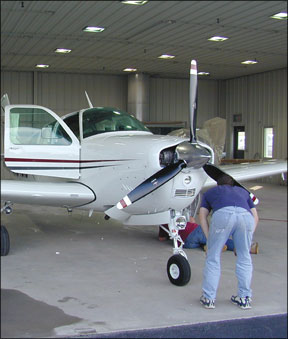
At some point during aircraft ownership, owners are faced with the prospect of a post-maintenance flight test with a technician or shop representative riding shotgun. Depending on the level of maintenance the shop performed on the aircraft, a lot can go astray-and were not just talking about in-flight emergencies (although the odds of one are higher after heavy maintenance). And even relatively simple owner-performed maintenance chores, like oil changes or brake-pad replacement, have been known to create airborne drama. Whenever an aircraft comes out of maintenance, some sort of test flight should be conducted with the idea of verifying the work performed. In fact and perhaps unsurprisingly, the FAA has a regulation covering post-maintenance test flights, FAR 91.407. Its applicability to a specific situation hinges on the extent to which, if any, work on the aircraft “appreciably changed its flight characteristics or substantially affected its operation.” Thats a fairly broad definition, and one an owner should think about whenever some maintenance is planned. But thats not all. Areas requiring consideration and planning for a post-maintenance test flight include piloting currency, insurance coverage, crew coordination and other FAA regulations, to name a few. For example, another regulation, FAR 91.305, states flight testing must be conducted over open water, or sparsely populated areas having light air traffic.

Read More »

Takeoff Aborts

Takeoff and initial climb accidents are 10 times more deadly than landing accidents, according to the AOPA Air Safety Foundation (ASF) presentation “Mastering Takeoffs and Landings.” And, when you think about it, the ASFs numbers make sense. After all, during a takeoff, the airplane is as heavy as it will be for that flight, youre accelerating, not slowing as when landing, and you arent accustomed to the wind or the airplanes loading, among other factors. If in fact takeoffs are so potentially fatal, its worthwhile to discover how to detect when a takeoff or “first-stage” climbout is going bad and, if needed, how to safely abort it before joining the NTSB tally. What clues do we have to a takeoff anomaly, and how can we safely abort a takeoff when things arent going right? Im in favor of letting the student do everything possible on the first lesson, but the relative ease at which we launch into the air-at least compared to what it takes to learn to land-might make us complacent about critically observing our takeoffs. After all, when turned into the wind and the powers brought up, were thinking about the flight ahead, or perhaps focused on an initial heading or altitude restriction. It takes a lot of discipline to be thinking about the takeoff itself.

Read More »

An Airspeed For All Occasions

At times during my training it often seemed the phrase most often uttered by the instructor was, “Watch your airspeed,” or its more-assertive variant, “Mind your speed.” If I didnt respond immediately, he continued his urgings, which usually escalating in volume and octave. That I eventually figured it out is evidenced by a piece of FAA paper in my pocket. And that was just the primary training. In talks with other many fellow aviators, we found a shared memory of instrument instructors who seemed almost sadistic in their ability to distract us with airspeed warnings when all we wanted to do was center the needles or roll out on the correct heading. We all recalled the endless grilling as our instructors drilled us on our ability to quote, hit and hold target speeds. Of course, by the time wed hit instrument training, we all understood and absorbed the message-one which remains clear as crystal years later: Managing all of the multiple, simultaneous demands of flying becomes considerably easier once I could instinctively and automatically manage power and pitch to achieve the correct airspeed for each condition.

Read More »
Pilot in aircraft
Sign-up for newsletters & special offers!

Get the latest stories & special offers delivered directly to your inbox.

SUBSCRIBE