Features

Successfully Ditching Jet Transports

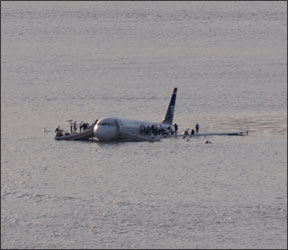
The FAAs Aeronautical Information Manual, at paragraph 6-3-3, puts it bluntly: “A successful aircraft ditching is dependent on three primary factors. In order of importance they are: sea conditions and wind, type of aircraft, and the skill and technique of the pilot.” I maintain that the AIM leaves out one critical component of a truly successful ditching: The performance of the crew and passengers, together, during the aircraft ditching and subsequent evacuation of the aircraft. You want to know how I know? Ive been there. On June 14, 2001, I was piloting a Cessna 210 out of Key West, Fla., on an IFR flight plan heading to Grand Cayman Island. Onboard were my two daughters, ages 8 and 9, their babysitter, age 15, and a 20-year-old first-timer in my airplane. I was the only pilot and we were loaded to maximum gross weight. I did myself a favor the evening before by briefing the babysitter at the airplane, about her responsibilities both during the flight, and if there was a problem. Being a bantam weight, I decided her best seat would be in the rear, since it was probably the most difficult seat from which to egress. We talked about the slim chance that a problem would occur, and we talked about the options and safety equipment that I had onboard. I showed her how to don her life vest, where the life vests lived, and we talked about the importance of wearing them for takeoff and landing, when wed be low over the water, with no time for donning them. We briefed on the life raft, which sat between the seats and just behind me. Finally, I showed her the mini SCUBA rescue bottle, with its own regulator, that sits in the seat pocket directly in front of the rear seat passenger. I told her it would give her a couple of minutes, even if she was underwater, and I had her turn it on and take a breath, just so shed know.


Read More »

The Approach and Runway Lighting Patterns

The Boeing 737 collided with 75-foot high electronic transmission cables, approximately 7000 feet short of the runway. The crew had been flying a Runway 27 localizer back course approach when the first officer misidentified street lights on a stretch of interstate highway along the east airport perimeter, thinking the lights were part of the runway environment. The FOs callout influenced the captain to continue below minimums for the approach and into the power lines. The crew executed a missed approach and recovered successfully at a former military airfield. No one was hurt. The NTSB found several errors that contributed to the mishap. For one, ATC failed to provide accurate weather information to the crew, which might have warned them not to expect visual contact with the runway environment while still more than a mile short of the threshold. Controllers also failed to vector the aircraft onto the localizer outside the Final Approach Fix and “committed other errors in handling the flight,” according to NTSB, contributing to full-scale deflection of the localizer needle inside the FAF that called for a missed approach the crew did not make before impacting wires. Further, an FAA inspector conducting an en route inspection of the flight from the 737s jump seat did not inform the crew of the errors they were committing in the planning and execution of the approach. Ultimately, however, NTSB found the crews lack of approach planning, which among other things would have helped them visualize the type of approach lights to expect and when in the approach to expect them, was the probable cause of the crash.

Read More »

Night Flying In The Mountains

Our current flight training regime does a pretty good job at getting people with little or no aviation knowledge or experience through a checkride. However, it does a really lousy job of preparing people for the “real world” of operating personal aircraft. The popular way to express this characteristic is to label a private certificate as “a license to learn.” The same can be said for the commercial and flight instructor certificates, also. As but one example, it took me a long time after earning my private before becoming comfortable with the quality of my flight planning before I could launch on a cross-country flight with confidence. That confidence had less to do with whether Id reach my destination than it did whether I had the tools and knowledge to deal with problems cropping up along the way. Relatively fresh pilots with whom Ive met recently remind me of those days, so its easy for me to conclude things havent changed much. One example: So little of our flight training is spent climbing to cruising altitude and establishing an efficient cruise configuration. It took me forever to figure out that 2200 rpm in a Skyhawk at 1500 feet MSL was a lot different in power output and speed than the same 2200 rpm at 9500 feet. The former is a great way to putt around and train; the latter is a waste of time if youre trying to go somewhere and paying hourly rental fees. Another example is brought to the fore this month: How to predict and handle in-flight turbulence. Except for an elementary understanding of a VG diagram, theres very little in current curricula to help new pilots understand and predict where there will be major turbulence. Even relatively experienced pilots-at least by dint of certificates-havent picked up this knowledge nor have they learned what to do if they encounter it. Exhibit A of our evidence is offered herewith.

Read More »

ELT Alternatives

Emergency locator transmitters (ELTs) are one piece of equipment airplane owners love to hate. They dont work very well and they always seem to need replacement batteries. And, beginning this month, satellite monitoring of 121.5 MHz ELTs will cease, instantly making what didnt work all that well to begin with next to useless. This turn of events should not come as a surprise, since the U.S. Department of Commerce first publicized the Cospas-Sarsat decision to stop monitoring 121.5 MHz in November 2000. Cospas-Sarsat, of course, is the international organization charged with maintaining and monitoring the satellites listening for distress signals from ELTs and other devices. For pilots and aircraft owners, one question is whether 121.5 MHZ equipment will continue to be adequate. Another is whether alternatives exist to upgrading to a new-technology ELT transmitting on 406 MHz, the frequency on which Cospas-Sarsat satellites will continue to listen. The answers arent that complicated. Lets first take a look at the two technologies, and then something in the way of an interim solution to have a 406 ELT on a 121.5 budget.

Read More »

Night Visual

These pages often discuss the tricks and traps of night flying, stressing along the way the only real difference between doing it after the sun goes down instead of in the daytime is you often cant see too well. As a result, we have to depend less on the seat of our pants and more on the “system” to get us home. The good news is theres more “system” than ever before. Infrared vision entered the high-end business jet cockpit a few years ago; its already trickling down to turboprops and the occasional well-equipped piston. Meanwhile, innovations like the synthetic vision technology are available on Cirrus Design airplanes equipped with the Perspective avionics suite. Even without all these tools, using data from the IFR system-minimum en route altitudes, approach and departure procedures, for example-will help keep us out of the weeds, also. The bad news is we still make dumb mistakes at night. Some of those mistakes result from known limitations of the human eye and should be easy both to identify and overcome. Other mistakes are more subtle and, in a way, a related to the eyes shortcomings but primarily result from there being fewer visual cues at night, often when we need them most. Like when landing. Too often, nighttime mistakes take on an “if only” characteristic: If only the pilot had waited to begin that descent, or if only s/he realized the runway lights disappeared because there was a hill between them and the airplane. Throw in the fact most of us are not functioning with peak efficiency at night, that theres an urgency to get home and get in bed, or that many night flights take place after the pilot or crew have put in a full day of work-whether the work is flying or sitting at a desk doesnt matter-and really bad things can happen.

Read More »

The First 400 Feet

The standard missed approach is designed around a 200 ft/nm climb gradient. The minimum rate of climb youll need to maintain this gradient depends on groundspeed. For pilots of most IFR airplanes, these climb rates are easily achievable, but if your airplane is heavy, the density altitude is high, or youre laboring with reduced engine power you may have to decide before ever beginning an approach near minimums if youll have the climb capability to miss the approach if needed. In fact, the minimums for many approaches, especially in hilly or mountainous terrain, are driven not by obstacle clearance requirements for the approach inbound to the airport, but the requirements for terrain or obstacle clearance for the missed approach. If there are towers or hills under the missed approach segment you may not be permitted to descend as low prior to the missed approach point as you would be allowed to otherwise. At the minimum 200 foot per nautical mile climb rate (below), youll be two miles from the point you initiate climb before youre 400 feet above your lowest altitude. Theres a lot going on in the first two miles (the first 400 feet) when trying to climb out from a gray hole close to the unseen ground, so you need to properly manage this transition time to safely begin the missed.

Read More »

Revisiting The Brazilian Midair

As we noted in our January 2007 article, “Because it involved two very modern jets operating under IFR and equipped with the latest in collision avoidance equipment, and because it occurred in controlled airspace, this is an accident that simply should not have happened.” We could have added to that statement information regarding Brazils modern ATC system, along with a discussion of the hyper-accurate altimetry and navigation systems required in RVSM (reduced vertical separation minima) airspace implemented throughout the world between 1997 and 2005. In fact, its arguable the accident happened because of RVSM and the accuracy it demands. Think about it: In years past something called the “Big Sky Theory” applied to so much of the altimetry and navigation standards. That theory held that, even if ATC screwed up and violated separation standards or-as in this case-put two oncoming aircraft at the same altitude-the inevitable variables in tracking a VOR radial or selecting barometric pressure in a Kollsman window provided a margin of error against midair collisions. Instead, this midair collision occurred in spite of all the “slack” built into the system. As the computer-generated image on the facing page demonstrates, the two aircraft were pretty much at the same altitude and displaced only 60 or so feet laterally. In the scheme of things, those are “noise-level” errors, the values of which dont really matter. In years past, with less-accurate systems, you couldnt have put these two aircraft that close together if you tried. The other automation-related event helping ensure this tragedy involves the way Brazils ATC system computer inserts a flights “cleared” altitude into the datablock displayed on controllers screens. In the event, they were presented with ambiguous data showing what the NTSB described as both the Embraers requested and cleared altitude. As the NSTB summarized it, “a design in which two distinctly different pieces of information…appear identical on the display is clearly a latent error.” Brazilian authorities defended this data presentation by noting, “controllers have always operated the system in this manner,” according to the NTSB. The NTSB went on to note the original clearance received by the Embraer crew cleared them to maintain FL370. Upon reaching the Brasilia VOR (BRS), the flight turned northwest to follow airway UZ6. As the NTSB drily put it, “The automatic change to the cleared altitude field did not accurately reflect the status of [the Embraers] clearance.” See below for an excerpt of the relevant FAA/NACO en route chart.

Read More »

To Scud Run, Perchance To Buy It

Scud running is the technique of flying very low to stay out of crummy weather. It was taught during flight training and regularly practiced for the first several decades of flight when, initially, instrument flight was not an option and, later, only a small proportion of airplanes had instruments. It was most successful in relatively flat territory and almost suicidal in any sort of mountainous terrain. The first professional pilots in the U.S. were airmail pilots. To avoid weather, they often flew but a few feet above the planet. Even in daytime, the accident rate was not pretty, especially in the Alleghenies and Rockies. Trying to fly without the benefit of good instrumentation (and training in how to use it) or radio navaids meant that foul weather flying was lethal. Nevertheless, particularly in the mid-section of the country, scud running could be practiced so long as the visibility wasnt too bad (fog and snow were killers) because a pilot could motor along 30 feet above a road knowing he was above the power lines and that broadcast antennas were located in the towns. All radio was AM, not limited to line of sight. For economy, the towers were put up on or beside the broadcast stations, not out in the country. In the late 20s, Henry Fords airline running between his auto manufacturing plants boasted on the order of a 95 percent on-schedule record, simply because the pilots could fly incredibly low and not have to worry about hitting anything.

Read More »

Dangerous Passenger Tricks

Get any two or more pilots together for a bit of hangar flying and youll hear a lot of interesting tales of aerial travails-some of them actually true, albeit with perhaps a touch of modest embellishment. One topic always standing out as a regular, reliable crowd-pleaser is the story of the errant passenger. Sometimes these are humorous anecdotes passed pilot-to-pilot, with the commensurate amount of growth in awe and severity; sometimes these are more-cautionary stories, told by the first-hand participants or observers with the appropriate degree of warning. Among my favorites-yes, there have been just a few in my flying days-are the ones of an honest innocence at work. But the moral of almost all of them is to be clear and complete in briefing passengers, novice and experienced alike. Its required by the FARs (see the sidebar), and you just may avoid becoming a subject of a tale of an errant passenger trick gone bad.

Read More »

Pitch And Power Exercises

Weve all struggled with it at some point. Maybe as a student you kept neglecting to add power when leveling off after a descent, or perhaps you couldnt quite grasp whether to pull back or push forward. Im currently helping a friend of mine teach a primary student to fly. Our student is really struggling to get a clear handle on how all this fits together. After I suggested some additional study and reading that didnt produce the desired “Aha!” moment, I came up with a few new ways to try to get the concepts across. Figuring it never hurts to review the basics, perhaps this might help you or someone you know gain a better understanding of the sometimes subtle effects that even small changes in power or pitch can have on altitude and airspeed. This better understanding may help a VFR pilot simply maintain better control of their aircraft. It might even help an old pro keep the needles glued to the center. Well look at examples of both.

Read More »
Pilot in aircraft
Sign-up for newsletters & special offers!

Get the latest stories & special offers delivered directly to your inbox.

SUBSCRIBE