Features

Approach Gates

An instrument approach procedure is often described as a series of windows, or gates, extending from the final approach fix (FAF) to the missed approach point (MAP). Stay within the ever-narrowing vertical and lateral limits and youll arrive at the MAP on glide path and centered on the inbound course. Its far less common to extend this concept backward from the FAF through the terminal area to the en route environment, and forward from the MAP through the missed approach to the holding fix.
Read More »

Fly The Airplane

Fly personal airplanes long enough and youll eventually have to deal with an open door or window. Usually its a cabin entry door that someone forgot to fully latch. Usually. Sometimes its a baggage door, and there goes your luggage, sliding down the runway at 70 knots. The thing is, inadvertent door or window openings typically occur at or shortly after lifting off from a runway, because thats when the changes in air pressure in and outside the airplane tend to find any weak spots.

Read More »

Flight Review: Nuisance Or Opportunity?

Most pilots who fly single-engine piston airplanes in non-commercial operations do not undertake formal training at annual or other intervals. Instead, they are only required to complete a flight review from a certified flight instructor (CFI) every other year to fly as pilot-in-command. For most pilots, this is an exercise to be completed with as little effort as possible. Some pilots resent the requirement while a few even dread it. This doesnt have to be the case, however.

Read More »

Good To Go?

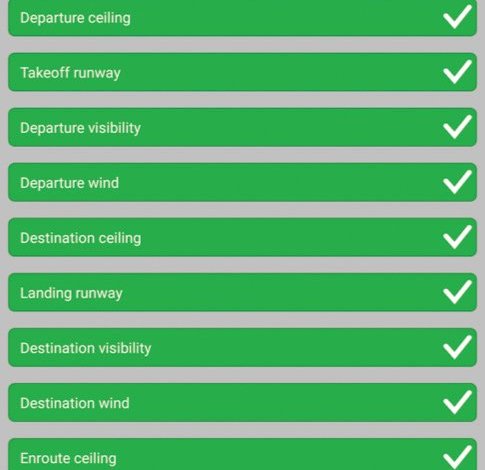
Regardless of what you fly, how its equipped, and how old or new it is, you eventually will encounter inoperative instruments and/or equipment during a preflight inspection. It can be something known to the operator and the maintenance department, or it can be something new. Once the inoperative component is discovered, you have to make a determination whether its legal to fly the airplane without repairs, and then decide if its safe to fly. The two are not the same.

Read More »

Risk And Benefit

I much appreciated Robert Wright’s May 2018 article, Risk Assessment Tools. We use a version of a flight risk assessment tool in our flying club, and while I agree that numerical values should not be the sole criteria for the go, no-go decision, the process does provide a checklist of sorts for decision-making. The most valuable risk assessment tool I use is not found on any web site or aviation app, but is the application of a simple philosophy: If I have to analyze a go, no-go decision for more than a few seconds, it is a sure sign that the risk requires serious mitigation or a willingness to stay safely on the ground.

Read More »

Aviation Accident Data For Skeptics

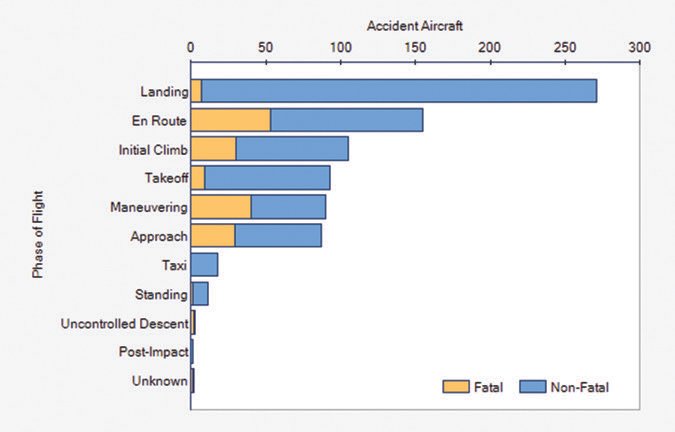
An aircraft accident would seem like an easy thing to identify: Look for the smoking crater with a few pieces of empennage sticking out, right? Okay, that one probably qualifies. But the national statistics are derived from a very specific definition of accident thats not based on either the events immediate effects on airworthiness or the projected cost of repairs. Airplanes can be and often are scrapped for damage that would cost more to fix than their hulls are worth but still doesnt qualify as substantial enough to merit reporting. Conversely, damage that does qualify sometimes goes unnoticed by the pilots who inflicted it, only to be discovered on a later pre-flight inspection.

Read More »

Braking Tactics

While conducting flight reviews and stage checks for students working toward various airman certificates, Im finding pilots who do not have a strong understanding of the operation and limitations of light aircraft braking systems. Ive also noticed many pilots misuse the brakes in landing and taxiing. For the former, brakes are incorrectly and/or unnecessarily applied immediately following landing. For the latter, excessive engine power requires the pilot to ride the brakes to control the airplane. Both are examples of poor technique.

Read More »

Lack Of Assertiveness

Any pilot whos flown in the system much knows air traffic controllers can be intimidating. The very use of the term controller implies a level of authority over pilots, which often translates into the mindset that pilots always must comply with a controllers instructions, or else. Thats true to an extent, but the pilot is always the final authority as to the operation of the aircraft. It says so, right there in FAR 91.3

Read More »

NTSB Reports

At about 1051 Eastern time, the airplane was substantially damaged when it struck terrain during an attempted go-around. The private pilot and the pilot-rated passenger were not injured. Visual conditions prevailed.

Read More »

FAA Rolls Back Complex Airplane Checkride Rule

Less than a month after the April 4, 2018, fatal crash of a Piper Arrow during a commercial-pilot checkride, the FAA has changed its policy to no longer require a complex airplane (one with controllable-pitch propeller, flaps and retractable landing gear) for the commercial pilot-airplane or flight instructor-airplane certificates. The change comes via FAA Notice 8900.463,Use of a Complex Airplane During a Commercial Pilot or Flight Instructor Practical Test, dated April 24, 2018. The policy change reflects the lack of suitable aircraft.

Read More »
Pilot in aircraft
Sign-up for newsletters & special offers!

Get the latest stories & special offers delivered directly to your inbox.

SUBSCRIBE