Airmanship

Max-Range Flying

Most pilots never need to eke maximum range out of the airplane. For others long-range flying is the norm, the reason for having an airplane in the first place. There are many considerations-some objective, some subjective-when youre planning a maximum-range flight. Lets define maximum-range flying as any flight planned to travel near the maximum distance the airplane can fly with the fuel on board, and have legal fuel reserves. When we think of max-range flying in light airplanes were usually thinking about a flight of three to seven hours, depending on characteristics of the specific airplane. If you take off with minimal fuel but are planning to use most of what youve got, however, even a short flight entails some maximum-range thinking.

Read More »

Getting Higher

I doubt I ever flew higher than 4500 feet while earning my private pilot certificate. I remember 9000 feet as “high-altitude flying” when working on my instrument rating. Perhaps it was a function of the training environment, or a result of piloting low-powered airplanes. I think more likely it is expediency and the “little-plane” mindset that causes most training to be done at lower altitudes. Which begs the question: Are there any advantages to flying higher up, and if so, how should pilots plan for higher-altitude flight? Many pilots have found theres a “sweet spot” for cross-country flying, above the general crowd but below the realm of turbine airplanes, where traffic is scarce but the advantages are many. This is flight in the mid-teens (of altitude), which Ill define as anything from about 12,000 feet to 17,500 feet MSL. Here youll avoid much of weathers worst, enjoy almost-certain direct-to routing and overfly the majority of “ATC required” airspace. What are the advantages of flying between 12,000 and 18,000 feet? Probably the biggest one is youll usually find clear air. I find the mid-teens to be especially advantageous when flying in areas of forecast thunderstorms-usually youll be above the general haziness and murk abounding on the muggy days that promote thunderstorm development, allowing you to see and maneuver around the big build-ups from dozens of miles away. Mid-teen flying often puts you in less turbulent air than the skies down below, and the airs much cooler, improving pilot and passenger comfort. Its much less stressful to cruise in VMC, so mid-teen flying can reduce fatigue and workload. Be careful, however, to avoid overflying weather thats outside the certified capability of your airplane, or that youre not equipped or experienced enough to handle if an engine or instrument malfunction forces you to descend from your planned cruising altitude (see the sidebar, “Unplanned Descent,” on page 14).


Read More »

Slow For Slows Sake

If youve heard this once, youve heard it a hundred times: “Im really behind the power curve today.” Youve heard it, but do you really know precisely what it means? Can you sketch the relevant graphs, fill in the data points, then relate it to the real, practical world of flying an airplane? Theres good reason to be able to do this, for a fundamental understanding of the basic lift/drag curves that remorselessly govern aircraft performance relate to directly to refined stick and rudder skills. It may be enough to have a good seat-of-the-pants feel for what the airplane is doing, but its far better to have both that and a lucid grasp of the physics. Where this applies most directly is in that great undersung skill we all had to learn to muddle through a private pilot checkride but havent used since: precise control in slow flight. Slow flight is undersung because its so rarely used where its of most practical advantage: high performance short field landings and adjusting the interval in a crowded pattern. Next time you fly, try this experiment: Set up your best shot at a short field landing and see if you can match the POH numbers for touchdown and rollout. Or set yourself the goal of always making the first turnoff on every runway and see if you make it. Chances are, you wont. Top performance in short-field work requires absolutely precise control of speed just above the stall. Most of us dont do this very well because it takes a lot of work and no small amount of nerve. With no compelling need to stuff the airplane into short runways, why bother? Who cares if you float 600 feet and make the third turnoff because you flew the approach 10 knots fast? Probably no one. On the other hand, that sort of laziness leads to skill atrophy and before you know it, youve smoked off the end of a runway that wasnt really very short.

Read More »

Putting It Down

One of the more unpleasant realities of personally flown aircraft is that ones exposure to the risk of coming to a stop in a fashion other than intended is higher than we care to admit. While many of us fly our entire careers without so much as a scratched airplane or an engine hiccup, others are not so fortunate. Those of us with an IQ above room temperature accept there is a true risk of being involved in a crash. Once the premise is accepted, the question becomes what to do about it. One answer is to think about it beforehand and act accordingly, especially when it comes to considering occupant protection, developing a personal checklist and preparing for when something ugly happens. Years of research and feedback from the school of hard knocks has shown time and time again that the single most important thing we can do to protect ourselves in the event of a quick stop is to wear all of the available restraining systems in whatever seat we occupy. There has been full-scale human impact research going on since World War II, and it is absolutely consistent in its results: An unrestrained occupant has a lousy chance of surviving any kind of crash impact. Even low-speed collisions generate G loads in the double digits, and no human being in the world is strong enough to “brace” for those loads (nor prescient enough to predict their precise direction even if it were possible). A seatbelt is the first line of defense; it keeps the occupant more or less in the seat and stops a major killer in accidents-that of being thrown out of the vehicle. (And, as comedian Bill Cosby once noted, it helps the ambulance driver find you.) While folklore is full of anecdotes about people who survived because they were “thrown clear,” inquiry into those stories has shown that virtually every one is a myth. A human isnt designed to hit the ground, a tree or wall going 30 miles per hour, much less whistling along at 70. The degree of pulverization of bones, soft tissue and internal organs when that occurs is the stuff of which pathology textbooks is made.

Read More »

Flight Training for Fatigue Awareness

The news stories were hard to miss: On February 13, 2008, a go! Airlines flight crew, already weary from prior days of cycle-intensive flying, felt the warmth of the sun through the cockpit windscreen as they guided their 50-seat Bombardier regional jet to Hilo from Honolulu. The captain felt he just had to close his eyes for a minute; he succumbed, as did his first officer. The next thing they knew, ATC was calling. The flight was already well past the destination after some 20 minutes of snoozing, the crew mumbled something about radio problems, turned around and landed safely. They later conceded to investigators they had slept through prior calls. The first officer even noted he could hear the calls in his sleep-he just couldnt respond. go! Airlines, a division of Mesa Air Group, suspended the two pilots that day; in April the airline terminated them citing evidence that both airline pilots apparently fell asleep on the flight deck. The outcome for other sleepy pilots has too often been more tragic than comic. Even though studied to near exhaustion, the insidious effects of fatigue, sleep interruption and sleep deficit continue to plague pilots in their planes. You dont need to be an airline or corporate pilot, flying multiple segments two and three days in a row, to find yourself struggling to stay awake in the cockpit. You dont even need to fly long leaps across multiple time zones. Fatigue sets in from issues as innocuous as a business or vacation trips with upset routines-later bedtimes, earlier rising, more late-night alcohol or unusual eating times all can contribute. Even something as simple as disrupted rest cycles for two or three days contributes to a sleep deficit. And like financial deficits, a shortage of good rest must eventually be repaid. If not, the body may force compensation against your will-and next thing you know, youre asleep at the yoke.

Read More »

Runway Considerations

According to Darwinian Theory, species that do more than survive and actually thrive tend to be the ones best able to adapt to their circumstances. Transferring that perspective from biology to aviation, we can see a direct parallel: The best pilots adapt to their situation-or conditions-depending on the circumstance. Got a forecast for Level 4 or 5 weather along the route? We adapt by making a decision, maybe go around the turmoil, maybe wait for a better day. Runways are a good example. If the runway we need is the one weve got, we cant automatically say, “Not going.” Delaying the trip may still be the only smart response. But often, the best response is to adapt. Wet runways, icy runways, snow, slush, slopes, peaks and lengths all complicate the published runway-performance numbers for a given airplane. And all are generally surmountable, as long as the pilot-in-command knows how and why to adapt to the variables. Lets take a look at considerations for a sloping runway, regardless of which direction. For example, we know that managing our approach speed is critical to a good outcome. But adapting to a downhill-sloping runway requires more of us than accurate speed control; it also requires us to be as slow as we can get away with, and that we touch down as close to the threshold as possible. Heres what happens if were too fast when flying a generic airplane, according to a presentation by Sam Harris of V1 Aviation Training LLC: If your approach speed is five percent high, your landing distance can increase by 10 percent. For every degree of downhill slope, count on an increase in landing distance of 200 feet.

Read More »

An Airspeed For All Occasions

At times during my training it often seemed the phrase most often uttered by the instructor was, “Watch your airspeed,” or its more-assertive variant, “Mind your speed.” If I didnt respond immediately, he continued his urgings, which usually escalating in volume and octave. That I eventually figured it out is evidenced by a piece of FAA paper in my pocket. And that was just the primary training. In talks with other many fellow aviators, we found a shared memory of instrument instructors who seemed almost sadistic in their ability to distract us with airspeed warnings when all we wanted to do was center the needles or roll out on the correct heading. We all recalled the endless grilling as our instructors drilled us on our ability to quote, hit and hold target speeds. Of course, by the time wed hit instrument training, we all understood and absorbed the message-one which remains clear as crystal years later: Managing all of the multiple, simultaneous demands of flying becomes considerably easier once I could instinctively and automatically manage power and pitch to achieve the correct airspeed for each condition.

Read More »

Proficiency Checklist Could Save You Fuel Costs

We all work hard to develop the skills necessary to pass a checkride. A lot of effort and expense is involved. But we often lose sight of the real objective-not just building those skills to pass a checkride, but to keep those skills sharp so that we might call upon them when theyre needed. One mechanism to help us do that efficiently is a proficiency checklist, one inspired by an Aviation Safety article enough years ago that its been lost in the easily accessed archives. Recently weve gotten some feedback from long-time readers that they liked the article and still use the ideas presented there. They suggested we revisit the idea and present it again. Given the extraordinary cost of fuel and flying today, its become ever more difficult to allocate the money to just go up and play or even to simply maintain proficiency. Increasingly, weve got to have a specified purpose to justify going flying. Before we delve into the proficiency checklist, though, lets take a look at the way a typical GA pilot maintains proficiency.

Download a FREE Checklist To Track Your Proficiency

Read More »

When Flying Birds Collide with Your Aircraft

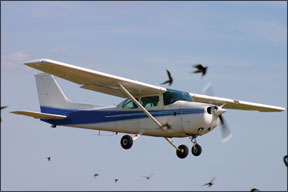
As we practice our license to learn, some hazards demand our frequent attention: Traffic, weather and terrain are the top three. They present varying levels of predictability, and a huge amount of brain power and economic investment has been poured into keeping pilots out of the teeth of these hazards. But what about the less predictable living hazards that share the airport-and sky-with us? Plenty of critters live on and around airports, and as for sharing the sky with birds, well, they got there first. Sometime in the 1980s, a Japan Airlines-bound ab initio student at Napa Airport, Calif., (APC) had a rough time understanding the tower controllers by-the-book NOTAM. She warned, “Aircraft in the vicinity, be aware of large waterborne fowl in and around the airport environment.” After several futile rounds of the hapless student pilot requesting that she say again, she finally bellowed, “Birds! We have birds on the runway!” Birds in the aviating environment are far from the cute critters alighting on Cinderellas hand. A brown pelican, for instance, can pack a punch, weighing up to six pounds (and lets hope you never encounter the 33-pound Dalmatian pelican). Turkey vultures weigh up to 10 pounds; however, the mass generated by a closure rate greater than your en route cruising speed can be incredibly destructive. Size doesnt always matter: The tiny starling is a feathered bullet, with a body 27 percent more dense than the herring gull.

Read More »

Batteries Not Required

When was the last time you planned a flight? No, we dont mean hop in the aircraft and punch direct on the nearest GPS navigator; we mean really planned the flight the good old-fashioned way…with a pencil, a plotter, an E6-B, a sectional and a flight log. Its been a while, hasnt it? At this point, youre probably thinking, “Here comes another really boring article about navigation,” but thats not the case. Instead, this really is about safety and situational awareness; its about really understanding what is happening when you fly from point A to point B. Finally, its about remembering and utilizing the basic skills of a VFR pilot that may have some rust on them. Youll recall the three basic forms of navigation: Pilotage, ded reckoning and electronic. (Okay, there also is celestial, but were making the broad assumption that there are not a lot of flight navigators out there.) Each has its own tricks and tips. But the most important lesson is never, ever to rely on just one of them.

Read More »
Pilot in aircraft
Sign-up for newsletters & special offers!

Get the latest stories & special offers delivered directly to your inbox.

SUBSCRIBE