













FAA Updates Weather Services Guidance

Open your favorite EFB or log onto a web-based aviation weather site and youll be presented with a deluge of information on the environment in which we fly. Text-based weather observations and forecasts, plus Nexrad weather radar mosaics, satellite-based cloud and moisture images, and information-dense graphical products are but a few taps or clicks away. With a smidgen of understanding, a lot of it becomes self-explanatory to even the infrequent pilot.

Gemini Sparkle

Key Takeaways:

  • Aviation weather information available to pilots through EFBs and websites is vast and can be complex to interpret.
  • The FAA provides key reference materials, such as Advisory Circulars, to help pilots understand and utilize aviation weather data.
  • A significant update (Change 1) to FAA Advisory Circular AC 00-45H, "Aviation Weather Services," was issued in January.
  • This updated AC 00-45H adds guidance on new products like the Graphical Forecast for Aviation (GFA) and Terminal Convective Forecast (TCF), while also revising existing information and removing outdated content.
See a mistake? Contact us.

Open your favorite EFB or log onto a web-based aviation weather site and you’ll be presented with a deluge of information on the environment in which we fly. Text-based weather observations and forecasts, plus Nexrad weather radar mosaics, satellite-based cloud and moisture images, and information-dense graphical products are but a few taps or clicks away. With a smidgen of understanding, a lot of it becomes self-explanatory to even the infrequent pilot.

But each of the pictures, phrases and products have their own tale to tell, and a method behind their madness. Making sense of this sometimes-confusing collection of weather resources can require getting in touch with your inner wonk, but the rewards of being able to explain to your CFI why you prefer such-and-such a presentation over the one she recommends are both rare and satisfying.


Recognizing that not all pilots are meteorologists, the FAA long ago came up with various reference materials to help us understand the symbols, abbreviations and images used in presenting aviation weather data, along with their significance. In January, the agency issued a significant update to one of its go-to resources, Advisory Circular AC 00-45H, “Aviation Weather Services,” the latest version of which now is in Change 1.

According to the FAA, the revised AC adds guidance and information on the following products and services:

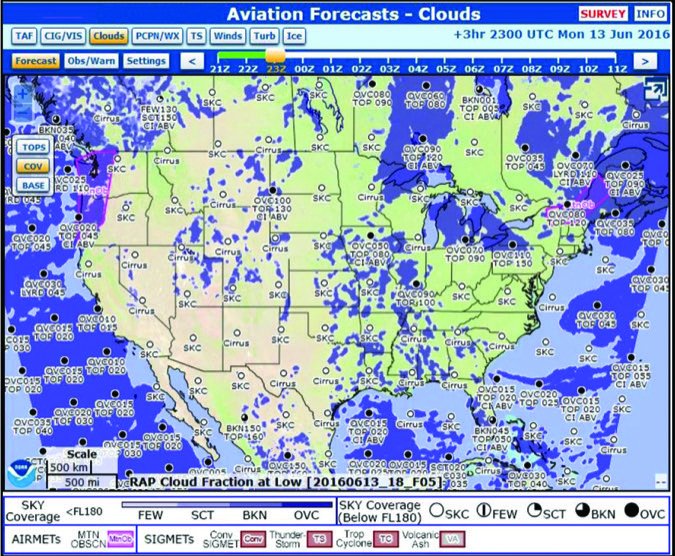
• Graphical Forecast for Aviation (GFA);

• Localized Aviation Model Output Statistics (MOS) Program (LAMP);

• Terminal Convective Forecast (TCF):

• Polar Orbiting Environment Satellites (POES);

• Low-Level Wind Shear Alerting System (LLWAS); and

• Flight Path Tool graphics.

graphical area forecast

It also includes updates on Direct User Access Terminal Service (DUATS II), Telephone Information Briefing Service (TIBS) and Terminal Doppler Weather Radar (TDWR), and removes information regarding Area Forecasts (FA) for the continental U.S. Together with Advisory Circular AC 00-6, “Aviation Weather,” it’s a pilot’s standard reference on the subject. Both are available for downloading from www.faa.gov.

Ready to Sell Your Aircraft?

List your airplane on AircraftForSale.com and reach qualified buyers.

List Your Aircraft
AircraftForSale Logo | FLYING Logo
Pilot in aircraft
Sign-up for newsletters & special offers!

Get the latest stories & special offers delivered directly to your inbox.

SUBSCRIBE