















U.K.’s Vertical Thinks U.S. Will Lead Way in Electric Air Taxis—for Now

Developer brings its flagship Valo to the U.S. and announces a network of New York City-area routes.

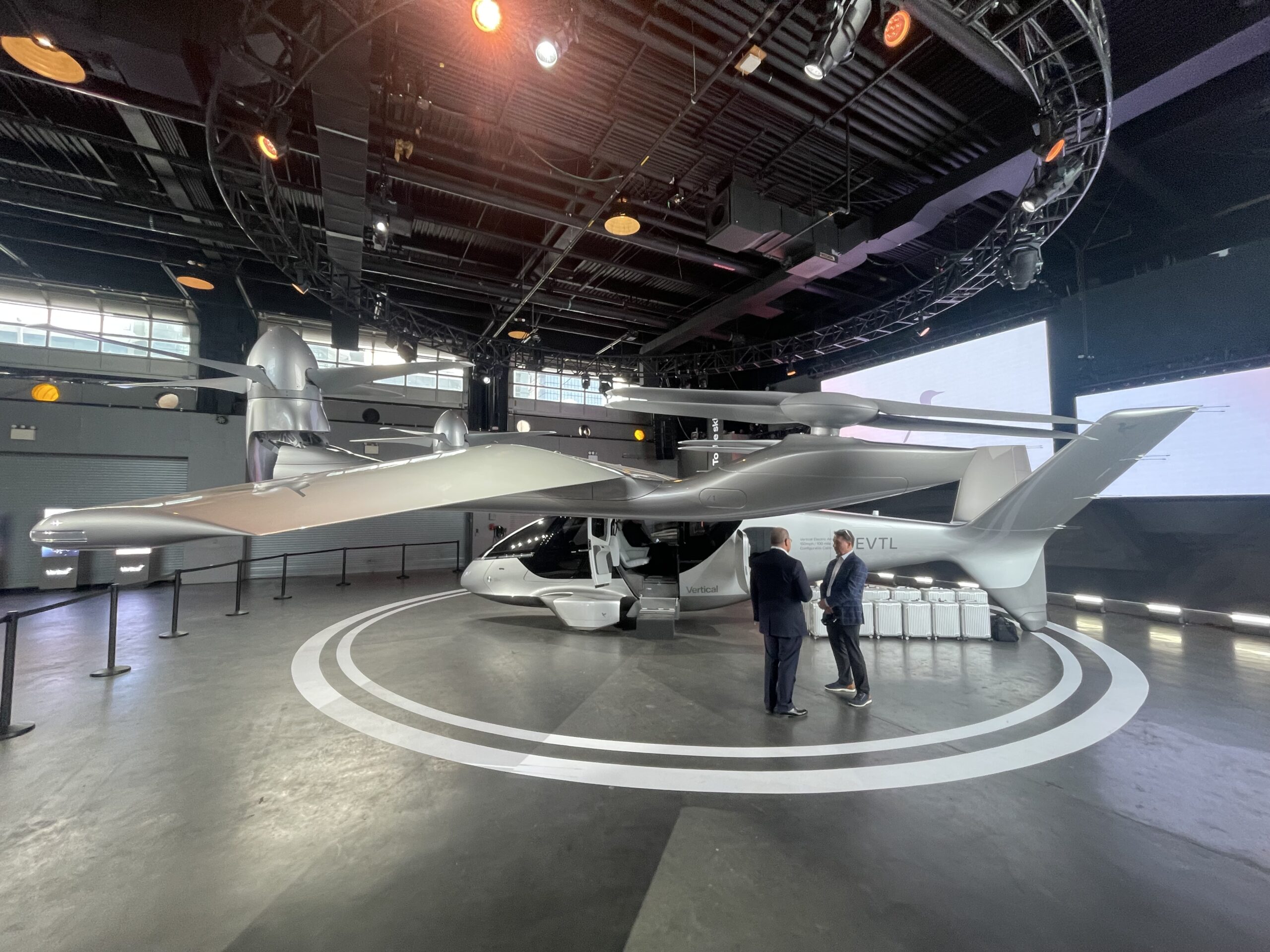
Vertical Aerospace full scale electric air taxi display in Manhattan
Vertical brought a full-scale model of its flagship Valo air taxi to the Classic Car Club Manhattan in New York City last Friday [Credit: Jack Daleo/FLYING]
Gemini Sparkle

Key Takeaways:

  • Vertical Aerospace has introduced its Valo eVTOL to the U.S. market, aiming to compete with rivals and establish a New York City air taxi network, supported by significant global preorders including from major U.S. airlines.
  • Valo differentiates itself with a larger passenger capacity and superior payload/luggage space, designed to offer greater revenue potential for operators compared to smaller competitor aircraft.
  • The company plans for concurrent U.K. and European certification by 2028 under higher safety standards (10^-9), anticipating this will streamline its approval process for the U.S. market (10^-8 standard).
See a mistake? Contact us.

U.K. electric vertical takeoff and landing (eVTOL) aircraft developer Vertical Aerospace this month brought its flagship Valo air taxi to the U.S., where it could compete with eVTOL designs from Joby Aviation, Archer Aviation, Beta Technologies, Boeing’s Wisk Aero, and others.

Vertical has around 1,500 preorders, with about one-third coming from each of the Americas, Europe, and Asia. The company will face more competition to sell its aircraft here than across the Atlantic, where European regulators have taken a more patient approach to eVTOL regulations than the FAA. But Michael Cervenka, Vertical’s chief commercial and technology officer, believes the U.S. is where the action will be.


“The U.S. is the biggest aviation market in the world,” Cervenka told FLYING. “In the near term, for eVTOLs, I think it will be the biggest market.”

At least, for now.

Ultimately, Cervenka believes there could be greater potential in the megacities of the Asia-Pacific region, where Vertical has received aircraft predelivery payments from Japan’s Marubeni Corporation and is pursuing a binding agreement with South Korea’s Kakao Mobility. Japan Air Lines and AirAsia are seeking to acquire Valo through aircraft lessor Avalon, which preordered 500 aircraft in 2021.

But the U.S. is home to two of Vertical’s marquee customers. American Airlines preordered up to 250 aircraft plus 100 options and has paid to secure 50 delivery slots. Helicopter operator Bristow Group preordered up to 50 aircraft plus 50 options. Vertical’s “U.S. roadshow”—which began with a display at the Classic Car Club Manhattan in New York City on Friday—aims to net more.

“It’s an opportunity for us to really tell the story and for people to see the aircraft,” Cervenka said. “Plenty of people have sat in Joby or Archer’s aircraft. When they come and actually sit in this, they’ll just see it’s a completely different proposition.”

The Vertical executive said Valo will initially be manufactured in the U.K. But “pretty soon” the company will look to establish manufacturing capabilities on both sides of the Atlantic. Honeywell, Vertical’s supplier for flight control software and avionics, already makes most of those components in the U.S.

“We have a heavy U.K. engineering presence, but this will also have a strong Made in America approach for the U.S. customers,” Cervenka said.

Big Plans for the Big Apple

Already, Vertical has unveiled its vision for a New York City-area air taxi network.

The hub would be Manhattan’s Downtown Skyport, jointly operated by Groupe ADP and Vertical partner Skyports. The latter is electrifying the site for Valo and other eVTOL designs aligned to the auto industry’s combined charge system (CCS) standard. Planned connections include John F. Kennedy International Airport (KJFK) and East Hampton Airport (KJPX) on Long Island, as well as Newark Liberty International Airport (KEWR) and Teterboro Airport (KTEB) in New Jersey.

The network could facilitate airport transfers, cross-town or weekend travel, aerial sightseeing, medical transfers, and shuttles to events at MetLife Stadium in New Jersey, Vertical said last week.

The company will not operate the aircraft. Rather, it will work with “ready to fly” partners such as Bristow that have the necessary approvals to handle operations, maintenance, insurance, and other tasks.

“Day one,” Cervenka said, Valo will operate in helicopter corridors, which are typically over water and restrictive. But he believes the aircraft’s low noise—30 times quieter than helicopters, by his estimate—will convince city officials to lift noise-based restrictions that limit where and how many helicopters can fly. He added that early operations will utilize existing helicopter infrastructure.

Vertical aims to introduce Valo as soon as 2028, pending CAA certification. Cervenka said the company is also “heavily engaged” with the FAA.

Introducing Valo

Vertical unveiled its flagship design in December after years of testing with its VX4 prototype.

Per Vertical, Valo will have an all-electric range of about 100 miles, cruise speed of about 150 mph, and service altitude of about 2,000 feet. Flight controls comprise a simple joystick, Honeywell’s Anthem flight deck and digital fly-by-wire system, and three flight control computers that Cervenka said are “certified to airline levels of safety.” A cockpit divider separates the pilot from passengers.

“The pilot’s not really flying the aircraft,” he said. “The pilot’s essentially telling the aircraft, ‘This is where I want to go.’ So if I want to go up, I just pull the right stick backwards. If I want to hover, I just let go of everything.”

Vertical Aerospace electric air taxi cockpit
Vertical gave visitors in Manhattan an early look at Valo’s cockpit design [Credit: Jack Daleo/FLYING]

Cervenka added that electric actuators and instant torque on Valo’s motors give the pilot “immediate control” over the aircraft during takeoff and landing. Propellers will tilt and change speeds on their own.

“A helicopter is really difficult to hover close to the ground, because you’ve got all the air being blown down…It’s like an upside down fountain bouncing back up, buffeting the aircraft,” Cervenka said. “On this aircraft, we can take off, let go of the controls…and then you can do a 360-degree turn on the spot with gusting winds.”

Vertical will train pilots—commercial helicopter and fixed-wing certificate holders who will add a Valo type rating—through an exclusive partnership with CAE. Cervenka estimated that training will take just a few weeks.

New and Improved

Vertical is working toward a crewed transition from vertical hover to forward flight—the key differentiator between eVTOL models and helicopters or fixed-wing aircraft—with its VX4 under the “rigorous oversight” of the U.K. Civil Aviation Authority (CAA), Cervenka said.

Crucially, Valo maintains the prototype’s eight vertical propellers—four of which tilt forward—and their size and location relative to the wing. Both models use Honeywell’s flight control software.

“That’s really important, because one of the key things you need to learn with prototypes are the handling policies of the aircraft and the sizing of the electrical powertrain,” Cervenka said.

Prototype testing prompted Vertical to make what he described as a “shrink-wrapped optimization” to its flagship design.

For one, it smoothed out the fuselage to eliminate a “big kick-up” behind the passenger cabin that created drag. Cervenka said engineers managed to preserve the size of the passenger cabin and luggage compartment while reducing the carbon fiber airframe’s wetted area by 15 percent, making it lighter and more efficient.

“There is this kind of saying in aerospace—if it looks beautiful, it’s going to fly well,” he said. “If you think about the best aerodynamic shape, it’s a bit like a teardrop.”

Vertical Aerospace Valo electric air taxi wide view
Valo eliminates a “big kick-up” on the VX4’s airframe to reduce drag [Credit: Jack Daleo/FLYING]

Through Bristow, the company gained access to an Airbus-owned wind tunnel, where it tested different tail configurations, with and without pylons and propellers.

“We’ve done a whole amount of computational fluid dynamics modeling and simulation on high-performance computers all the way to testing this,” Cervenka said.

Valo also replaces the VX4’s tricycle landing gear arrangement with a taildragger configuration. Cervenka said placing two wheels in the front and one in the tail makes the design more accessible and structurally efficient.

“The main gear is now essentially under the wing, where all the center of gravity, center of mass of the aircraft is,” he said. “So all the structural loads to take that weight…are in one location. Whereas with a tricycle arrangement, you have this nose gear all the way out front. It’s got to be really heavy to cope with a kind of nosing landing, and all of that’s got to be braced back to the center.”

The Valo Advantage

Cervennka believes one simple advantage makes Valo—with U.K. certification targeted for 2028—the “no-brainer” air taxi for U.S. operators: more seats.

“Do you want to buy one Valo?” Cervenka asked. “Or do you want to buy two of the competitor aircraft, have to train twice as many pilots, have to pay twice as much in landing fees?”

Valo is indeed larger than Joby, Archer, and Wisk’s air taxis, which are designed to seat up to four passengers, and Beta’s two electric designs, which seat up to five. At launch, it will have only four seats. But Cervenka said Valo’s passenger cabin can accommodate three-abreast, “effectively economy-class” seats. With six passengers, he said, operators could sell more tickets and make more revenue.

Valo also has a payload of about 1,200 pounds, with room for six checked and six carry-on bags.

“Nobody else can do that,” Cervenka said.

Vertical Aerospace Valo electric air taxi luggage storage
According to Vertical, Valo will have enough storage space for up to six carry-on and six checked bags [Credit: Jack Daleo/FLYING]

For comparison, Archer’s Midnight and Joby’s S4 have a maximum total payload of about 1,000 pounds. Wisk’s Generation 6 has a nose compartment that can store luggage for up to four passengers. Beta says its Alia will carry about 1,400 pounds, but only when configured for cargo missions.

Cervenka said the decision to go bigger was informed by conversations with more than 140 airlines, helicopter operators, and other customers, who sought a premium layout and flexibility for different missions.

He added that Valo’s size makes it easy to translate the design to variants, such as a hybrid-electric concept Vertical aims to certify in 2029. Electric generators and gas turbines will be installed in a portion of the storage area.

“We remove some of the batteries under the floor, reposition them so we maintain the same central gravity, and we put a fuel tank in,” Cervenka said.

Despite losing some cargo space, the hybrid model’s payload will align with Valo’s, Cervenka said. And because the turbine could charge the generator in flight, its range could extend to 300 miles. That opens use cases such as surveillance, reconnaissance, electronic warfare, medevac, and ship-to-shore delivery, both crewed and uncrewed.

“That really disrupts the intermediate single lightweight helicopters, because it’s 30 to 50 percent cheaper to operate than a helicopter but offers all the utility,” Cervenka said.

The Outlook

Cervenka said Vertical will first pursue concurrent certification with the U.K. CAA and European Union Aviation Safety Agency (EASA), which “will literally sign the certificate on the same day.” That’s because they are aligned to the same 10-9 standard (one catastrophic failure per billion flight hours) and commercial airline standards for electronic hardware and software.

“That gives us, effectively, a certification moat in Europe, where we’re going to be the only aircraft certified to that highest standard, able to fly over populated areas, all the kind of real high value use cases,” he said. “It also helps when you think about the ability to sell this aircraft all over the world.”

The FAA, by contrast, will hold eVTOL aircraft to a 10-8 benchmark and lower standards for the safety of electronics. Because Valo will meet the higher EASA requirements, Cervenka said bringing it to the U.S. will be like “passporting.”

“That’s how, for example, an Airbus aircraft gets certified in America, or Boeing aircraft get certified in Europe,” he said. “The difference for us is because the European standards are higher, you can go from Europe to America. You can’t go the other way around.”

Vertical and Joby, for example, have different expectations for how the CAA will regulate safety, per The Air Current.

The U.K. manufacturer in 2025 estimated that it will cost about $700 million to certify Valo. It has about $117 million in cash on hand, per its most recent earnings report, which it estimated will fund activities through mid-2026. A U.S. tour could help it attract further investment.

“There is just a disconnect between Vertical’s capital market valuation versus some of the competitors,” Cervenka said. “We need to raise more money. We’ve been very public about that. This is part of just getting us more visible to existing investors and future investors.”

Jack Daleo

Jack is a staff writer covering advanced air mobility, including everything from drones to unmanned aircraft systems to space travel—and a whole lot more. He spent close to two years reporting on drone delivery for FreightWaves, covering the biggest news and developments in the space and connecting with industry executives and experts. Jack is also a basketball aficionado, a frequent traveler and a lover of all things logistics.

Ready to Sell Your Aircraft?

List your airplane on AircraftForSale.com and reach qualified buyers.

List Your Aircraft
AircraftForSale Logo | FLYING Logo
Pilot in aircraft
Sign-up for newsletters & special offers!

Get the latest stories & special offers delivered directly to your inbox.

SUBSCRIBE
