












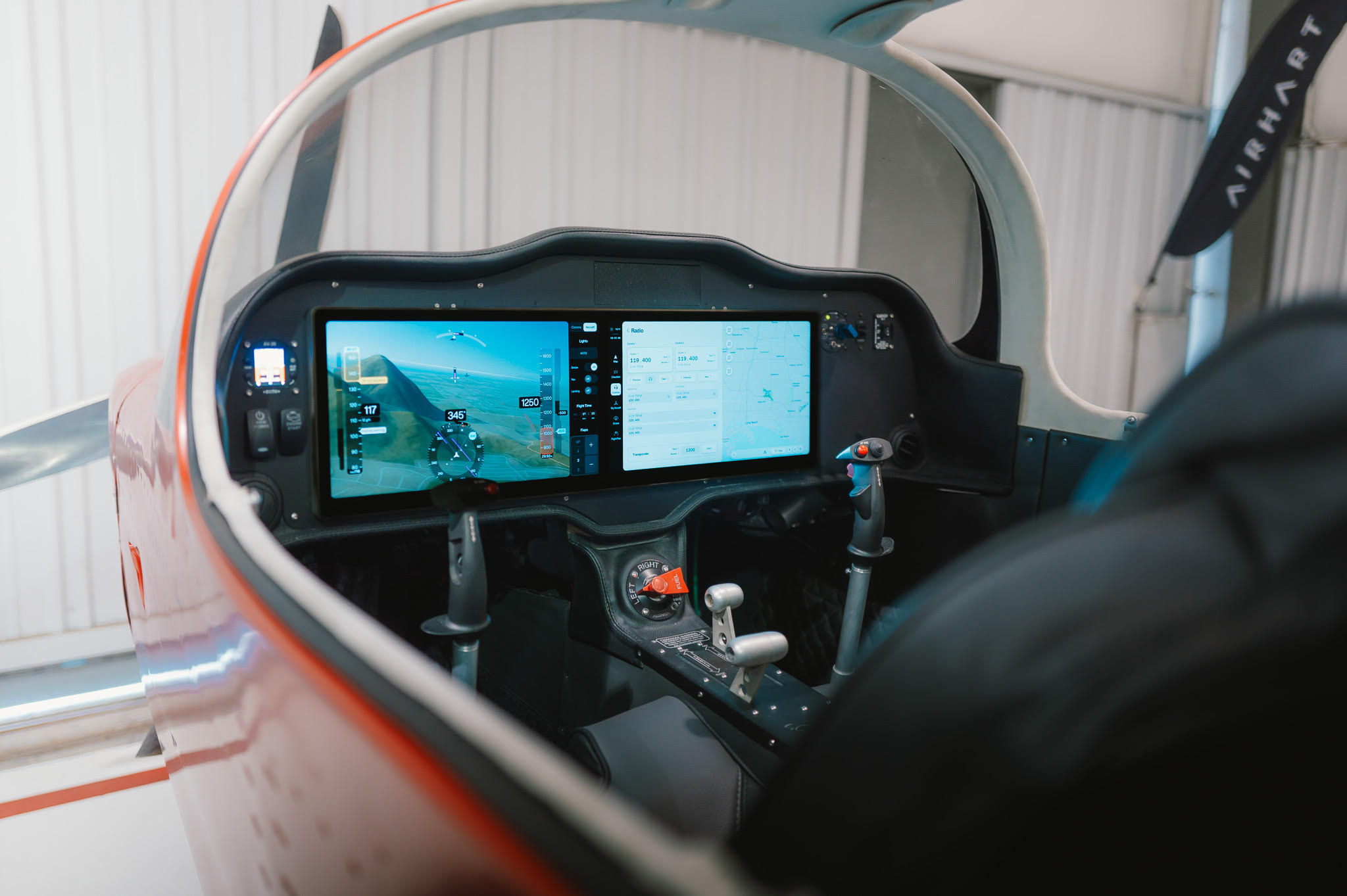


United Airlines is backing a developer of fully digital cockpit technology that is designed to make flying as simple as driving a car.
United Airlines Ventures (UAV) has invested an undisclosed amount in Airhart Aeronautics, which said Thursday that it is “about to begin initial customer installs” of its flagship advanced avionics suite. Airhart said the “first stage” of its avionics system is now available to order.

The system uses synthetic vision, full ADS-B, and advanced autopilot technology to reduce pilot workload and minimize the risk of accidents, similar to Skyryse’s SkyOS, Reliable Robotics’ Reliable Autonomy System, and Merlin Labs’ Merlin Pilot.
UAV has invested in Archer Aviation and Eve Air Mobility’s electric air taxis, Heart Aerospace’s regional electric airliner, ZeroAvia’s hydrogen-electric powertrains, JetZero’s blended-wing body Z4, and Boom Supersonic’s Overture—a candidate to succeed Concorde. Its most recent investment is curious, though, because Airhart is focused specifically on the personal aircraft market.
UAV did not immediately return FLYING’s request for comment.
Airhart in October raised $4.56 million, which it said will help finalize its unified flight intelligence platform and scale it to multiple airframes, as well as train pilots. Avionics installations will evolve the company’s proprietary fly-by-wire system, which sits at the heart of its planned future aircraft.
The company intends to bring the aircraft—developed with South Africa’s Sling Aircraft—to market later this year. A prototype is expected to be on display at EAA AirVenture in Oshkosh, Wisconsin, in July.
United’s Latest Project
Airhart was founded in 2022 by Nikita Ermoshkin, a certificated pilot and former SpaceX avionics engineer who worked on the company’s revolutionary Falcon 9.
The company in March opened its inaugural design and innovation center in Long Beach, California, where it recently began production test flights. It said Thursday that it has significantly expanded its design and production teams as it looks to begin building more aircraft.
Airhart’s avionics suite is designed for “light aircraft” that often lack the automation systems of larger, commercial jets.
Dials that display altitude, airspeed, and other indicators and measurements are gone, replaced by touchscreen displays. Sticks and rudder pedals are swapped out for a single, active-feedback sidestick—redundant flight computers, sensors, and servos make the needed adjustments after the pilot pushes it forward, back, left, or right.
A bar on the center console controls speed by adjusting pitch, power, and trim. It is integrated with controls for taxiing, allowing the pilot to engage the brakes by pulling the bar all the way back.
Per Airhart, aircraft equipped with the system are powered on with the push of a button, matching the simplicity of Skyryse’s finger-swipe takeoff and touchdown mechanism. Checklists, lighting, flaps, and trim are all automated. Integrations with Foreflight and SpaceX Starlink enable tighter control and over-the-air software updates.
The Airhart fly-by-wire system developed using the avionics suite is intended to power its flagship Sling, based on Sling Aircraft’s TSi. Sling provided the airframe and powerplant. Airhart is redesigning the interior and installing its systems.
Powered by a Rotax 915iS engine, the aircraft has an intended range of 800 nm and cruise speed of 148 KTAS. Flying with a pilot and three passengers at that speed, Airhart claims it will burn just 7.4 gph—better than the Cessna 172 and other popular regional models.
Ermoshkin told the Los Angeles Business Journal that the company will explore alternative propulsion systems, such as electric power, to reduce its reliance on jet fuel amid a spike in price volatility.
Airhart unveiled the Sling in 2024 and has already flown it across the country. United’s investment could help get it through the gauntlet of certification.

