












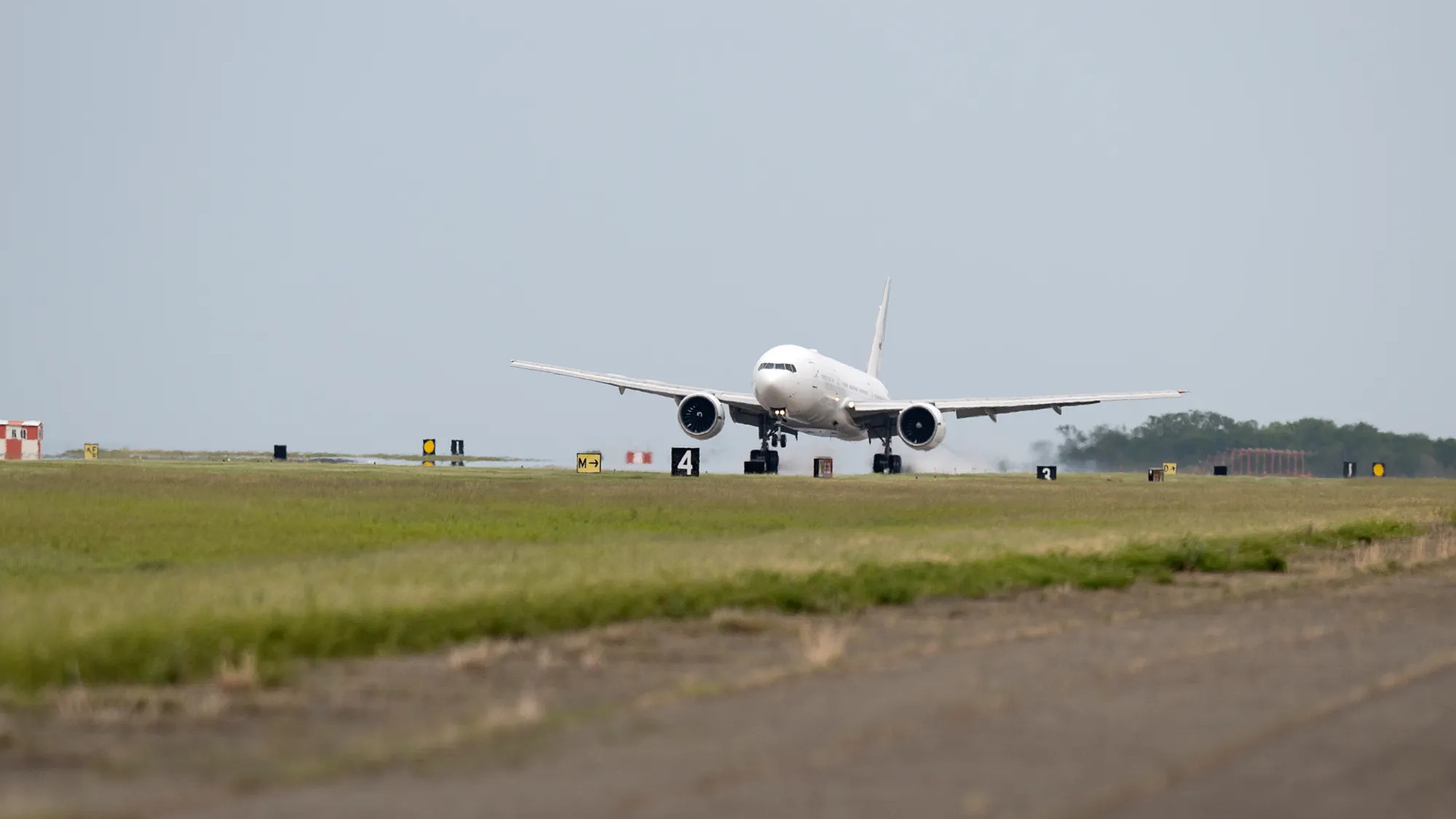


A heavily modified Boeing 777-200ER formerly operated by Japan Air Lines will soon become NASA’s largest flying science laboratory.
The retired commercial jet arrived at NASA’s Langley Research Center in Virginia on Wednesday following a check flight and three-hour transit from Waco, Texas, where L3Harris since January 2025 had been making structural modifications. It will replace the space agency’s retired Douglas DC-8, which flew its final science mission in 2024 after 37 years in service.

Per fiscal year 2023 budget documents, the 777 cost NASA a little under $30 million.
The airborne science laboratory’s debut mission will be the North American Upstream Feature-Resolving and Tropopause Uncertainty Reconnaissance Experiment (NURTURE), scheduled for January 2027. It will study wind, snow and ice storms, and other cold weather phenomena across a region spanning North America, Europe, and the Arctic, making use of its 9,000 nm range.
The 777 will help researchers around the world study the atmosphere, oceans, natural disasters, and other Earth science data. Its debut has been long awaited as NASA acquired the aircraft in 2022 after using the DC-8 to study everything from archaeology to atmospheric chemistry.
The DC-8 had capacity for up to 45 personnel and 30,000 pounds of satellite communications systems and other equipment. It had a much shorter range of 5,400 nm and could remain aloft between 1,000 and 24,000 feet for up to 12 hours, though most missions lasted six to 10 hours.
Compare that to the 777, which NASA says will have capacity for up to 100 operators and 75,000 pounds of equipment. Flights will last up to 18 hours at altitudes up to 43,000 feet.
From DC-8 to 777
NASA paid $24 million to acquire its DC-8, which arrived at Ames Research Center in California in 1987. Its inaugural mission that year was the first to investigate the chemistry of the Antarctic ozone hole, which influenced amendments to the Montreal Protocol. It would go on to play an essential role in atmospheric monitoring and NASA’s formation of international partnerships, flying across all seven continents.
Before the DC-8s, NASA relied on a pair of converted Convair 990s, but both were lost to catastrophic crashes.
The aircraft was used to aid the development of sensor technologies, verify sensors already on satellites in orbit, retrieve space vehicle launch and reentry data, and study the Earth’s surface and atmosphere. It was retired to Idaho State University, where aircraft maintenance program students use it to hone their techniques.
“NASA’s DC-8 was an incredible workhorse for Earth science for nearly 40 years,” Kirsten Boogaard, NASA’s 777 program manager and former DC-8 deputy program manager, said Wednesday in a news release. “I’m excited for what the 777 will bring. It gives us the ability to bring together more partners, more educational opportunities, and more instruments. That will make a real difference in the data we collect moving forward.”
NASA was influential in the design of the twin-engine, widebody jet back in the 1990s. Tests designed to improve the performance of the space shuttle drove improvements to the 777’s engines, and its digital fly-by-wire system was developed using the Apollo program’s guidance, navigation, and control hardware.
Since January 2025, L3Harris and partner Yulista have enlarged and added new nadir and window ports. They installed power, data, and communications systems, as well as viewports on the aircraft’s belly that will serve as mounts for advanced science instruments. Nearly 35,000 holes were drilled through four layers of reinforced material to map out hole patterns.
“We’ve been completing the engineering design and analysis to install the NURTURE payload into the aircraft in parallel with the portal modification,” said Derek Rutovic, manager of NASA’s Airborne Science Program (ASP). “We’re excited to get the airplane back home to NASA and on the road to its first mission.”
At Langley, NASA and military shipbuilder HII are now installing dedicated research stations. They will also add extensive wiring to allow payloads to communicate with lidar, infrared cameras, and other sensors during flights. The modifications are scheduled to be completed by October, per the ASP website. NASA previously expected to fly the aircraft by the end of 2025.
Beyond the DC-8 and 777, the ASP uses Gulfstream G-III, G-IV, and G-V aircraft, including the C-20A military variant of the G-III. It also flies the P-3 Orion, WB-57, and high-altitude ER-2 based on Lockheed’s U-2.

