












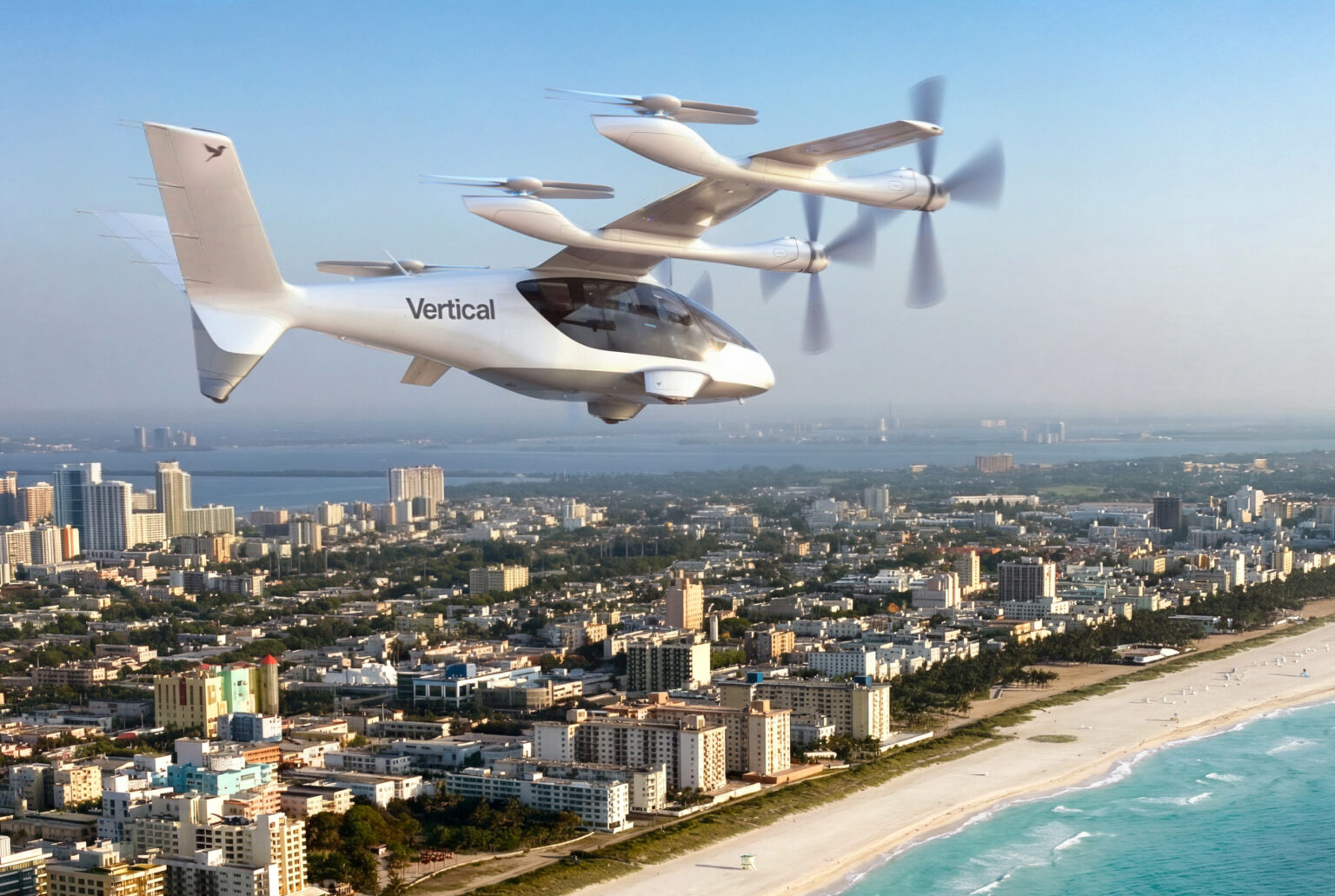


American eVTOL (electric vertical takeoff and landing) air taxi developers such as Joby Aviation, Archer Aviation, Beta Technologies, and Boeing’s Wisk Aero face a legitimate competitor from across the Atlantic.
U.K. air taxi leader Vertical Aerospace—which last week entered rarefied air by achieving a crucial flight test milestone—said Monday that it finalized a funding package totaling up to $800 million. The company said the money will be enough to complete testing and certification for its flagship Valo aircraft by 2028.

Though still a far cry from the billions of dollars raised by American competitors, the $800 million—plus $50 million raised in March—puts Vertical on track to compete for customers by the end of the decade. It estimated in 2025 that Valo’s certification will require about $700 million.
Once certified, Valo could be primed to take on Archer’s Midnight, Joby’s S4, Beta’s Alia, and Wisk’s Generation 6. Its cabin will accommodate up to four passengers at launch but is large enough to expand to six seats, which would beat U.S. counterparts. Valo’s estimated 1,200-pound payload in passenger configuration—with enough room for six checked and six carry-on bags—would also be best in its class.
Vertical in 2026 has displayed Valo in New York City, Miami, and Atlanta. It has shared potential route maps for New York and South Florida, linking airports to city centers and other locations. The company envisions it handling commuter trips, sightseeing flights, shuttles to MetLife Stadium in New Jersey, and other applications.
“The U.S. is the biggest aviation market in the world,” Michael Cervenka, Vertical’s chief commercial and technology officer, told FLYING at the New York City display in January. “In the near term, for eVTOLs, I think it will be the biggest market.”
Vertical is pursuing concurrent U.K. Civil Aviation Authority (CAA) and European Union Aviation Safety Agency (EASA) certification in 2028, with entry into service and validation from other regulators such as the FAA expected soon after. American competitors are working on similar timelines, with hopes to launch commercially even earlier.
Closing the Air Taxi Gap
For the past five years, American and Chinese manufacturers have dominated the eVTOL conversation.
Archer, Joby, and Beta have been testing full-scale prototypes for years, while Wisk in December conducted the first hover flight of its Generation 6. China’s EHang began extremely limited passenger operations in 2025. Outside the U.S. and China, Embraer’s Eve Air Mobility is the furthest along, having begun full-scale prototype flight testing.
The European environment has been difficult for air taxi developers. Germany’s Lilium and Volocopter—for years considered the continent’s two eVTOL leaders—both folded in 2025, with Diamond Aircraft acquiring the latter’s assets.
Vertical’s coffers are still smaller than its American rivals’—Archer, Joby, and Beta ended 2025 with $1.96 billion, $1.4 billion, and $1.7 billion in liquidity, respectively. But it also spends less. Vertical burned about $112 million in 2025, leaving it with about $97 million in cash on hand. Archer, Joby, and Beta recorded respective net losses of $618 million, $930 million, and $746 million.
Joby in February said it expects to spend $340-$370 million in the first half of 2026. Herman Cueto, Beta’s chief financial officer, said on the company’s latest earnings call that it plans to spend at least $500 million this year. Both believe they will need additional funding to complete certification, per SEC filings.
Archer spent about $730 million last year and “will require significant additional capital” for its project at Hawthorne Airport (KHHR) in California, per its latest annual SEC filing.
Vertical on Monday said it has about $160 million of working capital “in the near term” and in March said it planned to spend $195 million over the next 12 months. It has already taken out about $30 million from the new funding package.
Having completed the critical piloted transition from hover to forward flight earlier this month, Vertical will now turn its attention to public flight demonstrations with prototype aircraft. It is also developing a hybrid-electric variant and aims to expand its battery and aircraft production sites. The latter will produce seven conforming Valo aircraft for compliance testing with the CAA, akin to the FAA’s type inspection authorization (TIA).
The $800 million package is headlined by a $500 million equity line of credit opened by Yorkville Advisors Global, from which Vertical can draw “from time to time” over the next 36 months. Yorkville will also provide $250 million in convertible equity that could be issued to Vertical for the next 24 months. The remaining $50 million comes from new convertible secured notes from longtime investor Mudrick Capital.

