













Taking the Beaten Path

Those out-of-the-way airports tend to be basic—one or two simple approaches. But simple doesn’t always mean easy. There can be a lot of decisions to make.

Gemini Sparkle

Key Takeaways:

  • Pilots must thoroughly brief all available approach minimums and procedures, not just the primary, to be prepared for unexpected situations like glideslope failures.
  • Effective IFR flying requires dynamic decision-making and willingness to adapt plans, such as switching approaches or diverting to a safer airport, based on changing conditions or equipment issues.
  • Prioritize safety by critically assessing the risks of challenging approaches in marginal weather and choosing a more suitable alternate when conditions at the planned destination present unacceptable risks.
See a mistake? Contact us.

Most all approaches follow a basic template, especially RNAV procedures. Load it up, follow the course and altitude. Brief the minimums, brief the missed, add personal preferences. You can’t go wrong with that. But when there is more than one way to get in, you’ll be weighing each option. Beware: The best choice might not be so obvious.

Standard Brief

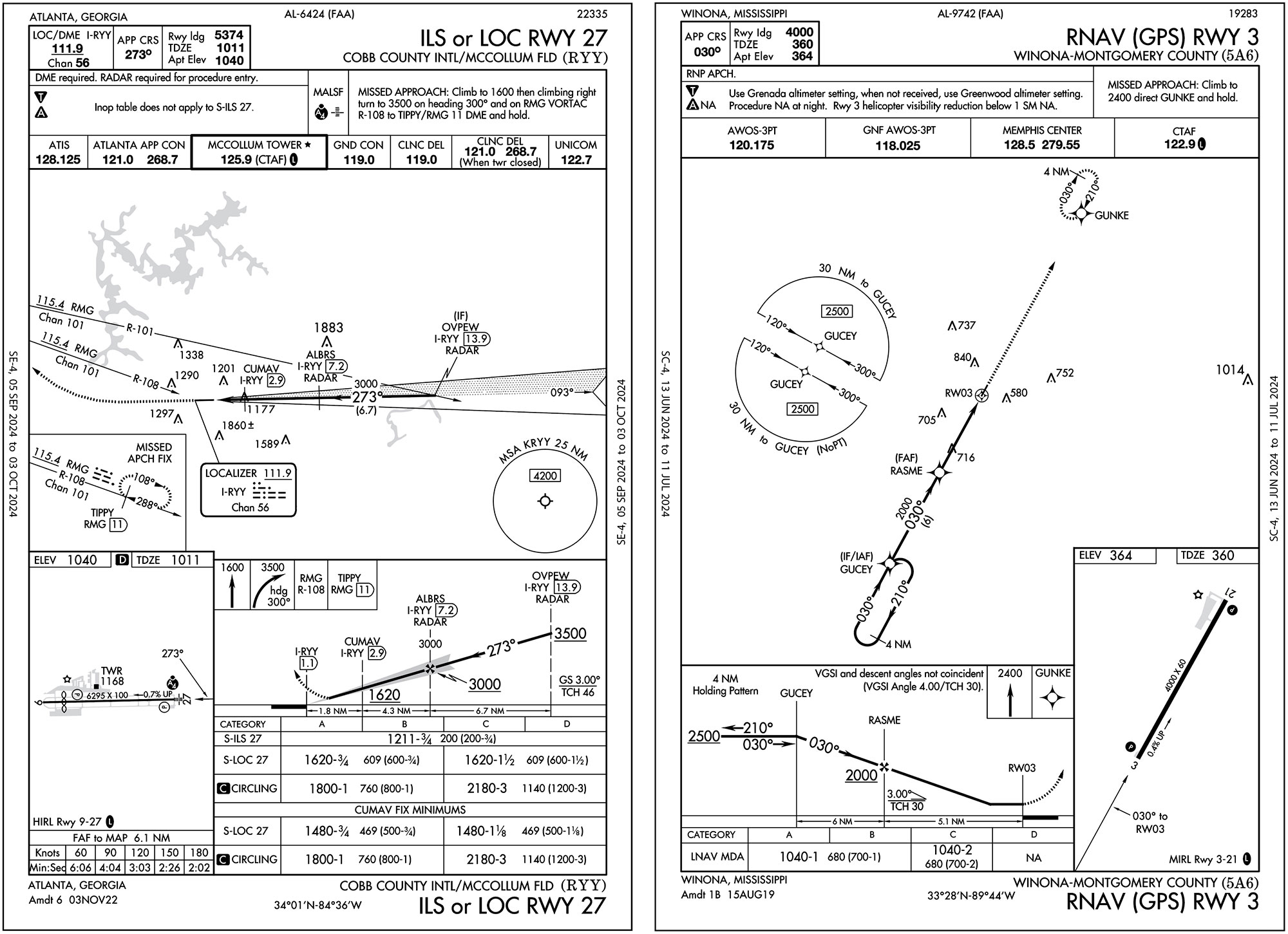
You’re a frequent IFR flyer on long trips, so leaving the large, comfortable home base in Anderson, Indiana, on this cool, cloudy day isn’t a huge deal. But when you find you’ll be flying into a rural airport identified with numbers and letters, you know to check on stuff like approaches, services and the presence of wildlife—including snakes. This trip has two legs: solo to the Atlanta area, Cobb County, to pick up two relatives at KRYY, then heading west to 5A6, Winona, Mississippi. There, the three of you will take a look at a chunk of property for sale, arranging to meet the agent at the airport. You file to KRYY and plan on the RNAV 27 with LPV mins of 1211-¾. Due to the low weather in the area, the alternate will have to be east at KGTR, near Columbus, Mississippi.


Departing KAID, it is indeed crummy. Still, it’s up to 400-5, good enough to depart and then get back in for a mechanical problem, or even a forgotten cell phone. Below that, you tell yourself, it’s for aircraft issues or medical emergencies only. A turnback would be via the lowest feasible approach, here the ILS 30 at 1209-¾. Those minimums are a bit lower than the RNAV 30 LPV (1234-1), which would serve as an easy plan B.

Despite the cloud layers for most of the climbout, you cruised in smooth blue skies on top of the low overcast. On the descent, the Cobb County ATIS advertised the ILS 27, conditions being 600-3. Although you could have requested the RNAV 27, things were getting busy on the radio so you just loaded the ILS. The inbound portion is similar to the RNAV version with the same intermediate and final fixes, and the precision approach minimums are identical. And the “DME required” note is covered with the IFR GPS, which will identify the correlating fixes on the approach along with TIPPY, the missed approach fix.

Forgotten MDA

With the overcast lower yet in Atlanta, you wonder if you oughta pay more attention to the missed approach. Coming off a traditional ILS, it’s one of those long-winded, radio-based legacy procedures that you wish would go away—climb, turn to a heading, intercept a radial to a DME fix, top it all off with a parallel holding entry. These things, of course, never come into play even when you do go missed, especially in busy airspace like this. Their only practical role these days is to serve as a lost-com procedure. 

Going missed with everything working usually results in a brief radio exchange to get vectored back around again or to get cleared to wherever you want to go next. That’s reassuring. But to prepare for the remote possibility, should you have RMG, the missed approach VOR, tuned and set for the 108-degree radial on NAV2? Or can you skip this step, knowing you can navigate to TIPPY using the textual instructions and following the GPS navigation? You tune in the navaid but get occupied joining the line of vectored aircraft to the ILS.

You probably should’ve paid more attention to the several straight-in minimums listed. After receiving a clearance for the ILS 27, you descend to 3000 feet and see that the glideslope was rock-solid at ALBRS. A mile past the fix, though, the GS flags on your only glideslope receiver. You already briefed for the LOC minima of 1620-¾. But you didn’t consider that you qualified for the CUMAV-fix minimums, 1480-¾, which would allow for the 600-foot ceiling. You weren’t expecting to descend to 1480 feet without that glideslope; should you continue with the newly discovered MDA? With everything as stable as can be, you don’t touch a thing, but mentally re-bug 1500 feet to brace for a missed. 

Getting the lead-in lights in sight 100 feet to MDA was probably the only thing that allowed you to continue comfortably. Breaking out a mile from the threshold did too. A two-day break will be a good thing. You can work around the glideslope going inop and review the game plan for getting into Winona, which is RNAV-only anyway.

Find a Straight-In

When it’s time to launch for 5A6, the wind had shifted to the northeast. That just made it more interesting at Winona, where it’s picking up past 10 knots and light rain is forming over the airport, bringing it down to 700-1, just at minimums. The RNAV 3 approach is LNAV-only, with just one line of minimums (1040-1 for you) to the 4000-foot runway, which is noted in fair condition but comes with a two-light PAPI. 

The absence of circling mins is puzzling, but you didn’t want to try that today anyway. Must be an obstacle issue. The larger conundrum is the marginal conditions for a non-precision approach that requires precision flying to avoid nearby trees. Plus, you’re managing a four-degree glidepath to a runway that will be wet and won’t offer loads of safety margin. 

The other option is the RNAV 21 and circle to 3. This has lower circling mins at 960-1. Too bad the wind won’t allow a straight-in to 21 with an even lower MDA. On top of that, be aware that you must circle south and make right turns to line up for 3, as circling on the other side is NA. 

To miss on the approach to 21, circle to 3, you’d best start that missed while still pointing southwest if any doubts about a safe circle-to-land arise. Once you turn base for 3, the only options are to fly the straight-out climb to the northeast that is the missed approach for the RNAV 3, or continue circling in a right-hand pattern if conditions allow. At any rate, you can go missed early if there is any doubt and then contact Memphis because you’re going to Greenwood.

A straight-in requiring higher mins seems better than circling. How about delaying the meeting and waiting for the weather to improve? You’re told that wouldn’t work unless you can make it in two hours. That’s definitely in doubt given the day’s forecast. 

So, how about just going to Greenwood now? The meeting window will still work with the 20-minute drive between the two airports. KGWO is down to 400-2 in rain, but that’s a welcome relief as you’ll have vectors to a straight-in LPV glidepath to 520-1 and a lot more runway. Of course, you had to file for an alternate 45 miles further west at Greenville, but that, too, has a tower and precision approaches.

It was a great relief to depart Atlanta with a much better plan, plus it just occurred to you that departing Greenwood will be way, way more comfortable than departing Winona. You already knew you wouldn’t accept a circle to land in minimal conditions, much less deal with the rather high risk of abandoning the approach with no safety margin. 

Meanwhile, if you find you’ll be visiting Winona often, you’ll fly in only on those days when a straight-in to higher minimums is comfortable, or it’s VMC and you can fly the traffic pattern. With a great alternate in Greenwood just 20 minutes to the west, you can’t go wrong with that. 


Elaine Kauh is a CFII in eastern Wisconsin. One of her specialties is designing IPCs with multiple circle-to-land scenarios, which are best practiced in good weather. Throw in a simulated emergency and she’ll break out the popcorn.

Ready to Sell Your Aircraft?

List your airplane on AircraftForSale.com and reach qualified buyers.

List Your Aircraft
AircraftForSale Logo | FLYING Logo
Pilot in aircraft
Sign-up for newsletters & special offers!

Get the latest stories & special offers delivered directly to your inbox.

SUBSCRIBE