













Hiding in Plain Sight

After you fly enough approaches, they all start looking pretty similar. Is that your brain working for or against you? Or both?

Gemini Sparkle

Key Takeaways:

  • Pilots are susceptible to cognitive biases, such as "expectation bias," which can lead them to overlook critical, subtle differences in instrument procedures, assuming they are similar to others previously encountered.
  • Older or "circling-only" approaches, like Gunnison's GPS-B, may feature dangerously steep descent angles (e.g., 9.2 degrees) that preclude a stabilized straight-in landing, requiring pilots to plan a circling maneuver even to an aligned runway.
  • Procedures in complex airspaces (e.g., Teterboro) often include unique conflict management elements, such as mandatory "at" or "at-or-below" altitudes at specific fixes, or speed restrictions in underlying Class B airspace, which demand meticulous briefing and execution.
  • To enhance safety, pilots should combat complacency by adopting a "spot the difference" mindset during approach briefings, actively looking for deviations from typical procedures rather than assuming familiarity.
See a mistake? Contact us.

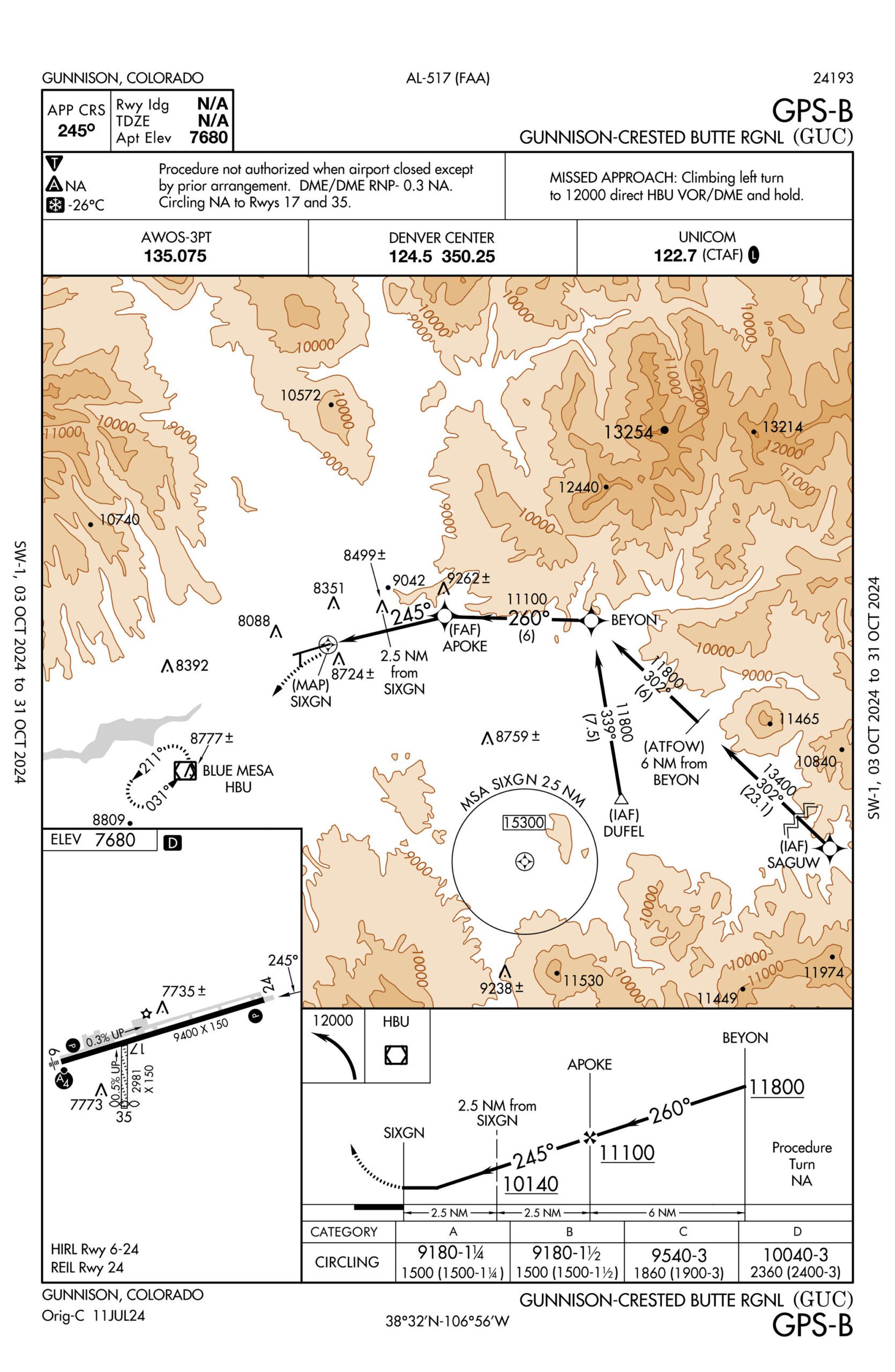
We recently heard an eye-opening tale of an approach into Gunnison, Colorado (KGUC), in which a jet crew flew the GPS-B approach in instrument conditions with a planned landing into the wind on Runway 24, but found themselves unexpectedly struggling with the approach. At first glance the approach looked to the crew to be a fairly typical non-precision RNAV approach, but what do you think? Pause here and see if you catch any subtle warning flags before continuing. 

We know that every instrument procedure must be unique, since the specifics of the airport, traffic flow, and obstacle environment are all unique. However, in practice many of the approaches appear similar at first glance—and many times they are indeed more similar than different. 

This can result in our brains forming shortcuts that allow us to more rapidly make decisions, which can be a good thing (after looking at many approach charts, your brain is tuned to know where to quickly look for necessary information). 

However, these shortcuts can lead to cognitive biases where we see what what we expected, as opposed to what’s actually there, when we encounter something out of the ordinary. In a sense it’s our human nature working against us. We have gathered a few real-world cases where some subtle details differ from the norm, and where our cognitive biases might trip us up.

Going Around at Gunnison

What did you notice about the GPS-B approach at Gunnison? For starters it’s the “GPS-B” rather than the “RNAV (GPS)-B” approach, which tells us that it’s pretty old and hasn’t been amended since the modern RNAV approach naming system was introduced, so it was built using older standards. While encountering old GPS approaches these days isn’t a problem by itself, consider it a cue to take a more critical look at the details looking for potential challenges. 

A more significant observation is that this approach has only circling minimums but appears to be aligned with the runway. Circling-only approaches are typically published when the final segment isn’t sufficiently aligned with the runway, but can also exist when the final segment descent angle exceeds TERPS limitations for the published aircraft categories. (See the sidebar below.) Encountering a procedure that has only circling minimums should be a cue for you to figure out why it lacks straight-in minimums. For this GPS-B approach, since it appears aligned with the runway, we should look closer at its descent angle. 

Wait a minute—what descent angle? Approach procedures usually have the descent angle and assumed threshold crossing height in the profile view. This is a useful reference while flying the approach, since approaches with descent angles steeper than the typical three-degree glidepath often require higher rates of descent and lower power settings than usual. Of course, discovering all this should come from a careful approach briefing. 

Unfortunately, descent-angle information is omitted since this is a circling-only approach, leaving us with no handy reference figures for the final-segment descent. 

However, we can compute the vertical angle that would be necessary for the crew to lose the necessary 2460 feet from the final stepdown to the runway over just 2.5 nm. It turns out it requires a descent angle of about 9.2 degrees, which is over three times that of the typical descent angle. It’s no wonder that the crew had trouble trying to land straight in since it would require roughly a 1600 feet/min descent rate inside the final stepdown, assuming a 120 knot final approach ground speed. There’s no way that could be accomplished while being considered a stabilized approach. 

Instead of attempting to land straight-in to Runway 24, the crew could have planned to circle to Runway 24 instead. Although it isn’t as commonly trained, pilots can still circle to a straight-in aligned runway, and that is likely what was assumed would be done with this procedure. To accomplish this, once the runway is in sight at the circling MDA, think of that as an upwind leg of a traffic pattern and just fly a normal pattern to land. This has the added benefit of allowing you to fly normal speeds and descent profiles. 

This approach ended up being quite different from the typical non-precision approach that it appears to be at first glance, since some of the cues that we’re accustomed to are missing, leaving our brains to fill in the blanks based on what we have usually seen in the past. (That’s called expectation bias.)

Conflict Management

The nature of flying is that it’s often a solitary affair, which is only reinforced in actual conditions when nothing can be seen outside of the aircraft. However, considering the complexity of the air-traffic environment, it’s often not very solitary at all. This is certainly the case in dense metropolitan areas where multiple airports coexist and somehow everyone gets where they want to go, without running into each other, and usually without too much delay. The need to keep air traffic deconflicted can lead to a few easy-to-miss details on procedures—and if you do miss them, you’ll likely hear about it very quickly.

Most altitudes on approaches have you cross fixes at-or-above the charted altitude. It’s easy to get conditioned to expect this to always be the case and tune out those little lines above or below the charted altitudes. Once in a while, though, you’ll come across something different, and it can be easy to overlook the difference. You’re more likely to come across these subtle differences in procedures in busy areas where air traffic needs to use all the tools in the toolbox.

The ILS Z or LOC Z RWY 6 at Teterboro, New Jersey (KTEB), is a great example of two such subtle differences. It features a mandatory altitude at DANDY to deconflict with traffic arriving at nearby Newark but is overlooked by arriving aircraft with some regularity. This is particularly tricky because if you were to capture the ILS glideslope early and ride it all the way down (which many pilots do), you would cross DANDY above the mandatory 1500 feet, possibly making a Newark arrival more exciting for its crew. Recall from AIM 5-4-5.b Note 2 that the glideslope is only valid inside the glideslope intercept point (lightning bolt), so you’re on your own to ensure fixes are crossed appropriately if you choose to follow it outside of the intercept point. 

The missed approach on the ILS at Teterboro also has a subtle difference to ensure separation: an at-or-below hold-down altitude. Normally there’s only one altitude to worry about on the missed approach, and we want to get up to it as soon as possible. However, on this approach you’ll need to level off at an intermediate altitude first. Since we don’t often see that, it can be easy to overlook and just start climbing up to the final holding altitude. Don’t.

Another potential gotcha when flying departures or missed approaches in higher-performance aircraft at Teterboro and other airports in major metropolitan areas is failing to keep in mind the requirements of §91.117(c), which limit speeds to 200 KIAS in areas that underlie Class B airspace. This is easy to miss, since we often don’t need to think much about airspace classification when operating under IFR. But as an example, the missed approach on the ILS at Teterboro has you level off at 2000 until crossing TEBLE, but reference to a sectional chart shows the Class B airspace at TEBLE begins at 3000, so be sure to monitor your airspeed. 

Outsmarting Your Brain

Once you’ve flown a bunch of approaches, it’s hard not to start noticing the similarities between them. This is helpful since it can make approach briefings go quicker and help you know what to expect, but at the same time this is a path that can lead towards complacency. Expecting procedures to look mostly similar makes it that much more difficult to see subtle differences when they are present, especially when they are rarely encountered such as those that we’ve highlighted here (which is certainly not an exhaustive list). 

Remember those “spot the difference” puzzles where you are presented with two similar pictures, and you need to identify as many differences between them as you can: such as the person is wearing a different hat, or the table has three legs instead of four? It can be helpful to apply the same thought process to your approach briefings. In this way you can retune your brain to take advantage of having seen a bunch of approaches by focusing on identifying the things that stand out to you as compared to your mental ideal of an approach. 


Lee Smith is a corporate pilot, flight instructor, and aviation consultant in Maryland. Having supported procedure design activities for over a decade, he enjoys seeing both sides of IFR procedures.

Ready to Sell Your Aircraft?

List your airplane on AircraftForSale.com and reach qualified buyers.

List Your Aircraft
AircraftForSale Logo | FLYING Logo
Pilot in aircraft
Sign-up for newsletters & special offers!

Get the latest stories & special offers delivered directly to your inbox.

SUBSCRIBE
