













Flying light retractables is the best of both worlds, with extra speed compared to their fixed-gear brethren, and similar runway capabilities, with a little added complexity. Nothing two instrument co-pilots can’t handle, right? But when one wants to push things a bit more than the other, finding middle ground can be a good decision-making exercise.
Discuss and Decide
Your golfing/flying co-worker will go to great lengths to combine his two passions, and this one might just be … off the charts? He proposed a stop at Excelsior Springs, Missouri (3EX) to visit the adjacent golf course of the same name. Since you’re both attending a conference in nearby Kansas City and flying there in the club’s Piper Arrow, it’ll be a short and fun stop on the way home to Minnesota.

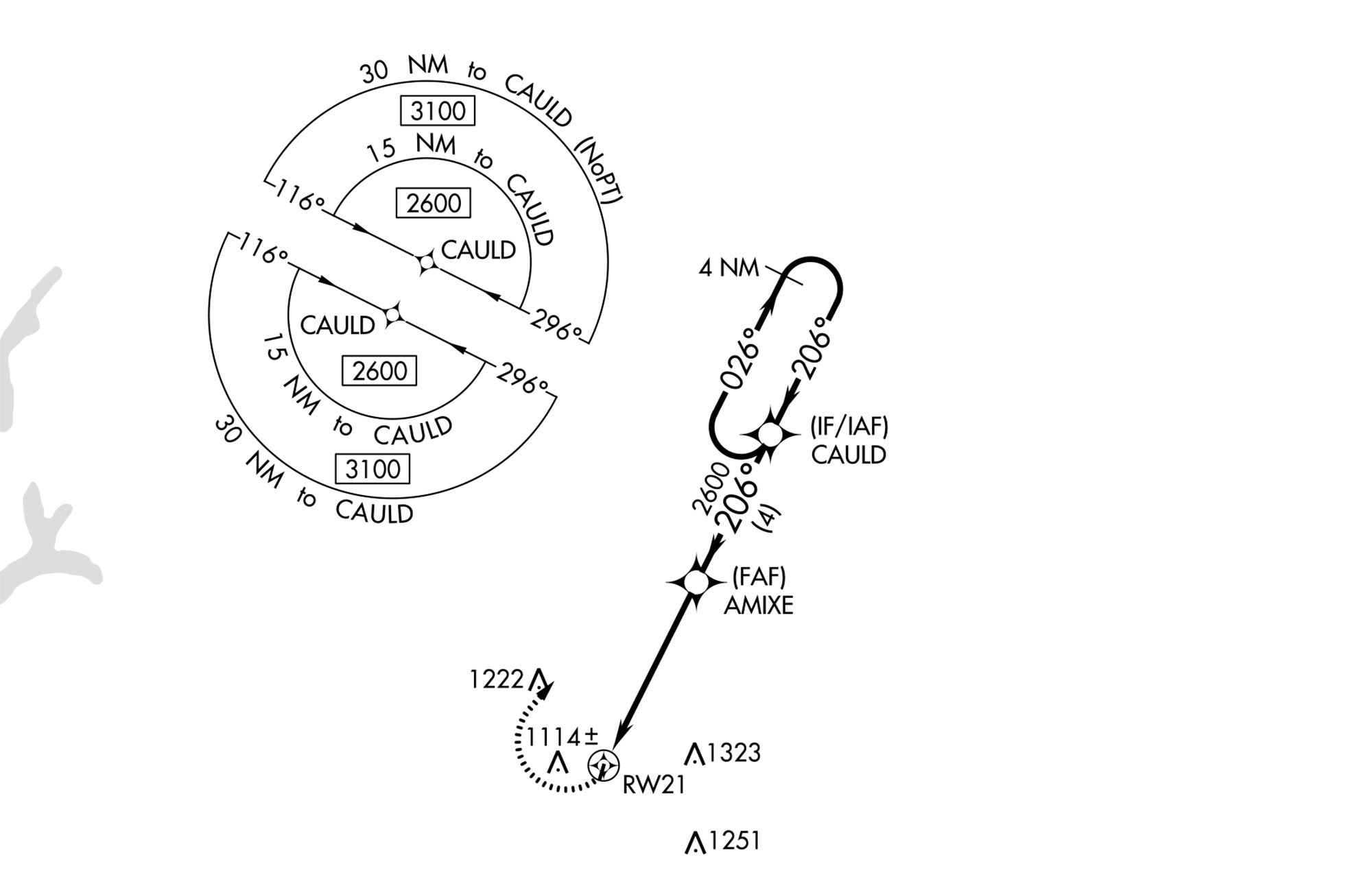
How your cohort finds these places is a secret he has yet to divulge. Anyway, at first glance it looked great—rental cars are available if pre-arranged, and the terminal has basic services. There’s one runway, 3/21, and one approach for the whole field, an RNAV (GPS)-B. It’s closely aligned with Runway 21, so a straight-in might work; in any case, visual conditions are likely. If not, a north wind would require circling to 3. Hmmm…
Checking the approach chart, you see the runway is 2004 x 50 feet. You send a screen shot of this to your partner with a note: “No-go and no wx.” Without an on-field AWOS, you’re supposed to use the altimeter setting from Charles Wheeler Downtown, which happens to be where you’ll park for the conference. It’s more than 20 miles from 3EX. General weather information is available just five miles west at Midwest National (KGPH), but still.
How about just fly to KGPH and drive to the golf course from there? With a longer runway and approaches to both 18 and 36, plus an ILS, most any weather except the worst will be fine. But your cohort did his homework and you got a screen shot of the Arrow’s obstacle-landing distance chart. He’d drawn the lines for a hot, calm day. Result: 1450 feet. You’ll likely have a headwind, and the Arrow responds well to good short-field technique. Whose technique? That’s when you propose the landing contest to practice at home.
By the way, he texts back, he’s out of six-month instrument currency, would you be the PIC? Sigh … at least he’ll cover all the expenses for this excursion as a trade. So you file to 3EX, with Charles Wheeler as the alternate. You also get your friend to practice takeoffs and landings together at home, using full flaps, short-field airspeed, plus the plant-it method and firm breaking, you can stop in less than 1400 feet.
You didn’t forget to check takeoff, too: Short-field technique will get you airborne between 800-1800 feet, depending on conditions. Satellite images of both arrival ends show there’s nothing in the way on the other end, providing plenty of margin. Assure touchdown before the second taxiway, or go around. On condition that there’s at least 10 knots of headwind for 21, with higher-than-MDA clouds, you agree to go.
GPS-B briefing
The RNAV-B at 3EX also lacks a base-to-final; it only has a hold-in-lieu-of-procedure turn. Minimums are 1660-1. First request vectors, fly the HILPT as a second choice. You research this circling-only thing and see in the Instrument Procedures Handbook that it’s not uncommon to see the final approach course aligned with a runway as is the case here.
But it’s designated as circling if the “descent gradient is greater than the 400 feet/NM from the FAF to the threshold crossing height (TCH). This does not preclude a straight-in landing if a normal descent and landing can be made in accordance with the applicable CFRs.” And, the “Visual Segment – Obstacles” note, when checked on each runway end, indicates mostly trees on either side, but nothing onerous. And you’ve checked the aerial images.
Since you’ll be in the clouds until at least AMIXE, descent to the MDA of 1660 feet should happen as soon as practical so you can start looking outside. The missed approach has bigger obstacles, requiring a right turnout and climb to 2600, initially going by two towers before it’s clear on the way back to the IAF hold.
And no-brainer, this’ll be a daytime approach with at least three miles’ visibility due to scant lighting—no PAPI, no end identifier lights. There are only low-intensity runway lights that are “non-standard” in spacing and color. The chart says airport elevation is 993 feet, with no TDZE, while the FAA data lists the airport elevation and TDZE as 999.6 feet. Okay, round the MDA to 1700 feet, round up the elevation number(s) to 1000 feet for a baseline minimum ceiling of 700 feet. Accept a ceiling of no less than 800 feet.
Change of Plans
After two days in Kansas City, it’s time to head to Excelsior Springs. Winds are from the south at ten to 15 knots, so 21 is useable for what will be a straight-in approach. And with a slight upslope, your landing numbers won’t be in jeopardy. The airport is unattended and fuel isn’t available, so be sure to get some up at Wheeler, but not too much. And like the approach, the runway doesn’t have much going for it. It’s listed in good condition but with “basic” markings.
At least that’s what it says on the airport data listings, but if you looked up runway marking levels in the AIM, the lowest level is “visual.” For this length—which won’t accommodate most aircraft beyond the light single or twins, much less “international commercial transports”—expect to see just the runway number (officially called “designation”) and a centerline, and that’s it. Thankfully, you can use 21, which has a slight upslope.
Oh, and the short runway at this airport means only Category A can use this approach. What category are you? You always assumed A, but you’ve never had to really study this detail. Straight from the IPH 4-8: “Category A speeds are up to 90 knots; B is 91-120. These speeds are supposed to be the aircraft’s VREF, or for the single-engine pistons, 1.3 × VSO at maximum landing weight as determined at certification.”
Usually everyone uses 1.3 × VSO as the default approach speed to plan any approach and landing, along with the POH-recommended speeds, plus whatever’s needed to account for any other weather or aircraft conditions. With that, the current guidance also says you can use faster speeds as long as you use the corresponding higher category, but you can’t use a category lower than what the aircraft was certified for. The aircraft landing-configuration stalling speed of 64 MPH x 1.3 is 83-84 MPH, about 73 knots, or Category A.
But closer to tee time, the ceiling at KGPH began trending downward to 700 feet, and the wind’s also dying down to southwest at eight knots. That’ll just make the approach MDA, but that wasn’t the plan. And you made a deal on a minimum headwind, too.
So rather than waiting for an unknown time to make it there, you both decide to amend the flight plan and head home. It’s been an interesting exercise indeed. You had very little information for this sparsely equipped airport to comply with 14 CFR §91.103, Preflight Action, but you ended up with a whole page of notes to meet the requirement to “become familiar with all available information concerning that flight.” This includes “runway lengths at airports of intended use” and “takeoff and landing distance data.”
Also mentioned are “aircraft performance under expected values of airport elevation and runway slope, aircraft gross weight, and wind and temperature.” How you “expect” airport elevation is yet unknown, but you’ve done something you don’t normally do: Actually read all that stuff, from elevation, runway dimensions and checked that bit of upslope on 21.
After clearing several red flags, though, just one—two, actually—scrubbed the mission. But it’s just for today. The upside is all the preparation means an easier flight plan for that day when you do get to try out that golf course, and have the other guy do the flying.
Elaine Kauh is a CFII in eastern Wisconsin. She specializes in IPCs that take unsuspecting pilots to short runways with no glidepaths, and enjoys the missed approaches as much as the successful landings.

