













Canceling IFR while still airborne appears to be a natural instinct of Pilotus instrumentae. Why is that? Maybe it’s our generous nature, helping your brethren waiting for release while you own the airspace. Or is it our mission-driven mindset—check that box; get it done. Or perhaps it’s simply fear of forgetting to cancel on the ground, followed by that embarrassing call on the FBO phone. (I had a, uh, friend who did that once.)
Some of us can eliminate the problem by flying only to towered airports, since Tower cancels for you upon landing. So we’re lazy, then. “None of the above,” one P. instrumentae declared. “When it’s non-towered, we wanna talk on CTAF to the VFR traffic.”

Marginal, Maybe
Good point. While Approach or Center can see many of the targets in the vicinity as you near the airport, they can’t see everything. And it’s difficult to monitor another frequency while you’re busy doing your IFR thing. Sure, ATC will have you switch to advisory a few miles out and you can stay IFR or at some point switch back to cancel if you wish.
Typically in VMC, and perhaps with VFR targets buzzing around, it’s easy to just cancel. But, be sure 1) you can keep the field in sight while 2) maintaining VFR, assuring you have the requisite cloud-clearance and visibility. There are workarounds to canceling early, like asking for a brief defined window—15-30 seconds can suffice—to switch to CTAF, announce your position and intentions, and listen for live ones in the pattern. Switch back, monitor advisory as best you can, and expect a full handoff a few miles out.
But every day is different, including this winter trip from Columbus, Ohio, to KLDM, Ludington, Michigan, in a four-seat retract. This is a one-leg trip and fuel is cheap at LDM. You’ll depart Friday at noon and drop off three passengers, then go home to return for a Sunday pickup. You keep Sparta or Fremont as reasonably priced fuel-stop options if you burn into your one-hour reserve. And with a recent snowfall, checking field conditions for destination, fuel stops and any alternates will take a few extra minutes.
It’s currently 2000-5 at KLDM, northeast wind at 10 knots and forecast that way for a few hours. Maybe you can omit the alternate for a larger fuel cushion. It’s legal—§91.169 says if the destination is “at least 2000 feet” one hour before and after your ETA. Plus, lakeshore airports are excellent at plowing their runways. Just in case, though, set aside the robust alternate of Grand Rapids, which will have reliable surface conditions and full services.
The cloud layers are smooth on climbout with bases at 3000, tops 5800; filing 6000 is working well. A trace of rime ice adds to your tops report. All that would be nice for other aircraft of your size to know; there’s that generous nature coming out. The layer you overfly thickens up to 1500-6000 entering Michigan, though, while you check with AWOS stations on the route. That’s when you start to focus more on the destination weather.
Making More Work
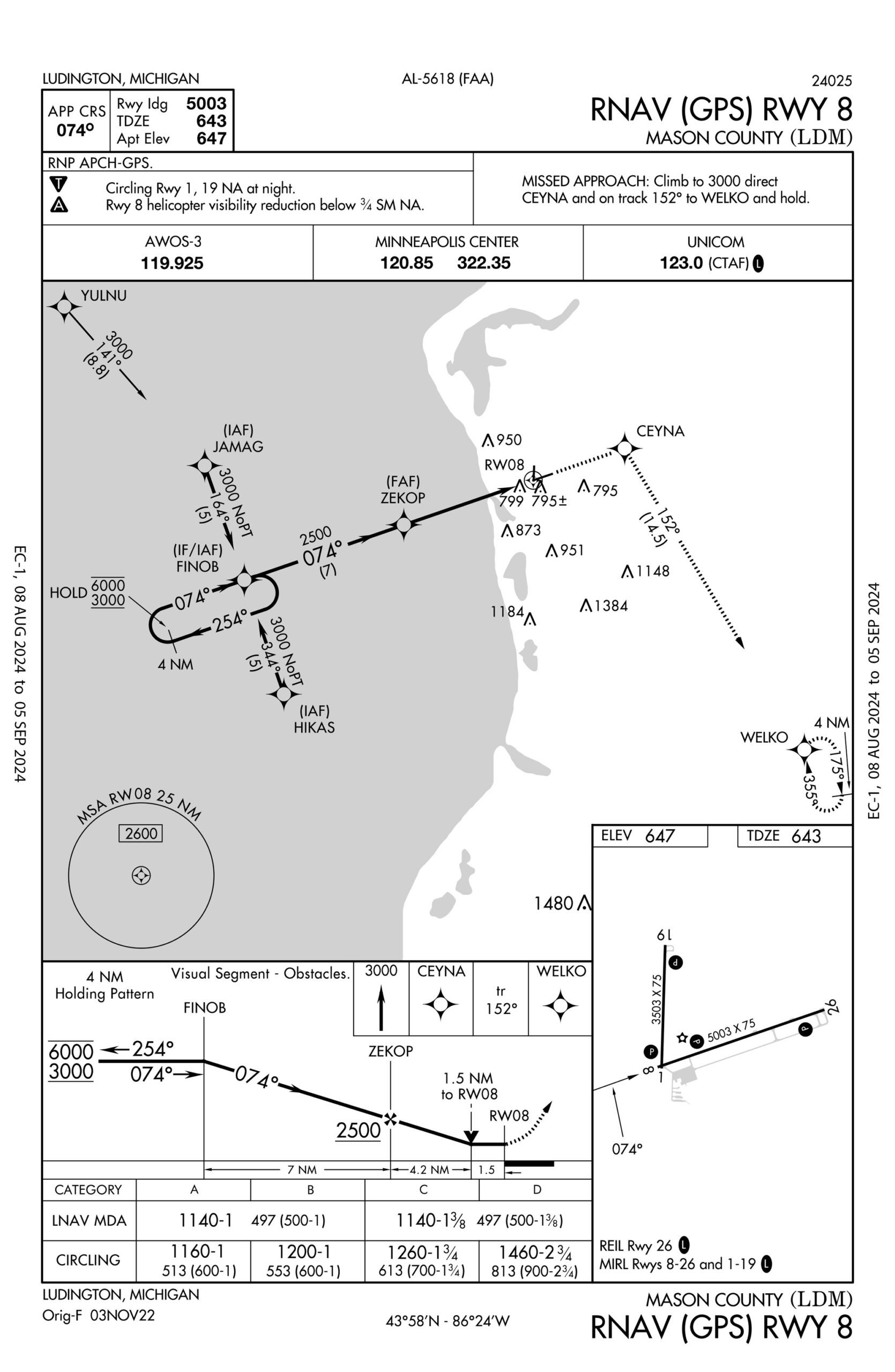
Weather at Ludington two hours later as you cross the border is worse than forecast—1000 feet broken, 1800 broken, 3000 overcast, visibility three miles. You would’ve been required to file an alternate for that. But it’s moot now, and you have some decisions to make. In about 30 minutes, Center’s gonna ask which approach you want. The go-to for now given the northeasterly winds is the RNAV 8, with only an LNAV MDA for the straight-in.
But that starts over Lake Michigan with about a seven-mile final offshore. You wonder if you ought to fly the RNAV 26 and use the circling MDA of 1160 feet to land on 8. That’s the same as the RNAV 8 circling MDA and it is only 20 feet higher than the straight-in minimum. The missed approach fix is about three miles out over the lake, which isn’t nearly as bad.
Give it a maybe and look at option three: Request a visual approach and fly over the field for left traffic to 8 (you need not specify the runway to Center, but you certainly can give an FYI).
The weather requirements for a visual are 1000-3, clear of clouds. This you barely have. Plan as normal a pattern as practical, which means using the traffic pattern altitude of 1700 feet, or even 1600 feet to stay out of the clouds. That’d be the fastest way to landing; your mission-mindset instinct is coming on strong. With the field in sight four miles out, you get the clearance and a handoff to advisory along with the usual options to cancel in the air or after landing. You got this, you think, and cancel. Center cheerfully accepts, but as you overfly the airport you see that the north side is a bit fuzzier on the visibility, forcing you down to 1500 feet to keep the runway in sight.
With possible lower ceilings in the vicinity, you just tightened your go-around margins to less than 1000 feet and, of course, there is no missed approach procedure with the visual. All that made the landing less than stellar, but you were just glad to be rolling as you did remember to put the gear down. After a brief lunch, you got the clearance back to KCMH and departed an hour later with ceilings now 2000 feet (of course). At least the flights home and back again will be much easier with better conditions—still marginal VFR, but with improved ceilings.
Departure Drill
As Ludington is unattended on weekends in the winter, your pre-arranged ramp access for your passengers paid off. You also thought it a good idea to call ahead for a departure clearance with a hold for release and void time while loading up. But with an unforecasted, thick snow shower moving in quickly from the west, you don’t have much time to take off before the visibility will drop to zero along with any defined ceiling.
For now, it’s 1000 feet scattered, visibility five miles. Mission mindset and regulatory anxiety clash. You can expedite the taxi and pre-takeoff checks, then call for release. While you are uncomfortable with a zero-zero takeoff, if you get an immediate release you’ll still be able to see enough before rotation.
But that didn’t work as planned; you get another “awaiting IFR release” as other traffic is set to descend and cross your initial route. You could depart VFR right now, and climb above the scattered layer, and call Center then. AIM 5-2-7 might look straightforward: “The ATC instruction, ‘hold for release,’ applies to the IFR clearance and does not prevent the pilot from departing under VFR.” But there are caveats: “However, prior to takeoff the pilot should cancel the IFR flight plan and operate the transponder/ADS-B on the appropriate VFR code. An IFR clearance may not be available after departure.”
So, at this point, the options are to wait for release and take off into the snow, or call back and cancel the flight plan so you can depart VFR (it will cost you precious minutes to do this). Heck, “should” doesn’t mean “must.” Fly VFR now to the next airport and refile with a new plan, and explain yourself when you call for the clearance (but that would be more than embarrassing). All that pondering ended up missing the VFR option anyway, so you wait out the weather. You do manage to stay a step ahead on this and call up Center to delay release. Thus the clearance is saved, and you can call back when ready.
It took another 20 minutes to wait out the snow and for the AWOS to report a real ceiling (you’ll take 500 feet) and a half-mile visibility (better than nothing). Cancelling IFR on the outbound risks safety or legality just like on the inbound, which you already figured out. It’s always best not to rush, especially when weather’s involved.
Elaine Kauh is a CFII in eastern Wisconsin. She loves flying two-seaters IFR to certain towered airports and waving to the 737s waiting for release.

