Register

Search Results for: general aviation inc

Features

The New ADIZ

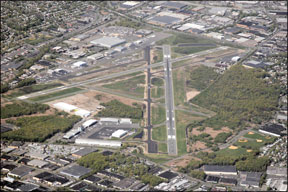
Some airspace designs are badly done. Some have “badness” thrust upon them. The Washington Air Defense Identification Zone (ADIZ), cobbled together by Notam in early 2003 as a “temporary” measure in preparation for the invasion of Iraq, managed to incorporate both extremes. Along with a “zero-tolerance” approach to even the most cursory and innocent violation, the Washington ADIZ became an operational burden, cartographic nightmare and growth industry for enforcement, all at the same time.
Read More »
Airmanship

Can I Land On That?

You are a skilled, proficient and responsible pilot. You do everything in your power to avoid dangerous situations but there are a few unavoidable moments during each flight where, if the unthinkable happened, youd be left with few options. Flying is, after all, an exercise in risk management, not risk elimination.Imagine that youre departing from Mega City Municipal. With a healthy climb rate established, you tuck away the landing gear, set climb power and prepare to enter the soup. Just as the airport fence slides underneath the belly, your sole engine shivers and goes silent. Youre only 500 feet above the ground, so turning back to the runway is not a reasonable option. You look out the window and all you see is a patchwork of gray and black boxes. Can you land on that stuff?

Read More »
General

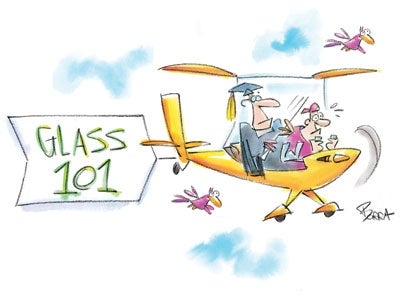
Teaching Glass

With the advent of the new glass cockpits, a lot of thought went into the kind of training that would be necessary to adequately prepare a pilot to safely utilize these more sophisticated systems. The FAA worked with the general aviation industry to put together a set of standards for glass cockpit training. The original […]

Read More »
Photos

Goodbye Avgas, Hello Switchgrass

The currently controversial theory of “peak oil” holds that the top of the curve of world oil production – a barrels-per-day arc that rises with demand until it begins to fall because of dwindling supplies – either has already been reached or will be soon. Whatever side of the argument you’re on – there are […]

Read More »
Training and Proficiency

The IFR High Dive

From the NTSB: “The controller asked the pilot if he had weather radar on board, and he reported he did and it gave him weather every five minutes. “At 0930, the controller reported to the pilot that the ‘lightest weather’ was ‘about a one nine five heading for seven miles and then it looks like […]

Read More »
Photos

Was the Lear Jet the First VLJ?

I received a letter from a reader after our story on the Cessna Mustang ran in the May issue asking me to compare the Mustang to the original Lear Jet 23, to measure 40 years of progress in light business jets. Interesting idea, and there is a valid comparison, but it’s not the Lear and […]

Read More »
Features

Flight Landing Alternates Made Easy

Flight under instrument flight rules (IFR) is largely procedural. Theres little room or tolerance for zany spontaneity so, if you love surprises, look elsewhere. But although we fly by the book, when the plot thickens, we do in fact have options (although theyre more like regulatory provisions) for choosing a different ending. Usually, the thickening agent affecting our best-laid plans is weather-related. Before we can exercise that freedom of choice, however, IFR pilots must fulfill certain obligations. Some of these rules are similar to those for VFR flight, such as how much fuel we should have on board. Some, however, go literally a step beyond, such as the requirement for specifying an alternate destination (as well as hopefully having some rough plan for getting there). The idea of even thinking of an alternate airport may be foreign for some newly anointed VFR pilots, but in the IFR world, its a well-known commodity.

Read More »
Editor's Log

The Good Stuff

In recent weeks, I had the opportunity to make several flights up and down the eastern seaboard, in good and bad weather, stopping into airports of all sizes and in many different locations. With one exception, and even including the ATC folks with whom I worked, the experience was positive. I was welcomed at FBOs, treated with respect by airport and FAA employees, and other GA pilots were cooperative, helpful and professional. At one fuel stop, the airport employee apparently pulls double-duty; he was riding a tractor up and down the runway sides, mowing grass. I was left to find the restrooms and pump my own gas, trusted not to abscond with anything in the FBOs office or tinker with hangared airplanes. It was all good.

Read More »
Features

Unusual Recoveries, II

We compared the Neutral Recovery Controls and the Hands-Off methods of spin recovery to the tried-and-true NASA Standard recommendations in Part I of this series (June 2007). Well now look at recovery strategies for airplane upsets specifically involving excessive angles of bank. Since leading supporters of Neutral Recovery Controls steadfastly maintain the method works in any attitude and in any airplane, well compare this strategy as well as the instinctive Split-S reaction (i.e., “Just pull, baby!”) to a more traditional roll recovery as embodied in the Power-Push-Roll procedure.

Read More »
Pilot in aircraft
Sign-up for newsletters & special offers!

Get the latest stories & special offers delivered directly to your inbox.

SUBSCRIBE