Register

Search Results for: general aviation inc

Photos

Atlantic Crossing?Part II

You may remember last month we left off in a brand-new TBM 850 halfway between Scotland and Iceland at Flight Level 280 with both a master caution and a master warning light flashing and a horn blaring. That we were a long way from any land much less any runway required no emphasis. A fuel […]

Read More »
News

GA Icon Boisture Takes the Helm at Hawker Beechcraft

From his perspective, ex-Air Force fighter pilot Bill Boisture has seen his share of business cycles and how the general aviation industry reacts to them. Boisture started his new job as head of Hawker Beechcraft on Monday, succeeding Jim Schuster, who last fall had announced his plans to retire as soon as a replacement could […]

Read More »
Unicom

Ditching Depth

We never fly over water in our single engine Saratoga. However, on a flight from Key West to Fort Lauderdale several years ago, Flight Service advised me that everyone flies over the Florida Gulf because it is never more than three to five feet deep. So we did fly direct. Is he correct? If so, why did Amy Labodas plane sink (“A Different Ditching,” March 2009)?

Read More »
Avionics and Gear

GPS Errors

Theres no question ours is an era of great advances in safety and position awareness. Its the rare IFR airplane that isnt equipped with at least a portable, moving-map GPS; theres not an IFR-certified airplane in production that doesnt include a GPS-driven “glass cockpit” as at least an option-one thats almost always added. The capability of GPS comes with great complexity. There are very different operating interfaces with units from competing manufacturers. Its a little surprising, then, that pilots seem to make the same errors and omissions pretty much regardless of the unit involved. What are these common GPS errors? What can we do to avoid them? David Zitt is the Flight School Manager of Sportys Academy, the flight instruction arm of Sportys Pilot Shop in Batavia, Ohio. He and his instructor staff work exclusively in GPS-equipped airplanes, some with full “glass cockpit” panels but most conventional round-gauge airplanes meeting the definition of Technologically Advanced Aircraft (TAA) through the installation of moving-map GPS. Zitt notes that “each [GPS] unit has its own pitfalls,” but finds common pilot mistakes regardless of the type of GPS installed. Prime among them is “instrument fixation” during the transition to TAA flight, a focused stare and excessive concentration on which button to push when the pilot is not completely familiar with the GPS used.

Read More »
Features

Icing And Tailplane Stalls

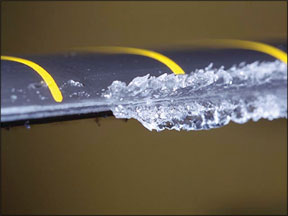
Even as the wreckage of Colgan Flight 3407 cooled in a Buffalo, N.Y., neighborhood in mid-February, the debate over flying turboprops into known icing was reigniting. Whether icing was the cause isnt known, and actually isnt relevant to the fact that this accident reminded everyone in the industry of an unresolved safety question: Are turboprops equipped with pneumatic boot de-icing systems really capable of handling all the icing they might be expected to encounter? And if they arent, how can pilots be trained to safely recover an airplane thats been iced up beyond the equipments capability or, worse, survive an icing encounter in an airplane with no ice protection? Another early question arising from this tragedy involves reports of what might be considered inappropriate control inputs as the Bombardier Q400 departed controlled flight. According to the NTSB, information retrieved from the flight data recorder indicates the stall-warning stick shaker and stick pusher activated soon after landing gear deployment and wing flap extension to 15 degrees down. At that time, the aircraft then pitched up 31 degrees, far in excess of a normal maneuver in a transport-category airplane. While its entirely possible the pitch up involved the autopilots automatic and simultaneous disengagement, its also possible the maneuver was commanded from the flight deck. Why would the crew pitch up so severely? One explanation involves the crews presumption the tail had stalled. In such an event, the appropriate response is to pitch up, not down as would be the case if the wing entered a stall. Generally, the only way a tailplane is going to stall in normal operations is if its leading edge somehow becomes contaminated, as would be the case if ice accumulated.


Read More »
Airmanship

Putting It Down

One of the more unpleasant realities of personally flown aircraft is that ones exposure to the risk of coming to a stop in a fashion other than intended is higher than we care to admit. While many of us fly our entire careers without so much as a scratched airplane or an engine hiccup, others are not so fortunate. Those of us with an IQ above room temperature accept there is a true risk of being involved in a crash. Once the premise is accepted, the question becomes what to do about it. One answer is to think about it beforehand and act accordingly, especially when it comes to considering occupant protection, developing a personal checklist and preparing for when something ugly happens. Years of research and feedback from the school of hard knocks has shown time and time again that the single most important thing we can do to protect ourselves in the event of a quick stop is to wear all of the available restraining systems in whatever seat we occupy. There has been full-scale human impact research going on since World War II, and it is absolutely consistent in its results: An unrestrained occupant has a lousy chance of surviving any kind of crash impact. Even low-speed collisions generate G loads in the double digits, and no human being in the world is strong enough to “brace” for those loads (nor prescient enough to predict their precise direction even if it were possible). A seatbelt is the first line of defense; it keeps the occupant more or less in the seat and stops a major killer in accidents-that of being thrown out of the vehicle. (And, as comedian Bill Cosby once noted, it helps the ambulance driver find you.) While folklore is full of anecdotes about people who survived because they were “thrown clear,” inquiry into those stories has shown that virtually every one is a myth. A human isnt designed to hit the ground, a tree or wall going 30 miles per hour, much less whistling along at 70. The degree of pulverization of bones, soft tissue and internal organs when that occurs is the stuff of which pathology textbooks is made.

Read More »
Features

Ramp Safety

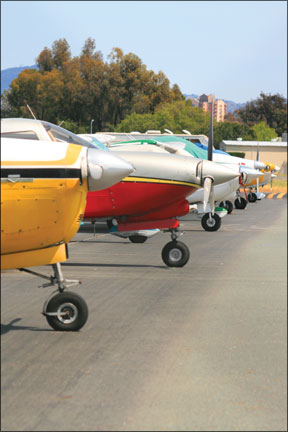
Every pilot, to one degree or another, spends time contemplating risk management. While aviation is known to be potentially risky, most aviators adopt the strategy of actively managing risk as a means of minimizing the exposure to danger. Each and every flight involves a series of choices and judgments, either conscious or not, that ideally insures the safe completion of the flight. Outside the cockpit, we spend a significant portion of time reading accident reports, attending safety seminars or even going through the new FARs. Virtually every aspect of flight safety is scrutinized. I say “virtually” since there is one area which is generally given very little consideration. That is what happens on the ramp. How safe (or dangerous) is it to be in the vicinity of an airport ramp? It is exceedingly difficult to derive a useful statistical comparison (like fatalities per 100,000 flight hours) since there is a broad spectrum in ramp activities; from a sleepy grass strip where hand-propping might be the greatest danger, to a large metropolitan airport where the intensity of activity can appear to create a blur. The risks and frequency of events are likely to be completely different across the spectrum of airports. However, knowing what has happened to other pilots and operators might make you pause to think next time you walk across the apron while talking on your cellphone or glancing at the likely departure procedure. Instead, we need to recognize the hazards of being in an area where bad things can and do happen, and then look at the ramp in different way.

Read More »
Aircraft Analysis

Preflighting Your Prop

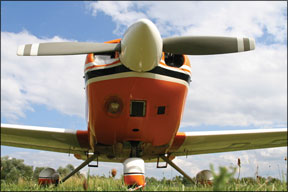
Unless youre among the small number of personal aircraft owners lucky enough to own a jet, your airplane has at least one propeller. It might be a fixed-pitch, metal or wooden affair, a multi-composite blade reversible spun by a turbine engine or one of the more ubiquitous constant-speed offerings from Hartzell or McCauley. And you might have more than one of them. No matter: Even a basic fixed-pitch model is a fairly expensive component, spinning away for hours on end, its tips approaching-in some cases exceeding-the speed of sound. If you have a constant-speed or full-feathering version, you also have a small collection of very expensive and specialized parts regularly subjected to massive forces. Contrast all that with what many pilots seem to think: A prop is a poorly designed handle with which to help move the airplane back in its hangar. In fact, according to the pros, treating your propeller like the critical component it is and lending it a little TLC every now and then can go a long way toward preventing costly maintenance. Or worse. The average propellers main enemy? Its not the wet-behind-the-ears private pilot who insists on using it to muscle the airplane in and out of the hangar. Its not even the guy who taxis over runway lights and into potholes while talking on a cell phone-more about him in a moment. Instead, prop shop managers and manufacturers reps tell us its aviations oldest bugaboo: corrosion. Look at just about any metal prop out on the tiedown line. Youll probably find its leading edge is rough, with small pits and-if it hasnt been painted recently-some whitish discoloration. Thats corrosion, and its slowly eating away at the prop.

Read More »
Photos

From Dream to Reality: A Girl, a Plane and a Space Suit

When I was three years old, I wanted to be an astronaut. Mostly because my older sister Gail wanted to be one, I think. But, still. Never mind that girls weren’t allowed to be astronauts back then. Obstacles, even seemingly insurmountable ones, never stopped anyone from dreaming — especially at age three. My father, enlightened […]

Read More »
General

More Window Dressing?

At the end of the year I renewed my annual Customs decal to expedite crossing back into the States on our frequent trips to Montreal, Canada. But this year the pleasurable anticipation of trips to Montreal was stifled by the announcement by the Department of Homeland Security (DHS) that, despite literally thousands of negative comments, […]

Read More »
Pilot in aircraft
Sign-up for newsletters & special offers!

Get the latest stories & special offers delivered directly to your inbox.

SUBSCRIBE