











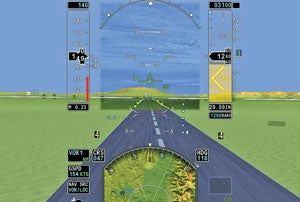


(January 2012) The question that was being debated around the halls of NBAA 2011 the other week was about as technical and geeky as it gets: When flying a very low approach, lower even than a decision height of 200 feet, where is the proper place for your “head,” that is, your eyes and your attention, to be? Should it be down, looking at the primary flight display, and then out, looking for the runway environment at decision height, or should your eyes simply be up and outside the airplane all the time?
At first blush, it sounds as though it’s a no-brainer. Why would the pilot be looking down when the runway is out there if he doesn’t have to be? Then again, unless the airplane is equipped with a head-up display, the pilot has to be looking down a good part of the time. Quantifying how much time is spent up and how much time is spent down is not an easy task. Proficient instrument pilots are skilled at monitoring two instruments simultaneously while peeking at a third, and the layouts of PFDs make it easier to see even more than that without shifting focus. I’ve long felt that the way we teach instrument students to scan is a poor imitation of the way we actually take in the flight instrument data and make sense of it, but one does have to start somewhere. The theory behind the HUD is that, by using it, the pilot has everything in the main field of view. There is still a scan going on, though it is a compact, fluid and efficient one, to be sure.

