














One of the more challenging aspects of teaching flight lessons is taking a two-dimensional diagram from a textbook or slide from a computer screen and translating it into three dimensions for the kinetic learners who need physical interaction for best results.
Flight instructors frequently use desktop aircraft models to illustrate the traffic pattern at the airport—and this works. But there are times you need to go bigger.
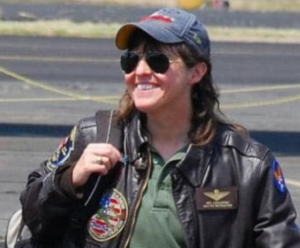
When I was teaching VOR navigation for a private pilot ground school, I created a VOR in the lobby of the flight school by moving the furniture out of the way and using painter’s tape on the tile floor to create a walkable VOR. The cardinal radials for north, south, east, and west were laid down, and the shape of a pentagon—the station—was placed on the floor.
It was realistic enough for the chief CFI to “request permission to cross the Godlewski VOR” when he left for the night. For the class, learning took place as they “became airplanes,” crossing, tracking, and intercepting the radials.
This kind of application works for many things. In particular, the airport traffic pattern, where all flights begin and end, is perhaps the most task-saturated environment for all pilots.

There is a concentration of aircraft, pilots of varying skill levels, airspace considerations, radio calls, etc. Add to that the fact that the cockpit is a terrible classroom, as it is loud and filled with distractions, and if you are not careful, it could collide with another classroom. The best instructors get creative about ways to lessen the saturation factor—and sometimes it involves artistic flair.
- READ MORE: Is the CFI Always the Pilot in Command?
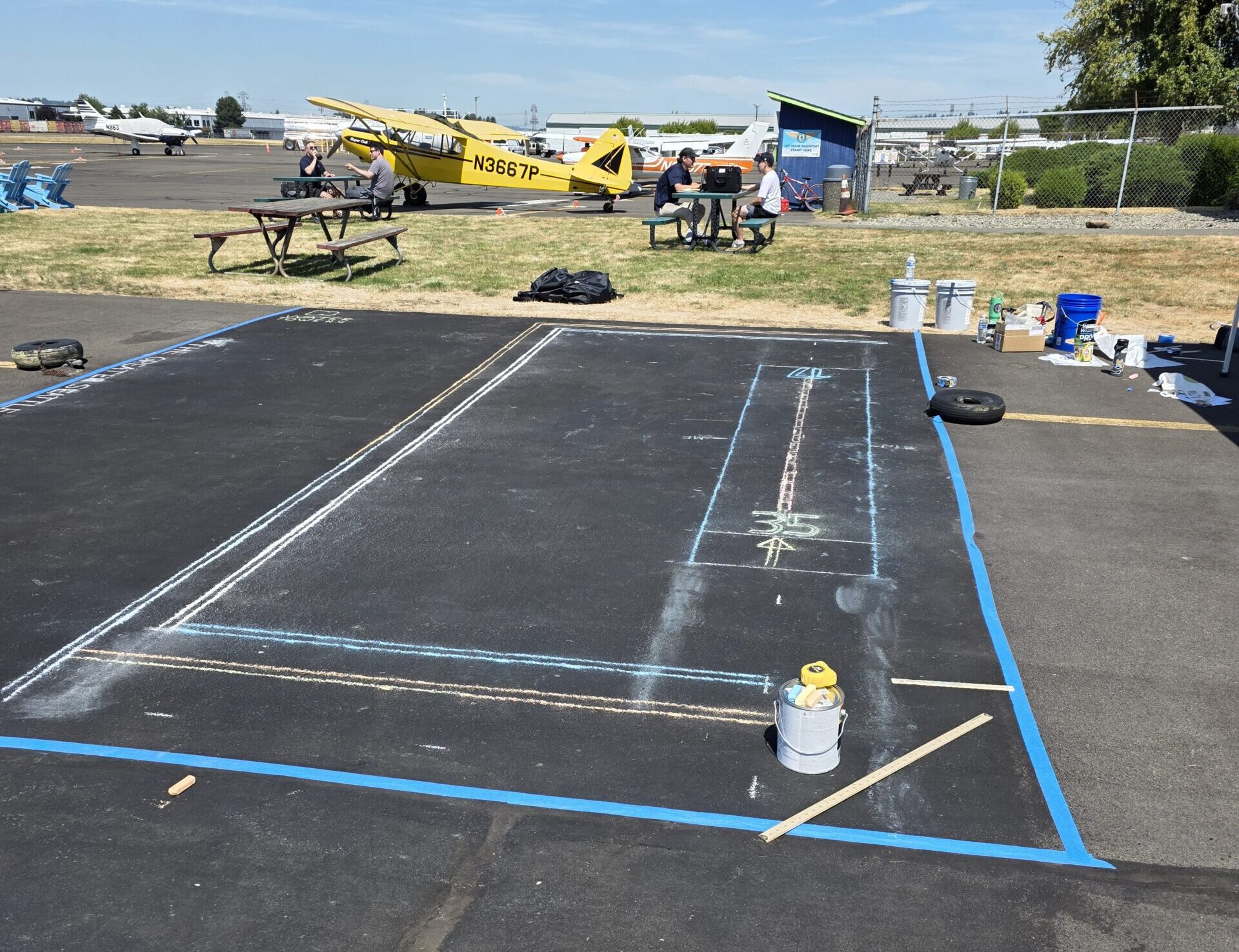
Abbie Weir, a third-generation pilot, flight instructor, and airport employee at Auburn Municipal Airport-Dick Scobee Field (S50) south of Seattle, said she literally dreamed up a way to help flight students learn the pattern at the busy nontowered airport by painting a visual tool on the pavement outside the airport administration building. The illustrated diagram is approximately 10-by-15, large enough for kinetic learners to walk the pattern as if they are the airplane.
Weir, who is a member of The Ninety-Nines: The International Organization of Women Pilots, emailed members of the Seattle chapter to see if there was interest in painting the diagram. The Ninety-Nines have been painting compass roses and other information at airports since the organization was founded in 1939.
The technical term for this process is “airmarking.” Weir heard back from Hannah McMahon, the airmarking chairman from the Seattle group. McMahon is also a flight instructor and saw the value of the diagram.

“I think it definitely would have helped me when I was a student,” said McMahon. “I’ve also had a few students with dyslexia, and I would just walk on the actual airport apron, walking out the traffic pattern. It helped, but I think this will be a lot better.”
S50 is one of the busiest nontowered facilities in the Seattle area. It is located some 8 nm southeast of the Class B airspace around Seattle-Tacoma International Airport (KSEA). If a pilot is not careful, they can drift into the Bravo, so there is an emphasis on local landmarks to prevent this.
- READ MORE: Don’t Dread the Flight Review
While the airport does have airport diagrams published on the website, some pilots benefit from a more interactive explanation.
“It is not quite a life-size version,” said Weir, “But it is a visual tool to help students learn the traffic pattern. We painted [and labeled] the landmarks that identify the 45-degree entry to the runway. So we have the cemetery for Runway 17 and the water towers for Runway 35.”
According to Weir, airport manager Tim Mesonides prepared the pavement by laying down fresh crack sealing, and the city of Auburn, the facility sponsor, paid for the supplies, which included tape, brushes, and paint. The labor was provided by 14 members of the Seattle Ninety-Nines, who cycled in and out during the day. They worked in shifts under a portable canopy, which provided protection from the summer sun.
“It’s been fun to watch my drawing come to life,” said Weir.
This was not the first time the Seattle Ninety-Nines have completed a project at the airport.
“Last year, we painted a compass rose on the corner of the airport,” said Ninety-nine Joelle Erickson. “So we’re coming back this year to do something a little bit more, and we have more and more airport managers who are calling us [for projects] in the pipeline.”

