












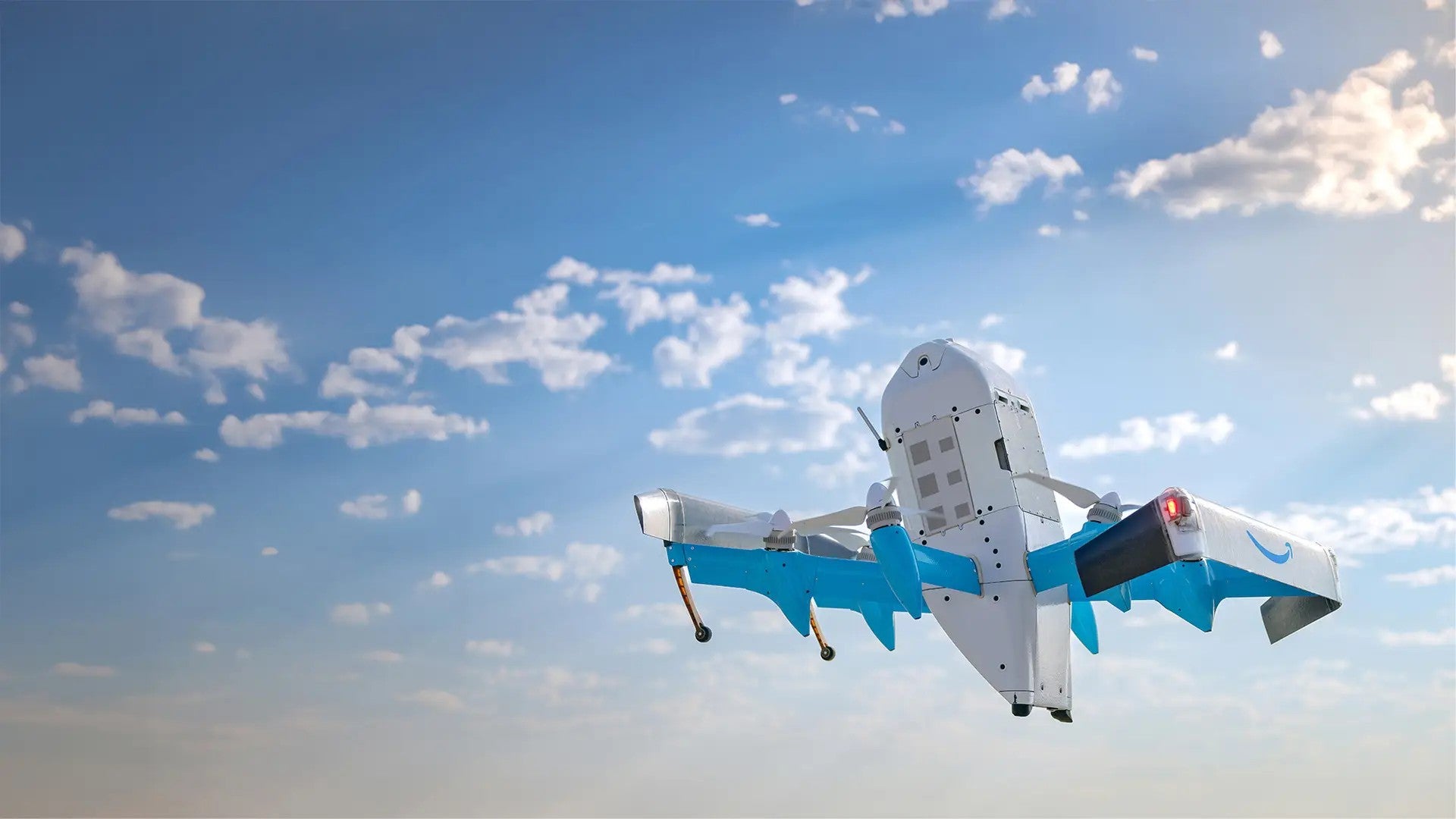


The FAA is probing an incident involving Amazon Prime Air’s MK30 delivery drone in Waco, Texas. But the National Transportation Safety Board (NTSB)—which is reviewing a pair of MK30 collisions that happened in October—will not investigate.
Per video obtained by CNBC, which was first to report the incident, the MK30 clipped an internet cable during liftoff after completing a delivery to a customer’s backyard. After impact, the drone performed what Prime Air describes as a “safe contingent landing,” and Amazon self-reported the episode. The company began commercial service in Waco earlier this month.

According to the FAA, the incident occurred around 12:45 p.m. CST on November 18. The drone’s propellers sustained some damage, but there were no reported injuries or internet service outages, Prime Air spokesperson Terrence Clark told FLYING.
“We’ve paid for the cable line’s repair for the customer and have apologized for the inconvenience this caused them,” said Clark.
Though the FAA has initiated a probe, there are certain cases where the NTSB is not required to investigate drone-related incidents. According to an agency spokesperson, the recent occurrence qualifies as a “non-action event.”
What’s a Safe Contingent Landing?
The MK30 is Prime Air’s flagship delivery drone. It began commercial operations in Tolleson, Arizona, and College Station, Texas, last November following FAA approval.
The uncrewed aerial vehicle (UAV) can carry up to 5 pounds cruising at up to 73 mph, with a service radius of about 7.5 miles and maximum altitude of 400 feet agl. It launches vertically using six propellers before transitioning to wingborne forward flight. Packages are stored within the drone’s fuselage and dropped to the ground from about 13 feet up.
The MK30 is designed to initiate a safe contingent landing when encountering unexpected weather conditions, obstacles, or air traffic—and in “rare instances” when multiple system failures occur. It switches from forward to vertical flight mode, using an onboard perception system to scan its surroundings for a clear landing spot. Amazon refines the system by simulating failures during testing, throwing it curveballs such as obstructed landing zones or fog.
After an incident, Prime Air sends a recovery team to bring the drone back to its base for inspection.
Not Amazon’s First Incident
Though this month’s incident resulted in only minor damage, Prime Air faced scrutiny in October after a pair of its drones collided with a crane boom.
According to the NTSB’s preliminary reports, a construction worker in Tolleson felt something impact the crane they were operating, discovering it to be an MK30. As the operator was investigating, a second MK30 struck the crane. Both drones suffered substantial damage and battery fires, and Prime Air briefly paused the Arizona service.
Per an NTSB review of flight track data, the first drone’s last broadcast altitude was about 200 feet agl—the flight’s planned altitude. The second drone descended from about 200 feet to 60 feet before losing contact, though it is unclear whether that was prior to impact. Per the crane manufacturer, the machine’s boom extends about 300 feet high, but the operator estimated the collisions occurred at about 150 to 165 feet.
As the FAA works to expand commercial drone operations, the Aircraft Owners and Pilots Association (AOPA) cited the October crashes as a reason to pump the brakes.
“The fact that two drones crashed within minutes of each other, into the same obstacle, would seem to indicate that a systemic problem exists that must be examined and addressed,” AOPA wrote in response to the FAA’s proposed Part 108.
Prime Air also suffered failures during testing in 2024 prior to voluntarily pausing its commercial service in January.
In December, two MK30s crashed due to incorrect altitude indications as the company was testing a software upgrade at its range in Pendleton, Oregon. Bloomberg reported that rain interfered with the drones’ sensors, but per the NTSB’s final report, there was no rain in the area that day.
In September, a pair of drones collided during engine out testing at Pendleton. Following the company’s voluntary pause, the NTSB investigated another Pendleton collision in February.
Prime Air said the hiatus was intended to address concerns that dust was interfering with the drones’ altitude sensors—a problem it discovered after flying in Arizona’s desert environment. It resumed commercial operations in April.
Prime Air’s Outlook
Prime Air will look to avoid further hiccups during a critical juncture for the drone delivery operator.
In August, the company ceased operations in College Station—its longest-running market—despite attempts to expand there as recently as mid-2024. It faced pushback from residents, who variously described the MK30 as “noisy,” “annoying,” “incessant,” and an “invasion of our personal space,” comparing them to chain saws, leaf blowers, and even a “giant hive of bees.”
College Station Mayor John Nichols urged the FAA to reject Prime Air’s proposed expansion, which would have more than doubled the size and frequency of its operations.
Now, the company is flying elsewhere in Texas and expanding to other states. In addition to Waco, San Antonio, and the Detroit suburb of Pontiac, Michigan—where it also launched this month—Prime Air is preparing for service near Kansas City, Missouri. It is also looking at Houston, Austin, and El Paso in Texas, per a recent amendment to its operational specifications.
In August, a spokesperson told FLYING that more locations would soon be announced.
Expanding Prime Air will be pivotal to Amazon’s quest to achieve 500 million annual drone package deliveries by 2030. The company is competing with Walmart and its drone delivery partners, Zipline and Wing, which combined have completed more than 2 million deliveries worldwide.
Prime Air drones surpassed 100 deliveries in 2023, and it has not provided an update since.

