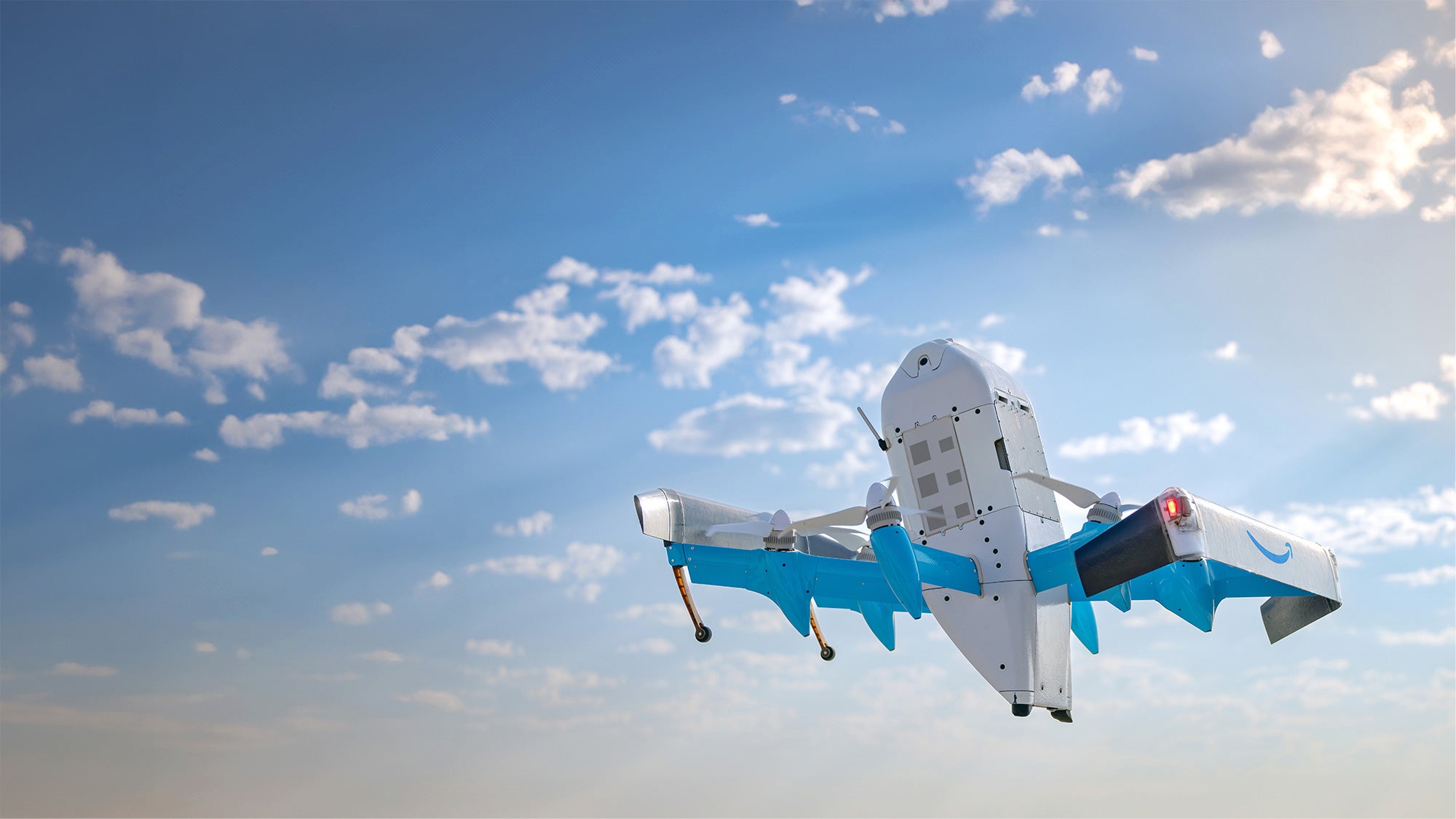
Amazon Prime Air is moving on from its longest-running drone delivery service as it eyes new opportunities for expansion.
First reported by local news station KBTX-TV and confirmed by an Amazon spokesperson to FLYING, the logistics titan on Sunday will make its final delivery in College Station, Texas, where it has operated since late 2022.
Customers ordered thousands of packages during the service’s three-year run. But Prime Air is looking to expand elsewhere in Texas, Missouri, and Michigan. According to a recently published FAA document, for example, it has proposed to complete 1,000 daily flights out of 22 hubs across the Dallas-Fort Worth, Austin, Houston, and San Antonio areas.
“We were happy to have Amazon and its drone service in our community,” College Station Mayor John Nichols said in a statement shared with FLYING. “It was a valuable learning experience for them and for the City. While we worked with them to find other business locations in College Station, they have chosen to move on to the next phase of developing their drone delivery service, and we wish them well.”
Nichols’ tone contrasts with that of a letter he sent the FAA in July on behalf of College Station residents. The letter urged the regulator to reject a proposed expansion that would more than double the size and frequency of Prime Air deliveries, permitting more than 450 operations per day within an area of 174 square miles. It followed a city council meeting in June during which residents voiced concerns about noise.
Per Wired Magazine, the FAA received about 150 negative comments on the draft environmental assessment (EA) for Prime Air’s expansion—far more than it has received for similar drone projects. College Station residents have described the uncrewed aircraft as “noisy,” “annoying,” “incessant,” and an “invasion of our personal space,” comparing them to chain saws, leaf blowers, and even a “giant hive of bees.”
Ultimately, though, the FAA in September found no increased environmental risk from the proposal.
Still, College Station homeowners at the end of July met with Prime Air, which agreed to reduce the number of drone flights and said it would look for a new operational hub. The company declined to renew its current facility’s lease, which expires at the end of September.
Drone Delivery Expansion
Now, Prime Air is saying goodbye to College Station, one of two locations that served as an early testbed for its MK27-2 model. The other in Lockeford, California, shuttered in 2024 after less than two years.
In November, the company introduced its MK30 drone in College Station, which appears to have addressed residents’ concerns. The model is estimated to be about 40 percent quieter, with a longer service range of about 7.5 sm and the ability to fly in light rain. A Prime Air spokesperson told Wired that the company has not received any complaints since the MK30 took flight.
The MK30 debuted in Tolleson, Arizona, a suburb of Phoenix, in November. A few months later, specks of dust interfering with the drone’s sensors forced Prime Air to make a voluntary two-month pause in service. However, those challenges could help the company avoid hiccups as it looks to expand.
In June, for example, the San Antonio city council approved Amazon’s use of a warehouse for drone delivery services. Tolleson is the first location where the company has deployed drones from same-day delivery centers, rather than standalone facilities.
The following month, Prime Air demonstrated the MK30 for residents of Pontiac, Michigan. And in August, it unveiled the drone at community events in Waco, Texas, and Kansas City, Missouri.
“We’ve done multiple studies with noise at our Phoenix site, and I’m not concerned with that personally,” Christina Carter, Amazon drone operations manager for Texas, told Waco Public Radio earlier this month.
The spokesperson said the firm is also eyeing the Dallas-Fort Worth area, where competitors such as Wing and Flytrex are operating under relaxed restrictions. It intends to reveal when those operations will begin, as well as further expansion plans, in the near future.
Amazon’s struggles have allowed competitors to corner portions of the market. Wing, for example, is the dominant drone provider in Dallas-Fort Worth and has completed close to half a million commercial deliveries. The Texas metropolis is the only place in the U.S. where commercial drones are allowed to share airspace. But that could change with the introduction of drone-tailored traffic management systems, such as those being tested by Wing and Flytrex.
Prime Air also stands to benefit from the FAA’s proposed Part 108 rule, released in July. The long-awaited regulation would create a far simpler path to beyond visual line of sight (BVLOS) operations, allowing drones to fly farther and reach more customers. The company secured a temporary BVLOS waiver for Tolleson and College Station. But without Part 108, it will need to rehash that process for each new service location.
Adding to the momentum are a pair of White House executive orders that direct regulators to loosen operational drone limitations, heighten counter-drone capabilities, and grant manufacturing and export privileges for domestic manufacturers, among other provisions. Those developments could help Prime Air catch up to the pack.
Like this story? We think you’ll also like the Future of FLYING newsletter sent every Thursday afternoon. Sign up now.