














NASA’s Quiet Supersonic X-59 Begins Taxi Tests Ahead of First Flight

Agency’s final stage of ground testing will culminate in the experimental model’s inaugural flight, targeted for later this year.

NASA Lockheed Martin X-59 experimental quiet supersonic aircraft
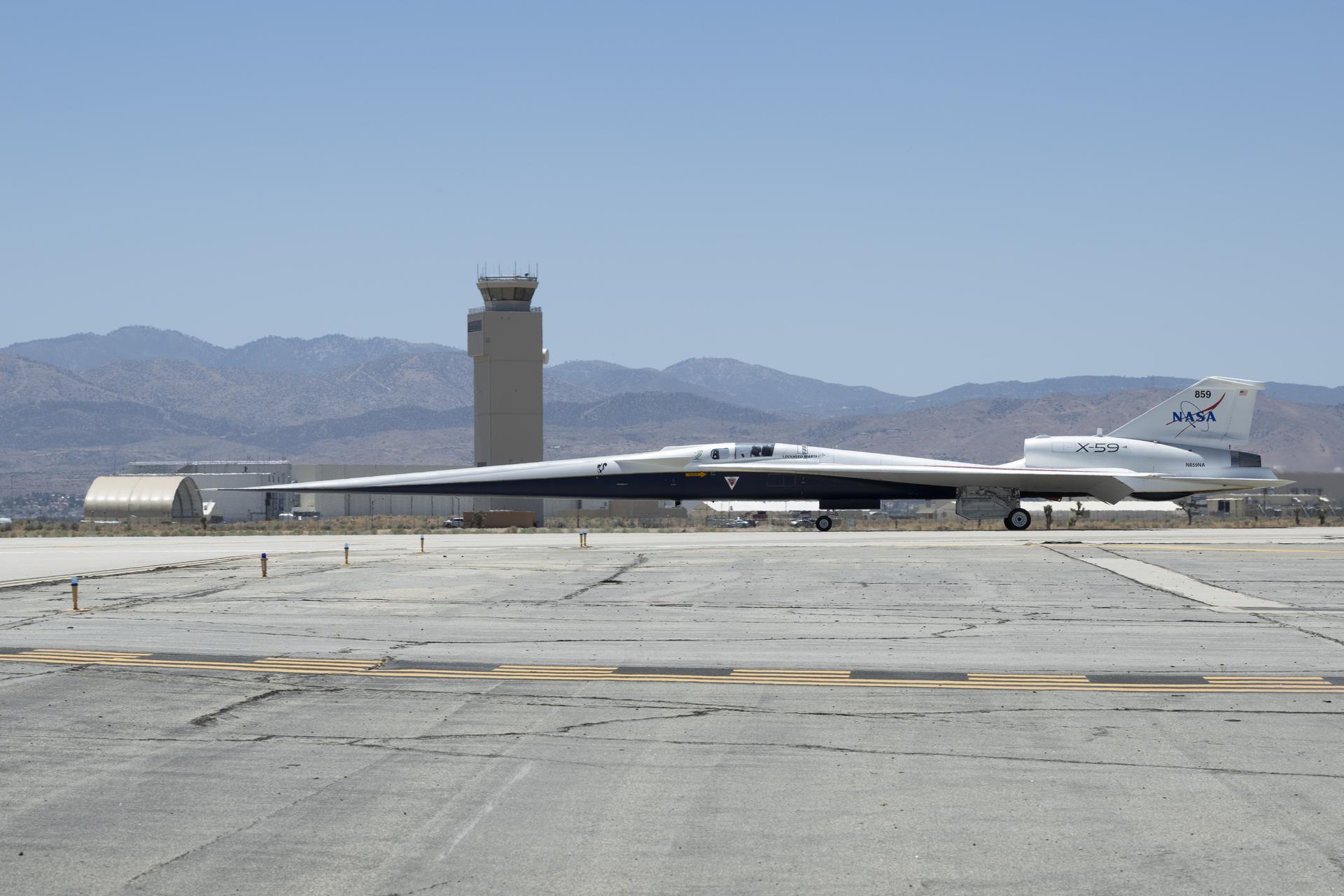
The experimental X-59 features a thin nose that spans about one-third of its nearly 100-foot length, designed to break up shock waves. [Courtesy: NASA/Carla Thomas]
Gemini Sparkle

Key Takeaways:

  • NASA's X-59 quiet supersonic aircraft has begun low-speed taxi tests, a critical final step before its anticipated first flight later this year.
  • The primary goal of the X-59 project (Quesst mission) is to develop technology that reduces sonic booms to a "gentle thump," aiming to overturn the 1973 ban on supersonic commercial flights over land.
  • Its unique design, featuring a long, tapered nose and an innovative cockpit with an external vision system, is engineered to disperse shockwaves and significantly mitigate noise.
See a mistake? Contact us.

For the first time, NASA’s quiet supersonic X-59 is moving under its own power.

The experimental aircraft has begun a series of low-speed taxi tests at contractor Lockheed Martin’s Skunk Works facility in Palmdale, California, the space agency said Thursday. First flight was initially scheduled for 2023 before being pushed to 2024 and now later this year. But taxi tests are the final step before it is cleared for takeoff.


Initial taxi testing took place in Palmdale on July 10, guided by NASA test pilot Nils Larson and the project team, comprising personnel from NASA and Lockheed Martin. Engineers and flight crews monitored the aircraft’s handling and are working to validate its steering, braking, and other critical systems. In the weeks ahead, personnel will steadily increase the aircraft’s ground speed, culminating in a high-speed test that will come just short of takeoff velocity.

Following a series of envelope expansion flight tests, NASA will officially take delivery of the X-59 and fly it within a supersonic test range at Armstrong Flight Research Center and Edwards Air Force Base (KEWR) in California to validate it. After that, pilots will fly it over communities to collect feedback from people below the flight path.

The goal of the project is to create acceptable noise thresholds for supersonic commercial flight over land, which the FAA has barred since 1973 due to noise concerns. The X-59 is the centerpiece of NASA’s Quesst (Quiet SuperSonic Technology) mission and is designed to reduce the volume of sonic booms to a “gentle thump, similar to a car door shutting in the distance,” per Lockheed Martin.

The X-59 Advantage

Skunk Works, Lockheed’s secretive advanced technology unit, earned a preliminary X-59 design contract in 2016 and has spent close to a decade refining the concept, which was formally unveiled in January 2024.

The experimental model has a projected speed of 925 mph, or about 1.4 times the speed of sound. Achieving that level of performance requires some unique design choices.

The X-59’s thin, tapered nose, for example, comprises about one-third of its nearly 100-foot length. This disperses shockwaves, preventing them from merging and creating a sonic boom.

The cockpit is located about halfway down the aircraft’s length and has no forward-facing window—another choice intended to reduce noise. An external vision system feeds imagery from high-resolution cameras to a cockpit monitor to compensate for that limitation.

A modified F414-GE-100 engine, meanwhile, sits atop the airframe, which is composed primarily of aluminum. Its white paint scheme, with red wing accents and NASA “sonic blue” underside, is designed to protect against moisture and corrosion.

The model incorporates flight-proven hardware, too—an F-15 Eagle life support system and F-16 Fighting Falcon landing gear, for example.

So far, NASA and Lockheed have completed engine runs and simulated flights on the ground. With the start of taxi tests, the X-59 moves closer to flight as pressure for change mounts.

Supersonic nonmilitary flights over land have been disallowed for more than 50 years. But a group of congressional lawmakers in May proposed a reversal of the ban. In June, President Donald Trump signed an executive order directing the FAA to lift it.

Supporters of more lenient regulations say U.S. companies have already developed the capability to mitigate sonic booms. Boom Supersonic, for instance, this year completed a series of demonstrator flights during which sonic booms were not recorded by microphones on the ground. The company leverages a physics concept called Mach cutoff—the idea is that when flying at high altitude and precise speed, the sound waves generated by an aircraft refract within the atmosphere.

Boom plans to incorporate that “boomless cruise” capability on Overture, its supersonic commercial airliner concept. Founder and CEO Blake Scholl is among the most vocal advocates for changes to the existing supersonic framework.

“Basically, it says ‘thou shalt not exceed Mach one,’” Scholl told FLYING in February. “And what it should say is, ‘thou shalt not make loud noises.’”

Like this story? We think you’ll also like the Future of FLYING newsletter sent every Thursday afternoon. Sign up now.

Jack Daleo

Jack is a staff writer covering advanced air mobility, including everything from drones to unmanned aircraft systems to space travel—and a whole lot more. He spent close to two years reporting on drone delivery for FreightWaves, covering the biggest news and developments in the space and connecting with industry executives and experts. Jack is also a basketball aficionado, a frequent traveler and a lover of all things logistics.

Ready to Sell Your Aircraft?

List your airplane on AircraftForSale.com and reach qualified buyers.

List Your Aircraft
AircraftForSale Logo | FLYING Logo
Pilot in aircraft
Sign-up for newsletters & special offers!

Get the latest stories & special offers delivered directly to your inbox.

SUBSCRIBE
