This Company Is Taking the ‘Boom’ Out of Supersonic Flight
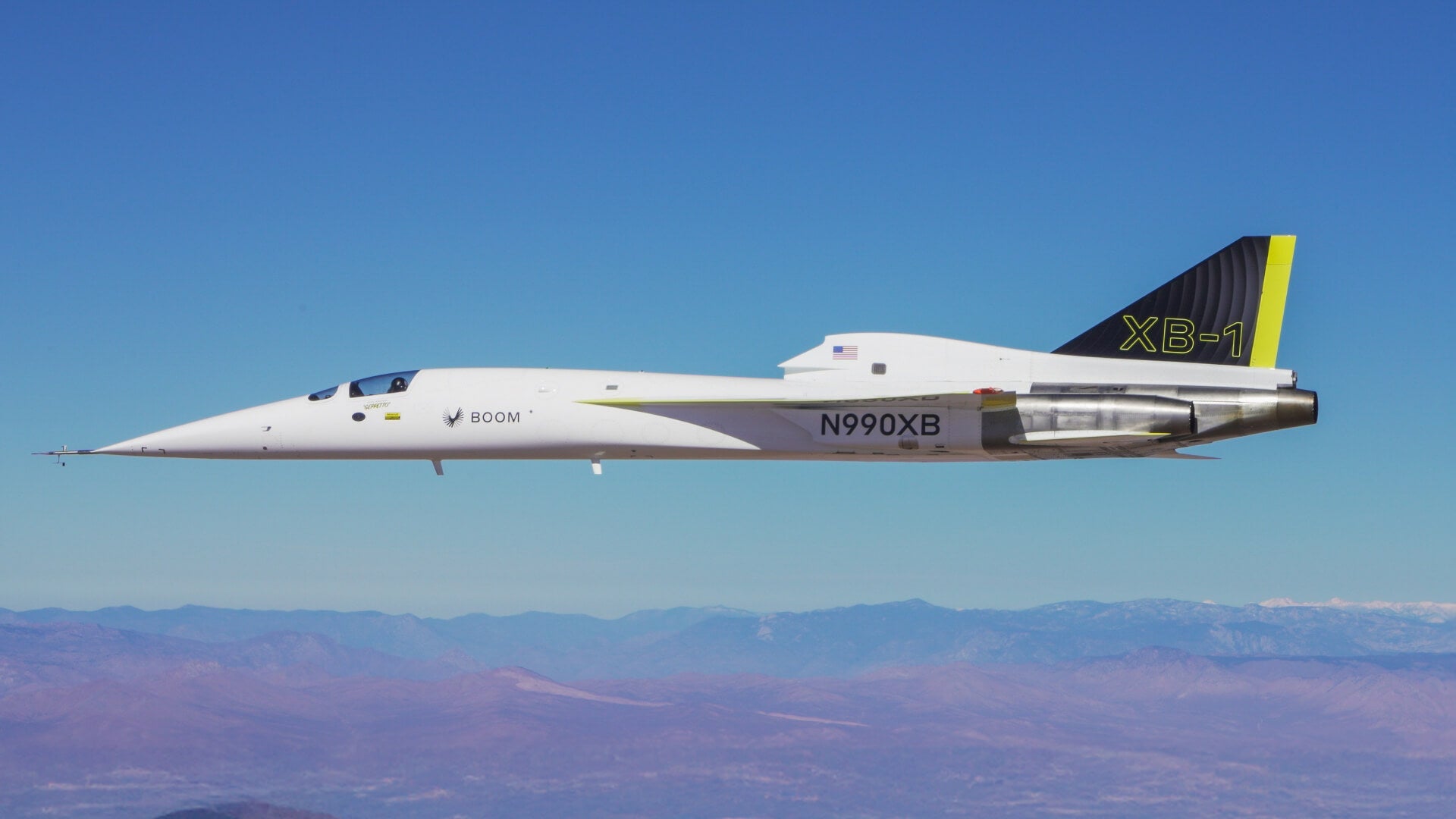
Boom Supersonic’s XB-1 demonstrator creates a sonic boom not audible from the ground below, potentially opening up opportunities for supersonic flight over land.
Boom’s XB-1 ‘Baby Boom’ demonstrator achieves supersonic flight with no audible sonic boom on the ground. [Courtesy: Boom Supersonic]
Key Takeaways:
Boom Supersonic's XB-1 demonstrator successfully achieved "Boomless Cruise," flying supersonically without an audible sonic boom reaching the ground, utilizing a physics concept called Mach cutoff.
This breakthrough technology is intended for Boom's Overture commercial airliner, which aims to provide faster supersonic travel (up to Mach 1.3 over land) without noise pollution.
Boom is actively campaigning to change current FAA regulations that prohibit all supersonic flight over land, regardless of audibility, to enable domestic supersonic commercial routes.
The effort to update these "outdated" regulations has received public support from figures like SpaceX CEO Elon Musk.
Last month in the skies above Mojave Air & Space Port in California—the same hallowed airspace where U.S. Air Force ace Chuck Yeager first eclipsed the sound barrier in a Bell X-1 in 1947—Boom Supersonic’s XB-1 or “Baby Boom” became the first independently built jet to hit supersonic speeds.
But you wouldn’t be able to tell from below.
CREATE A FREE ACCOUNT
Sign up to keep reading
Create a free account to continue. Already a member? Sign in below.
Jack is a staff writer covering advanced air mobility, including everything from drones to unmanned aircraft systems to space travel—and a whole lot more. He spent close to two years reporting on drone delivery for FreightWaves, covering the biggest news and developments in the space and connecting with industry executives and experts. Jack is also a basketball aficionado, a frequent traveler and a lover of all things logistics.