Register

Technique

Better Checklist Rituals

Id heard Stevie Ray recite The heat, the light, the auto-ignite during the last two takeoff rolls in the Citation before finally asking him what he was mumbling. Steve was known for cutting sarcasm and a lightning-fast wit; I hesitated to inquire but sensed a piloting technique was in there somewhere. Steve was surprisingly honest: I dont want to miss the pitot heat, the strobes, or the ignition switches when we get our clearance to roll, thats all. But Steve, I asked, we did the checklist and besides, there are no igniters on this bird, right? Maybe not, but our Gulfstream has em and Im not changing my habits. Stunned, all I could do was thoughtfully nod.Back then I would have dismissed Steves practice as feeble, but experience has brought an understanding that we pilots are the weakest link on the airplane-it only takes one bad day to prove it. Good day or bad, there are a number of steps that must be accomplished and it may come down to ritual or habit to see that the job gets done.
Read More »

No U-turns Allowed

One of the things I enjoy about doing instrument instruction in the radar shadow of mountains is that students have to fly the occasional procedure turn. Radar vectors make this skill practically arcane for pilots over much of the U.S., so to actually see it needed in practice is eye-opening.But its not just over the bumpy land where you might need or want a PT, and thats what makes the ILS or LOC Rwy 18 at La Crosse, Wisc., interesting. An IFR reader sent a query our way as to how someone arriving from the south would get turned around on this approach without vectors. There is no PT charted.

Read More »

Memorize the Checklist Boldface

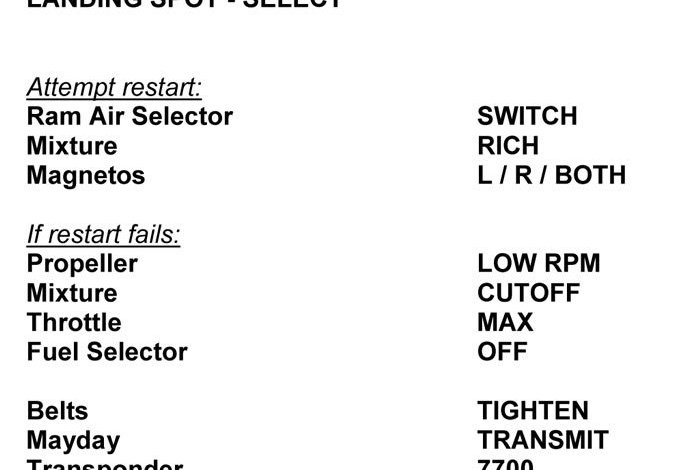
Any talk of checklist types isnt complete without the concept of checklist boldface. So named due to its all-caps and emboldened print, these memory items ensure an initial response to an emergency when a written checklist wont be referenced until after the initial bold items are accomplished and the situation is stabilized. For example, only the first four items on this Quick Ref are memory.

Read More »

Wake Turbulence In IMC

From my base in Santa Barbara, Calif., I often fly north to San Jose (KSJC). At San Jose, GA aircraft operate from Runway 29, parallel and to the west of the two main runways, 30L and 30R for jets. All the runways have straight-out IFR missed-approach procedures.One night, while I was waiting for release on 29, Southwest 376 (a 737) reported on final and asked, How close is 376 to the killer bee ahead? He was referring to a 757 and its reputation for leaving a brutal wake.

Read More »

How to fly an ILS without an ILS

If youve ever seen the dramatic final scene of Strategic Air Command with Jimmy Stewart, youve seen a Precision Approach Radar, or PAR, approach. A PAR begins with vector- to-course, much like an ILS, but also adding trend info to help the pilot build situational awareness.

Read More »

Wind on the ILS

Youre descending on the glideslope for the ILS 29 with a 25-knot tailwind. Winds at the surface are eight knots from the southwest. Quick: What two corrective actions will you need to make over the next three minutes? With enough experience youll get it right, but ask yourself: Is this brand of analysis second nature to you? Sure, you can just follow the needles and correct, but thats accepting being behind the curve rather than mastering it. An understanding of the variables affecting an approach path give you the capacity for proactive, rather than reactive, piloting.

Read More »

Readback: May 2010

On page 14 of the February issue (Glass Panel Scans), you state that a case can be made for flying track instead of a heading assigned by ATC. This I have to hear. When a controller assigns me a heading, that is what he wants me to do, and doing something else would seem to constitute failure to follow an ATC instruction. Your thoughts?

Read More »

Readback: April 2015

I see a lot of confusion between the terms VFR and VMC (as well as IFR and IMC). VMC and VFR are often used interchangeably, in fact.To me, VFR and VMC are in fact not the same because VFR refers to a set of rules that govern flight (visual flight rules), which includes airspace and so on. There are certain weather minimums to operate VFR. However, VMC can be interpreted as conditions that allow you to keep the plane upright by looking outside. You can be VMC but in VFR weather by simply being 1500 feet away from a cloud.However, while I could find VFR and IFR defined in FAR/AIM, I couldnt find anything for VMC. Are you aware of any FAA guidance on this?

Read More »

IFR Gone Good

I recently had a beautiful IMC flight on which I relearned how wonderful our capability to operate in the IMC world is. Its easy to lose that awe for the beauty of our environment and the utility of the machines at our disposal as we move safely through this environment. Such is the stuff of poets. So this is not a story of drama over bad weather, near misses or close calls. Its a story of the unique advantage and perspective that the few humans who call themselves pilot have been able to experience and enjoy.

Read More »

Silent Running

Part of training in the air traffic control profession is learning to recognize patterns in the flow of aircraft. Knowing what to expect from our traffic makes it all the more obvious when something doesnt look or feel right. Its not a spidey-sense or anything, but it can help us recognize developing situations more quickly.

Read More »
Pilot in aircraft
Sign-up for newsletters & special offers!

Get the latest stories & special offers delivered directly to your inbox.

SUBSCRIBE