Register

Technique

Whats up With the Clock?

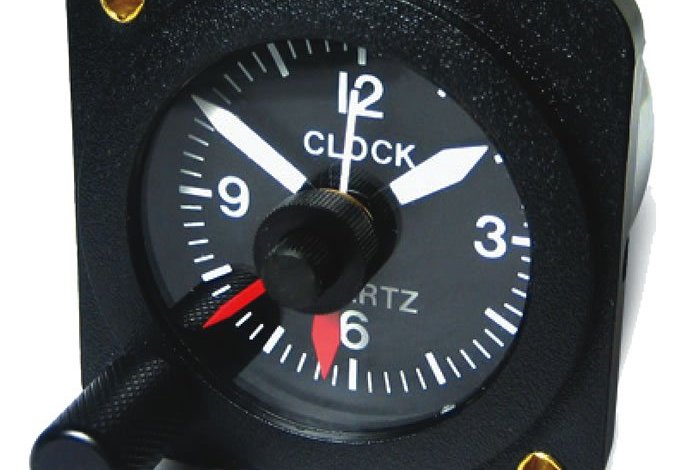
Most legacy aircraft came out of the factory with little round clocks in the panel, although these days theyre largely ignored in favor of the more convenient digital timers. Recall that a way of keeping time is listed among the required equipment for IFR operations-see 14 CFR 91.205(d). Technically, the clock displaying hours, minutes, and seconds with a sweep-second pointer or digital presentation is supposed to be certified, installed equipment, meaning it has to be the original clock or an approved replacement, and it has to be operational for legal IFR flight.

Read More »

Readback: May 2015

Rick Durdens December 2014 complex article about tailplane icing was well researched and well written. It also proved prophetic.At Cincinnati Municipal while my L-39 was being fueled, Bill Rieke, an icing researcher, came over to chat. He said that he thought the L-39 would be particularly susceptible to tailplane icing and stall because of the smallness of tailplane, the thinness of the airfoil and the need for ventral VGs.

Read More »

The Contact Approach

There are three ways to arrive at an airport when operating under IFR: a standard instrument approach procedure (IAP), a visual approach and a contact approach. A great way to bring hangar flying to a screeching halt is to ask about a contact approach. A lot of IFR pilots know that it is some sort of visually-flown maneuver, but when asked how it differs from a visual approach, blank stares often ensue. Lets fix that.

Read More »

Not So Fast

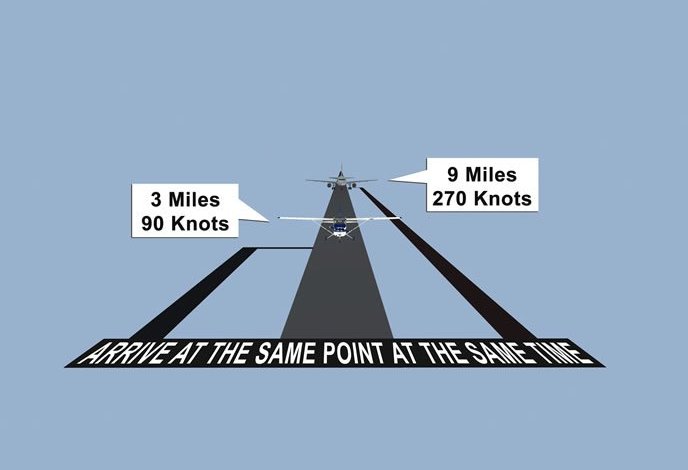
Its a signature moment in the classic 80s beach-volleyball documentary Top Gun. Two Naval aviators swagger past a parked line of Grumman F-14 Tomcats. I feel the need, Tom Cruises Maverick character declares to his buddy Goose, who joins in the chorus. The need… for speed! Mav and Goose were bragging about the sound-barrier-busting velocity only a few pilots get to experience. Still, whether your winged rides top speed is Mach two or 100 knots, there is one universal truth: if youre firing up an airplane, youve probably got somewhere to go or a mission to accomplish.

Read More »

Readback: June 2010

Regarding the ATC column Say More For Less in your March issue, I really enjoy reading articles like this. I take ATC very seriously and Im always interested to know exactly what they are expecting from me. I strive to be as professional as possible in the air, even though I fly just for fun. However, Im not perfect, and I can certainly be accused of wasting a lot of airtime over the years with something I cant seem to stop saying to each controller, Thanks.

Read More »

Too High on a Missed

Heres one of those questions that has a simple answer masking hidden subtleties: Youre on the approach to Orlando Executive with the family for a couple well-earned days in The Land of the Mouse. You loved the idea of flying in to Executive rather than putting the family in seats 27 A through D into nearby Orlando International.But now the reality of getting established on a back-course localizer in bumpy clouds has you behind the curve and working hard to meet the mandatory altitudes on the stepdowns. You barely made the restriction to cross MARYB at 1500 and now are at 1100 heading for BRICE, struggling with reverse sensing and losing. You decide its best to go missed now and start again. But, how to do it?

Read More »

Will 20 Degrees Right be Enough?

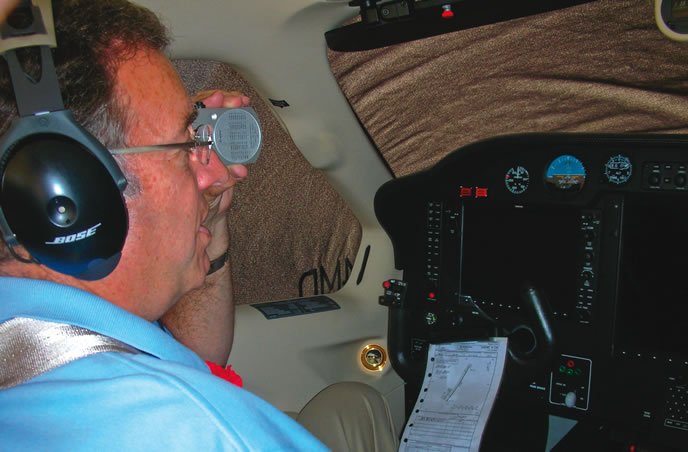
Picture yourself in the cockpit counting on your eyeballs to keep you clear of thunderstorms. Theres a buildup ahead and youve got to ask for a diversion. But how many degrees? You dont have a pretty cockpit display with the weather today, so youll be estimating.You can get a good estimate just using your binocular vision. Hold a raised finger at arms length and sight across that finger first with only one eye and then the other eye. Your finger displaces about 10 degrees. So if you put your raised finger between you and the storm with your right eye only and then look with only your left eye, the new position of your finger shows where a 10-degree turn to the right would take the airplane. In this way, you can measure 10-degree chucks of heading change against the view outside-and then confidently ask ATC for 30 right.

Read More »

Flying by Vertical Angles

Aircraft performance parameters are typically expressed as measurements of speed (indicated and true), altitude and vertical speed. Often overlooked is angle as an expression of performance. Angles are a terrific tool for estimating glide and approach performance, avoiding clouds and storms and avoiding obstacles and terrain on takeoff. There are two related subjects: how to measure angles while in flight, and how measured angles can solve in-flight problems. Lets start with measurement.

Read More »

Declaring the Big E

If there was ever a 400-pound gorilla that dared pilots to ignore their checklists, procedures and situational awareness, its the emergency. Pilots often practice What if … but when it really happens its more like What the hell? If there was ever a time to lean on ATC, this is it. There are no limits to the types of emergency scenarios and, therefore, no single response from ATC. The ATC rulebook (FAA Order 7110.65) recognizes this in paragraph 10-1-1 (d): Because of the infinite variety of possible emergency situations, specific procedures cannot be prescribed. However, when you believe an emergency exists or is imminent, select and pursue a course of action that appears to be most appropriate under the circumstances. We controllers have extensive information, resources and people at our disposal, but were out of the picture unless you tell us whats going on and ask for what you need.

Read More »

Catch Mistakes With these Crutches

Mnemonics like these are just a form of checklist or, sometimes, short-step do list. The preflight crutch below might be what you recite to yourself just before you grab your bags and walk out to the airplane:

Read More »
Pilot in aircraft
Sign-up for newsletters & special offers!

Get the latest stories & special offers delivered directly to your inbox.

SUBSCRIBE