Register

Technique

No More Medicals?

The FAA has released the medical requirements for the Pilots Bill of Rights 2 (PBOR2) and quite frankly, I think it is a home run for general aviation, pilots, and the AOPA who fostered it through Congress. The new program is called BasicMed that is technically the FAAs implementation of medical requirements in the PBOR2 portion of the FAA Extension, Safety, and Security Act of 2016 known (of course) as FESSA. The final rule from the FAA, released January 10, 2017, and effective May 1, 2017, can be found on the FAA web site, FAA.gov.
Read More »

New Sim Challenge

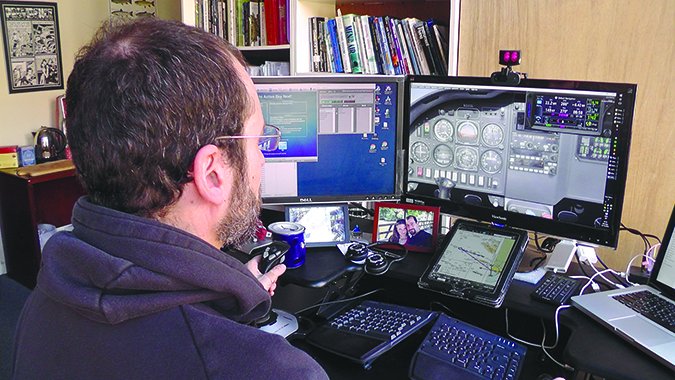
A few months back, Jeff Van West-previous editor of IFR and respected aviation journalist who still hangs around here, you know, kinda like the brother-in-law who needs to get a real job-and I were brainstorming about using a simulator to maintain instrument proficiency. We continue to stress this topic because its an important tool in proficiency. But, as more and more of you are flying simulators-either your own commercial or home-built sims, or one at your FBO or flight school-one common theme is that many of us arent sure what to do once were in the box.

Read More »

Readback: February 2017

Not sure if this is a question or a frustration, but after reading the August 2016 quiz about PIREPs, it made me wonder why there are so few PIREPs in the system. It appears that most reports of icing, tops, and bases that are given to ATC never make it into the PIREP system. Most of us frequently report these conditions when departing or arriving, however I seldom take the time to change frequency and submit an official PIREP. Is there a process or key phrase that we can say to ATC to ask them to submit the PIREP on our behalf. Seems like if a pilot reports icing in climb or in descent to departure or approach, ATC should submit that report as a PIREP.

Read More »

Best Glide Speeds

Perhaps we should cut right to the life-saving takeaway: If youre engine-out in a typical single and gliding into a headwind of 15 knots or more, pitching down to at least 10 knots over published best glide speed will probably extend your glide range. This is true down to short final. Holding best glide into a headwind on short final and see you clearly wont make it? Pitch down and see if that improves things. Just remember to slow back to your normal procedures for the actual landing, using or shedding those extra knots as necessary.

Read More »

New Jeppesen SIDS and STARS

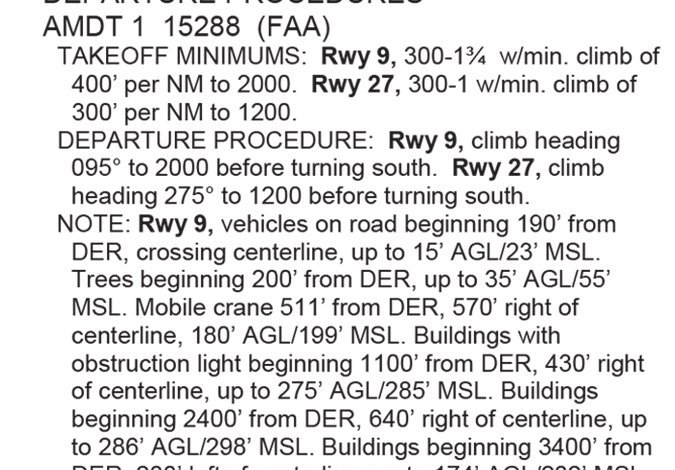
Airspace redesign, increased use of RNAV and optimum climb/descent profiles complicate and clutter STARs and SIDs. Procedure complexity previously stemmed from complicated lateral paths. Course changes and cross-radials required frequencies to be tuned and OBS knobs spun like the man behind the curtain. (Im supposed to identify each of these stations too?) The HAARP arrival into LaGuardia is an example: tracking outbound on Kingston R-203, the number two radio is set on Deer Park R-338, then number one on the Pawling R-211 or Huguenot R-107 to identify BASYE intersection.

Read More »

The IFR Simulation Challenge

A friend of mine used to work in customer support for a simulator manufacturer. He told me the most common customer support question was: OK, Im sitting at the end of the runway. Now what? Imagine a pilot in the real world pondering an equivalent question. There you are sitting at the end of the runway, engine running, and thinking, Hmm. What should I do with this airplane? Yet thats the abyss many folks face-and turn their backs on-when trying to use a simulator for proficiency.

Read More »

DIY SOP Considerations

Good single-pilot resource management calls for three basic elements: Knowledge of ones aircraft systems and characteristics, proficiency in their use under various conditions, and well-crafted, consistent routines. Those well-crafted, consistent routines-standard operating procedures, SOPs-encompass flows, checklists and callouts, but go well beyond the basics. Weve started down the path toward personal SOPs in Using an SOP in GA in the September 2016 issue.

Read More »

The Spartan Approach

Youre eager for your day trip to meet the gang and head to East Lansing, Michigan for a Spartans football game-provided you can get yourself to Tecumseh, southeast of Michigan State University. No big deal; its less than two hours flight from your home base and youre in your trusty Cessna 182. So far so good, until you actually see whats in store for you.

Read More »

Forecast Accuracy

Walk into any flight operation and theyll tell you that safety is the top priority. As of 2016, accident rates across the board from GA to commercial operations have fallen to an all-time low. This is thanks to the cooperative efforts of pilots, controllers, technicians, instructors, and the organizations that support them. Given the great improvements in safety and the stringent standards that apply to everything from replacement of a torque link bolt to the handoff of an aircraft by ATC, it might seem strange that were approaching the year 2020 and busted TAFs (Terminal Aerodrome Forecasts) are still a fact of life.

Read More »

Reader Feedback: January 2017

This gets into how these various Advisory Circulars are updated. Once an AC is issued, its assigned a number and a version letter, such as AC 00-45G, Aviation Weather Services. That version can be revised by issuing changes. So, the full specification of the most recent document is AC 00-45G, Change 2. The main document-original version-is what is returned by the various searches; youve got to dig just a bit further to find the changed versions.

Read More »
Pilot in aircraft
Sign-up for newsletters & special offers!

Get the latest stories & special offers delivered directly to your inbox.

SUBSCRIBE