Chart Wise: Training and Technique

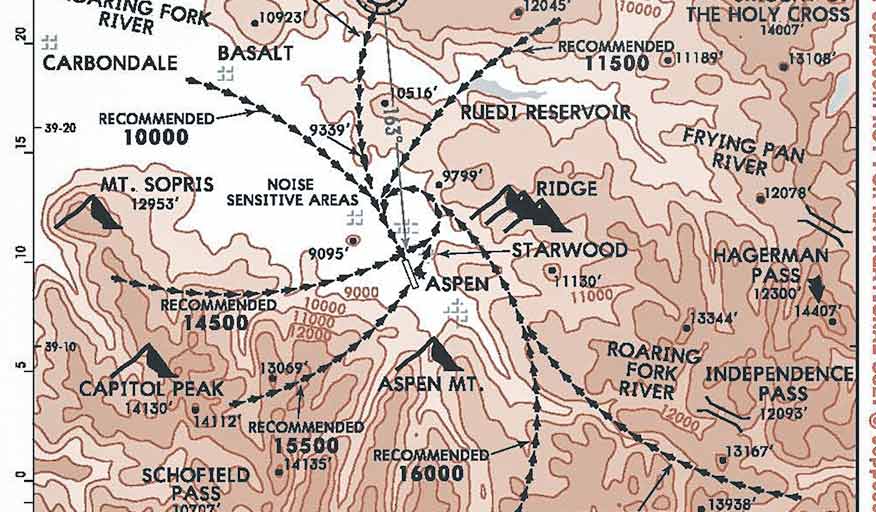
This month’s approach is the Aspen’s Roaring Fork visual. Jeppesen
Gemini Sparkle

Key Takeaways:

  • The Roaring Fork visual approach at Aspen transfers navigation and terrain clearance responsibility to the pilot, uniquely providing terrain and obstacle clearance if recommended altitudes are adhered to.
  • This visual approach has strict operational requirements, including local weather minimums of 6,000 ft ceiling and 10 miles visibility, mandatory active radar assistance, and is not authorized after dark.
  • It lacks traditional initial and final approach fixes, requiring radar control to establish the approach start point, and offers no official vertical guidance until a visual lock on the Runway 15 PAPI can be established.
See a mistake? Contact us.

Visual approaches offer pilots an opportunity to remain within the IFR system but fly direct to the airport on their own. Once ATC issues a visual approach, however, responsibility for navigation and terrain clearance is transferred from the ground to the cockpit. Avionics manufacturers recently began adding visual-­approach capabilities to their navigation suites to create an extended runway centerline and an imaginary final approach fix. Unfortunately, computer-drawn visuals do not provide terrain or obstacle clearance. This month’s approach, Aspen’s Roaring Fork visual, does provide terrain and obstacle clearance, assuming, of course, the pilot adheres to the recommended altitudes.

1) Before ATC, in this case Aspen Approach, may assign this visual procedure, local reported weather must be greater than a 6,000-foot ceiling and 10 miles visibility.

2) There’s no missed-approach procedure listed because acceptance of the procedure, based on the 6,000 and 10 weather minimums, assumes the pilot will not need to execute a miss.

3) This approach requires active radar assistance, so if the tower were closed and Denver’s radar happened to go down, the approach would not be authorized.

4) The Roaring Forks visual is not authorized after dark, because of the inability for a pilot to visually remain clear of the granite.

An oddity of this visual is the lack of both an initial and a final approach fix, hence the need for a radar controller to establish the point in space where the approach begins. The only true geographically based fix is the Red Table VOR.

5) With a transition level of FL 180, the Roaring Forks visual is likely to be assigned to turbine-powered aircraft descending out of altitudes in the flight levels. But it’s not impossible to imagine flying a turbo Cessna 206 at FL 190 and being assigned this procedure from one of the arrival gates.

6) There is no official vertical guidance until the pilot turns final and can establish a visual lock on the Runway 15 PAPI that’s set for a 3.5- degree glidepath.

Ready to Sell Your Aircraft?

List your airplane on AircraftForSale.com and reach qualified buyers.

List Your Aircraft
AircraftForSale Logo | FLYING Logo
Pilot in aircraft
Sign-up for newsletters & special offers!

Get the latest stories & special offers delivered directly to your inbox.

SUBSCRIBE