Instrument Flying

Handheld Six-Pack?

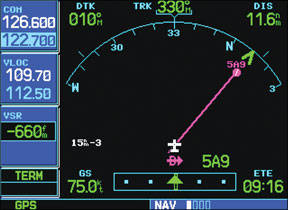
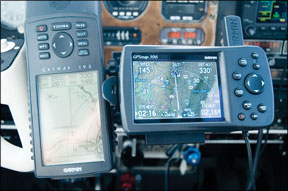
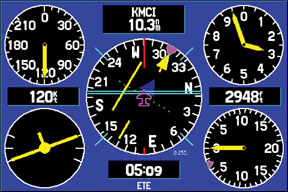
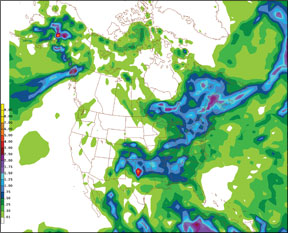
While it is unlikely youll ever have to use your hard-earned partial panel flying skills in a real emergency, critical systems do and will fail at the worst possible times. The good news is there are several relatively inexpensive tools on the market that can make the ordeal more manageable for a single pilot in IMC. The Garmin GPSMAP 396 and 496 handheld GPS receivers retail for under $2500, plus about $50 a month for the databases and XM weather subscriptions. In addition to a color moving-map display loaded with terrain and weather graphics, a “five pack” of virtual instrumentation provides most of the information one needs to accomplish partial-panel instrument flying. (There is no attitude information, hence its not a “six pack,” but more on that in a moment.) The 296 and monochrome 196 units each offer the panel page, too, but not the XM weather.
Read More »

IFR Into VMC

If youre Instrument-rated and current, you almost certainly own at least a modest complement of IFR charts and approach plates. Of course, the odds are you still make a number of flights under VFR and, if youre like me, you probably always have a couple of current Sectionals in your flight bag. But many Instrument-rated pilots from time to time find themselves so accustomed to the IFR “system” that the idea of going VFR and not talking to someone seated at a radar scope gives them the shakes. Also, flying a full VFR traffic pattern has been known to induce severe trauma in even the most jaded IFR pilots.

Read More »

Flight Landing Alternates Made Easy

Flight under instrument flight rules (IFR) is largely procedural. Theres little room or tolerance for zany spontaneity so, if you love surprises, look elsewhere. But although we fly by the book, when the plot thickens, we do in fact have options (although theyre more like regulatory provisions) for choosing a different ending. Usually, the thickening agent affecting our best-laid plans is weather-related. Before we can exercise that freedom of choice, however, IFR pilots must fulfill certain obligations. Some of these rules are similar to those for VFR flight, such as how much fuel we should have on board. Some, however, go literally a step beyond, such as the requirement for specifying an alternate destination (as well as hopefully having some rough plan for getting there). The idea of even thinking of an alternate airport may be foreign for some newly anointed VFR pilots, but in the IFR world, its a well-known commodity.

Read More »

Briefing The Approach

If your initial instrument training was anything like mine, you started flying approaches on the first or second lesson. Usually the CFII would set up the radios, say something about minimums and let me chase the needles. As I progressed toward the rating, I did more and more of the set-up myself, quickly becoming (what I thought was) expert at reading approach charts. Im not faulting my double-I-this was just the way it was done in that part of the country at that time.

Read More »

Autopilots And IFR

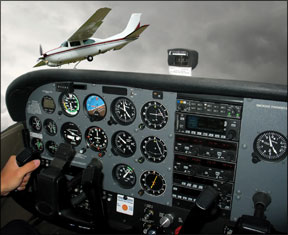
Autopilots are a fabulous workload management tool. In a busy, single-pilot cockpit they quite literally can be a lifesaver. Weve come to accept their precision and dependability. Theres a growing viewpoint that a functioning autopilot is an essential requirement for all instrument flight-many pilots I know say they would not contemplate IFR without an autopilot.

Read More »

Engine-Out IFR Approach

Youve been in the clag for what seems like hours. The monochromatic gray outside the windows is broken only by the raindrops streaking up your windscreen and meandering back at a slower pace along your side windows. Youve turned off your strobes, but you can see the reassuring red and green glow of the recognition lights at your wing tips, reflected back from the thick grayness.

Read More »

Lurking In The Murk

One of the fallacies of flying IFR in marginal-to-good weather is that its safe to presume everyone else out there is on the same page, under the watchful eye of ATC. Instead, its completely legal for someone else to be scud-running in barely VFR weather while youve gone to the trouble to get the rating, file the flight plan and follow the clearance.

Read More »

Going (And Being) Direct

Whenever we fly from point A to point B, many of us use the Victor airway system. We pick a route that offers us the smallest increase beyond a great circle distance, or the highest groundspeed and these days, especially perhaps the widest berth from unfriendly airspace. Not always will we get the route we filed and, too often, the cleared route will put us at a major disadvantage.

Read More »
Pilot in aircraft
Sign-up for newsletters & special offers!

Get the latest stories & special offers delivered directly to your inbox.

SUBSCRIBE