Features

More Cockpit Stress

In the May 2019 issue, I couldnt help but note the connection between Key Dismukes article Stress in the Cockpit and Mr. Burnsides observations in Cockpit Communication. When there is poor communication in the cockpit, stress levels are going to rise. It doesn’t matter if the communication shortfall takes place in the air or on the ground. Two of the four categories of errors made by airline crews that were pointed out by Dr. Dismukes were inadequate comprehension, interpretation, or assessment of a situation, and inadequate communication. These categories are faithful descriptions of the failure to explicitly define and communicate expectations that your friend experienced with his flight instructor.

Read More »

Managing Risk In Aircraft Certification

Most of my articles for this journal focus on managing the risk of flying piston-powered general aviation aircraft, with examples of good and poor risk management. But risk management is at least equally critical in the world of operating airliners and turbine-powered transport category aircraft. Recent air carrier accidents provide illustration and lessons relevant to operating small general aviation aircraft, especially when designing and certifying them. In fact, and just as during flight operations, the job of managing risk in the design and certification is to identify, assess and mitigate that risk. These procedures apply even more objectively when using rigid design criteria, especially when they involve transport category aircraft.

Read More »

Ill Be Missing You

We all know how to fly a missed approach. We probably did a handful of them on our instrument checkrides, and when were out practicing approaches, even in a sim, we most often go missed. We may not be flying a full missed approach procedure as published, but we still have to reconfigure the airplane and climb away. When were practicing, we know how the approach will terminate: by going around at the missed approach point. Its what we expect when practicing.

Read More »

Airborne Hot Spots

The FAA defines a hot spot as a location on an airport movement area that demands heightened attention by pilots and vehicle operators due to the history of potential collision or runway incursion. Knowing where any hot spots are at the airports you intend to use arms you with useful risk management information. Meanwhile, the FAA has gone sort of nuts with the airport hot spot concept. Dont believe me? Check out the airport diagram for Addison Airport (KADS) in Dallas, Texas, below. Every taxiway intersection east of the runway is a hot spot.

Read More »

Downwind Or Downhill?

Pilots are taught to take off and land into the wind, and avoid landing or departing with a tailwind. There is a reason: The performance penalty of a tailwind is much greater than the benefit of a headwind. How big a penalty? Go to your POH and calculate it. The most common figure is to add 10 percent to the takeoff or landing roll for every two knots of tailwind up to 10 knots. The specific penalty will vary based on a number of factors like runway surface, density altitude, and gross weight. Somewhere down in the fine print, you may see an additional penalty for runway slope. But often runway slope is neglected, because most runways are level.

Read More »

Stumbling Around In The Rain

Its not unheard of to think thunderstorms are only a product of summer weather, like were experiencing now in the Northern Hemisphere. Certainly they are more common in warmer months, but wintertime thundersnows are common enough that Ive seen a few. The point is that we can encounter thunderstorms any time of year, not just in the summertime. The kinds of weather Mike Hart discussed in last months article, Air Mass Storms, principally are warm-weather phenomena, while thunderstorms associated with frontal activity can be experienced year-round.

Read More »

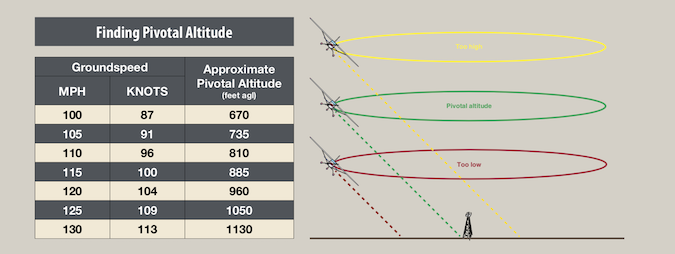
Finding Pivotal Altitude

A long-time pilot-friend of ours tells a story about his first check ride for the commercial certificate. Everything was going relatively well until the examiner asked him to perform the eights on pylons maneuver. His response was something along the lines of, Yes sir, thank you, sir, and what altitude would you like, sir? The examiner ended the check ride and told him to come back after talking with his instructor about pivotal altitude. When he did, he learned that the correct pivotal altitude for a given groundspeed allows a banked line of sight from the cockpit directly parallel to the lateral axis of the aircraft to the pylon, a stationary object on the ground. Our friend went on to be one of the first pilots to fly the Airbus A300 in the U.S., for Eastern Airlines.

Read More »

ELT Care And Feeding

The SAIB is focused on ELTs from ACR Electronics, Inc. (ACR, formerly Artex Aircraft Supplies, Inc., and Chelton Avionics, Inc.), models G406-4, C406-1, C406-1HM, C406-2, C406-2HM, C406-N and C406-NHM. According to the agency, these ELTs may not transmit alert and location signals in the case of an accident involving an aircraft to which they are mounted due to an inoperative or a deteriorated G-switch. The SAIB states that an ELT mounted in a high-vibration environment, for example in the tail of a helicopter, could have its acceleration sensor deteriorate after having been subjected to high levels of shock and vibration for five years or more. The new SAIB recommends best practices for the inspection, modification and replacement of these ACR ELTs located in high-vibration environments. In our view, these recommendations can be applied to similar ELTs from other vendors.

Read More »

IFR Route Changes

Sitting around and talking with pilot friends, you hear nonstop talk about aircraft and equipment. Eventually, someone always brings up ATC in conversation. Pilots argue among themselves more intensely than Socrates debating Plato. One question that new and even veteran pilots bring up is why, when they file an IFR flight plan, that their clearance is usually never as filed but includes a route change of some sort.

Read More »

Laters And Waiters

In the decade-plus since the coming ADS-B mandate became a thing for U.S. aviation, those whose operations will be affected have fallen mainly into two camps: early adopters and those who put it off as long as possible. In this binary world, I freely admit to being something of an early adopter. And despite some cool-and less expensive-new gear on the market, Im happy with my choice to equip with ADS-B in 2016. Its likely those who have taken a wait-and-see attitude also are happy.

Read More »
Pilot in aircraft
Sign-up for newsletters & special offers!

Get the latest stories & special offers delivered directly to your inbox.

SUBSCRIBE