Critical Moments

Rationalization

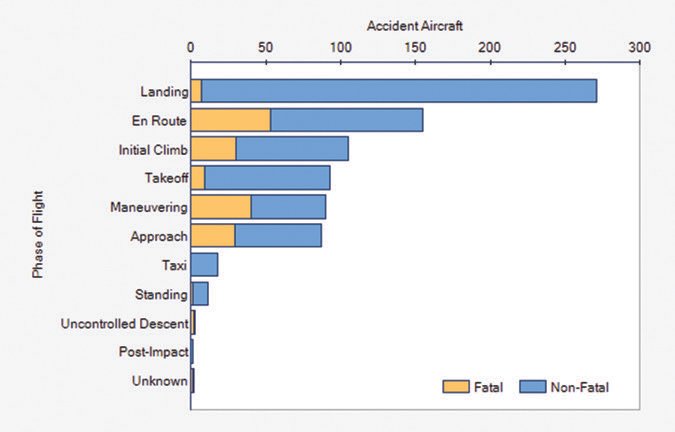
People wouldnt fly personal aircraft-or participate in many other activities-if there werent benefits. Thats human nature. Some benefits we seek by taking risks are intangible and hard to quantify. Others can be readily identified and weighted. Its a calculus we all employ daily in mundane ways. However, the problem isnt that we fail to assess benefits when we analyze risk. Instead, the issue is the inaccurate values we assign on both sides of the equation.
Read More »

NTSB Reports

At about 1051 Eastern time, the airplane was substantially damaged when it struck terrain during an attempted go-around. The private pilot and the pilot-rated passenger were not injured. Visual conditions prevailed.

Read More »

FAA Rolls Back Complex Airplane Checkride Rule

Less than a month after the April 4, 2018, fatal crash of a Piper Arrow during a commercial-pilot checkride, the FAA has changed its policy to no longer require a complex airplane (one with controllable-pitch propeller, flaps and retractable landing gear) for the commercial pilot-airplane or flight instructor-airplane certificates. The change comes via FAA Notice 8900.463,Use of a Complex Airplane During a Commercial Pilot or Flight Instructor Practical Test, dated April 24, 2018. The policy change reflects the lack of suitable aircraft.

Read More »

Why Do We Stall?

Fixed-wing pilots start learning stall recognition and avoidance during pre-solo training. The private and sport pilot checkrides require recovering from developed stalls with minimal loss of altitude, and stall and spin awareness are (or at least should be) refreshed during flight reviews for the duration of ones flying career. But unintended stalls still put dozens of airplanes into the ground every year. Is it possible that stall training as currently practiced isnt as effective as it might be?

Read More »

Ignition Switch Issues

The student pilot was doing an engine run prior to flight. Was unable on the first try to complete the magneto check as the key would not turn from the both position to the left/right/off position. After shutdown, the student was able to select off on the switch. The switch that was installed (p/n 103572101) included a push-to-start function. Found the switch sticking internally and replaced it with a new push-to-start switch.

Read More »

NTSB Reports

At about 1725 Eastern time, the airplane sustained substantial damage following a landing gear separation during landing. The flight instructor in the right seat and the pilot receiving instruction in the left seat sustained no injuries. Visual conditions were present.

Read More »

Spinning Your Gyros

Over the last couple of years, Ive spent some time helping students transition to full-fledged private pilots. One of the first questions I do is ask them is to picture a standard six-pack of steam-gauge instruments and explain what they each do and where they get their energy. Most pilots can quickly rattle off the airspeed indicator, the altimeter and the vertical speed indicator. Those systems are relatively simple to understand and describe.

Read More »

Just Go Around

Its a moment you probably wont forget. After your instructor handed back your signed logbook and reached for the cockpit door, he or she reminded you, If anything about the landing doesnt look right, just go around.

Read More »

A Big Win, For Now

Long-time readers will recall my several scribblings in opposition to proposals to privatize the U.S. air traffic control (ATC) system, and my encouragement to those same readers to communicate their views to their federal elected officials. Im happy to report our opposition to this solution in search of a problem has been successful: On February 27, U.S. Rep. Bill Shuster (R-Penn.), the proposals architect and chairman of the House of Representatives Committee on Transportation and Infrastructure, announced he would remove it from pending FAA legislation.

Read More »

Download the Full December 2017 Issue PDF

When it does, that new generation of personal aircraft likely will include technologies designed to prevent accidents. Things like envelope protection, where the machine doesnt allow its pilot to put it into an unsafe situation. Technologies like GPS and ADS-B are a given, along with a networked operating environment where it and all other nearby aircraft talk to each other to manage collision avoidance, sequencing and efficient routing. Operator certification wont be nearly as complex, time-consuming or expensive as it is today.

Read More »
Pilot in aircraft
Sign-up for newsletters & special offers!

Get the latest stories & special offers delivered directly to your inbox.

SUBSCRIBE