











Another Look

Fatals Higher In 2014

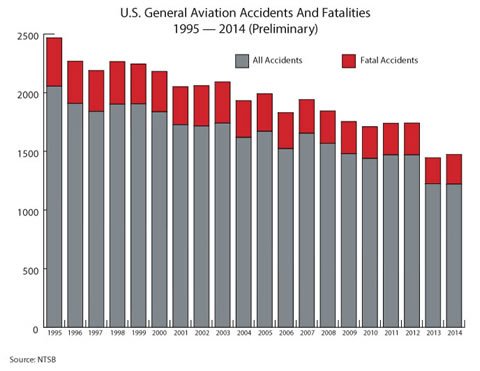
The NTSB in early August released preliminary general aviation accident statistics for 2014. Sadly, and despite major efforts at the FAA and within industry to enhance safety, the NTSBs preliminary 2014 data show an increase in fatal general aviation accidents, from 222 in 2013 to 253 in 2014. Our calculator says thats a 13.9 percent increase in fatal accidents between 2013 and 2014.

Read More »

Fly Safe

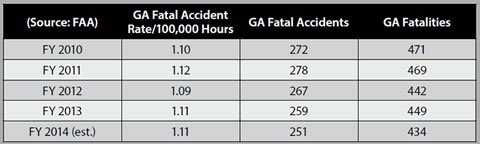
On June 6, at AOPAs Homecoming Fly-In, the association and the FAA formally kicked off a new program focused on improving general aviation safety. Dubbed Fly Safe, the FAAs campaign will be highlighting GA accident causes and solutions in partnership with AOPA and other industry organizations. The agency says preventing GA fatalities is one of its top priorities, with the goal of reducing the GA fatal accident rate by 10 percent over a 10-year period (2009-2018). Noting that loss of control (LOC)-mainly stalls-accounts for the largest number of GA accidents, the new program will start there.

Read More »

Go With the Flow? Check

The pilot of a single-engine experimental airplane climbed into the left seat, started the engine, taxied out to the runway at his California home base, and advanced the throttle for takeoff. As the plane left the ground, he discovered the awful truth.

After his last flight, he had wrapped the seat belt on the right seat around the right yoke, using the belt as a gust lock. Somehow, hed forgotten to release the belt before takeoff. The airplane stalled and veered left of the runway. In the crash, the pilot was seriously injured.

Youre laughing now, wondering how someone could be so, well, careless as to take off with the seat belt wrapped around the yoke. This is an extreme case of f…

Read More »

Turnback on Takeoff

The word emergency comes from the classical Greek, Emergos, meaning lets get out of here. Consider Icarus, the pilot who disregarded the service ceiling limitation on his Daedulus Skycoupe and failed to handle the subsequent forced landing by foolishly attempting a turn back to the island of Crete. Icarus perished because he had no plan to get out of there.

Three thousand years later, experienced pilots still take off with little thought of engine failure. Maybe thats because engines are fairly reliable and such a tiny portion of a flight is spent in the climb.

Still, depending on the type of aircraft, as many as 20 percent of emergency landings originate in the takeoff and cli…

Read More »

Power to Decide

Recently the FAA issued a warning to operators of jets and turboprops not to substitute K-1 kerosene (used for home heating, among other things) for Jet-A. The FAA had discovered a parachuting operation using K-1 in its fleet of turboprops and warned other turbine operators not to do the same.

The kerosene used in this case may work for a considerable amount of time until one gets a load of bad fuel, the FAA reported. The manufacturing quality control system used to produce K-1 kerosene is far less stringent than for Jet-A aviation fuel.

The use of kerosene in certified aircraft is a violation of the aircrafts type certificate, but warbird aficionados have wondered what differen…

Read More »

T-Storm Etiquette

You may see it coming, a boiling black cloud looming in your windshield. Others will have pinned you in on either side, making penetration likely.

More likely you will not. Youll be in the clouds and pick up a little turbulence. Then a little more. Then the rain starts. It may be torrential, but you hang on, thinking itll soon be over. The sudden flash of lightning and instant crack of thunder suddenly slam you with the reality that youve gone and done something stupid.

Youve flown into a thunderstorm. Hang on, the ride is going to get wild.Tales of airplanes being ripped apart by thunderstorms are held up time and again by instructors warning the unwary against thunderstorm penet…

Read More »

Full-Service Mistake

For many pilots, the end of the flight is the beginning of a routine. They land, taxi to the ramp, go into the FBO.

If theyre planning another leg, theyll order fuel, use the restroom, check the weather and maybe have a snack. They pay the fuel bill and walk back to the plane.

If theyre home or planning to spend a day or two, they put in a fuel order and leave.

Sometimes its the worst thing you can do.

For example, a Cessna 421C crashed in good weather in San Antonio, Texas, killing the pilot and one passenger instantly. Another passenger was seriously injured and died several days later. The pilots gamble came during the preflight and engine runup.

The flight was opera…

Read More »

The Truth About Takeoffs

The February article Moment of Truth on takeoff techniques brought a flood of mail. The comments generally pertained to two parts of the article: the dynamic effect of crosswinds and the effect of headwinds on takeoff runs.

Regarding the effect of crosswinds on controllability, the most common misperception is that the sole purpose of applying aileron control into the wind is to increase ground friction on the upwind wheel and stop the airplane from drifting downwind. It is true aileron into the crosswind does indeed increase friction on the upwind tire and aids in offsetting wind drift, but the primary purpose is to prevent the windward wing from rising.

The greater the surface area…

Read More »
Pilot in aircraft
Sign-up for newsletters & special offers!

Get the latest stories & special offers delivered directly to your inbox.

SUBSCRIBE