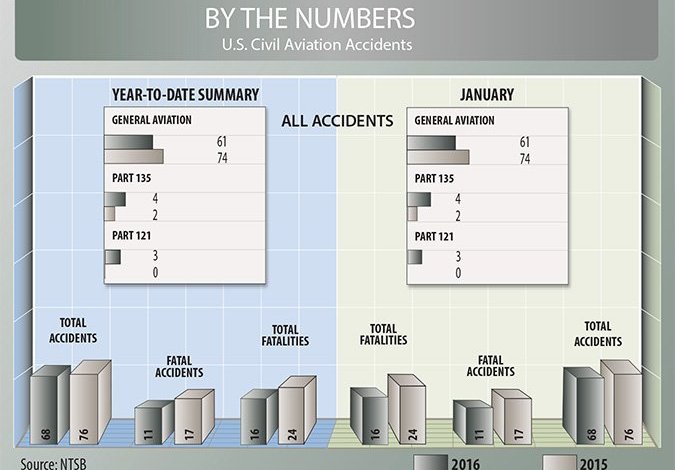
Accident Probes

March 2016 NTSB Reports

At 1945 Eastern time, the airplane experienced a total loss of engine power, was force-landed on a road and struck a telephone pole with the left wing. The commercial pilot and the passenger were both seriously injured. Visual conditions existed.

Read More »

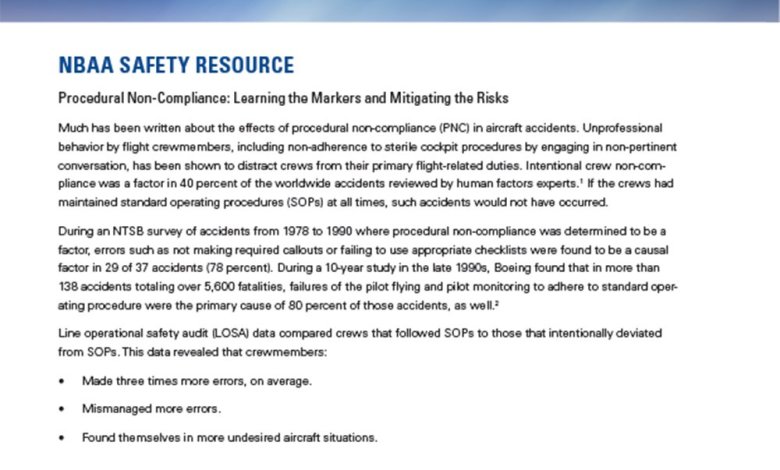
The Cost of Procedural Noncompliance

The safety consequences associated with procedural noncompliance-failing to correctly perform normal checklists-have become hot button issues within the business aviation community and the NTSB. All general aviation pilots should heed the warnings raised.

Read More »

Minimum Equipment

Until the 1990s, when backup options became widely available for personal aircraft, a vacuum system failure in instrument conditions was an extreme emergency. These days it still is, but electric backup instruments are relatively inexpensive and easy to install.

Read More »

Business Aviation Responds

To its credit, the business aviation community has risen to meet the challenge of procedural noncompliance. I serve on the National Business Aviation Association’s (NBAA) Safety Committee and for 2015, procedural non-compliance is one of the committee’s top safety priorities. I should point out that procedural noncompliance (PNC) is also on the NTSB’s 2015 Most […]

Read More »

Experimental Aircraft Fatals, New Advisory Circulars, and Avgas 2.0

Fatal accidents involving experimental, amateur-built aircraft (EABs) during the 2015 federal fiscal year-October 2014 through September 2015-fell 20 percent from the previous 12-month period. The FAA has published for public comment draft revisions to two ACs, as well as a handful of others useful to GA and other operators. The FAAs efforts to approve a new, unleaded aviation gasoline are continuing, with an ongoing series of lab tests being conducted at the agencys Atlantic City, N.J., research facility.

Read More »

The Impossible Turn

This magazine often has discussed the so-called impossible turn: returning to the departure runway and landing downwind after an engine failure during takeoff. Our view of the impossible turn is that it is possible, but only with practice, sufficient altitude and some luck. Generally, executing a forced landing straight ahead is preferable to attempting a steeply banked turn at low altitude. This is especially true without engine power or sufficient airspeed above the wings stalling angle of attack to enable the steep turn.

Read More »

NTSB Reports

At about 1950 Mountain time, the airplane was substantially damaged during a forced landing following a loss of engine power. The commercial pilot and his passenger were not injured. Night visual conditions prevailed. While en route, the pilot determined adequate fuel to complete the flight as planned was not aboard. The right fuel tank apparently failed to feed the engine. While preparing to land, the engine lost power. The pilot performed a forced landing to a field, during which the airplane nosed over and came to rest inverted.

Read More »

Piston Problems

During oil and filter change, chips and large metal pieces were found. During an annual inspection, the engine oil quick drain valve was blocked with debris. About a dozen pieces of what appeared to be piston ring pieces were removed. While performing a condition inspection, a crack was found on #6 intake. After takeoff, the crew noted engine vibration and lack of power. Inspection revealed excessive oil in the engine area and on the aircraft belly. After a precautionary landing due to power loss, a compression check showed zero on cylinder A4.

Read More »

Continued VFR Into IMC

Continued VFR into IMC accidents have been part of the general aviation accident scene since before I started flying more than 50 years ago. Some headway in reducing these accidents was made when private pilot applicants were required to demonstrate basic instrument proficiency beginning in the early 1960s. Cockpit technology has also improved, with even basic training aircraft equipped for instrument flight and devices such as autopilots and weather data link becoming more prevalent. On the other hand, there is a much higher percentage of high performance aircraft in the general aviation fleet than 50 years ago, and more non-instrument-rated pilots are flying longer distances in higher performance aircraft. As a result, the prevalence of VFR-into-IMC accidents is still very high.

Read More »

Weather Accident Types and Trends

Weather-related accidents have always been a big issue for general aviation. Their number has not been declining appreciably, as demonstrated by the graph at right, adapted from the most-recent AOPA Air Safety Institute’s 24th Joseph T. Nall Report, which discusses general aviation accidents in 2012. During the eight-year period from 2005-2012, the number of fatal […]

Read More »
Pilot in aircraft
Sign-up for newsletters & special offers!

Get the latest stories & special offers delivered directly to your inbox.

SUBSCRIBE