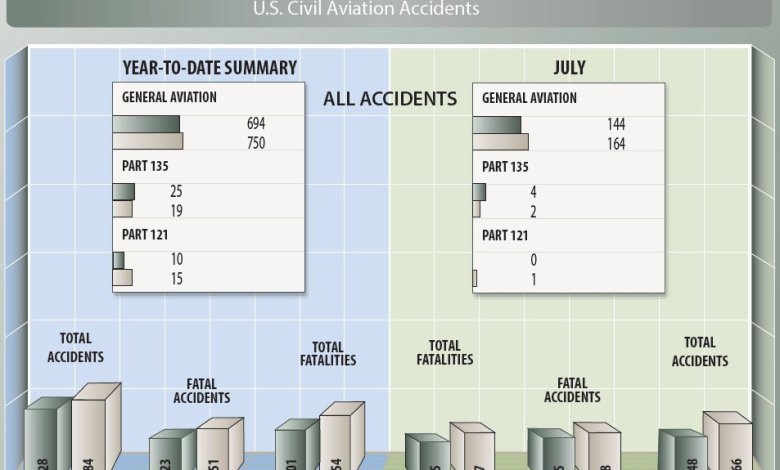
Accident Probes

NTSB Reports: January 2016

A pilot reported hearing a Mayday call from another airplane, stating that the engine had failed and he was attempting to land on the east side of a canal. No further communications were received from the accident airplanes pilot.

Read More »

Aircraft Engine Oil Checks

This months accident easily could have resulted from perhaps the most insidious preflight challenges: interruptions. Being interrupted in the middle of, say, refueling or checking the engine oil can have severe consequences. The trick for me always has been to start over after the interruption is resolved. If this means leaving passengers in the FBO lobby until Im ready, or missing a clearance void time, so be it. If it means answers to a passengers questions must be postponed, thats okay, too. Interruptions during a preflight inspection are insidious because they allow us to consider a task complete when it isnt. Well never know if an interruption during the preflight inspection helped cause this months accident, but its as good an explanation as any.

Read More »

Memorable Aircraft Accidents

The typical flight in a personal airplane is uneventful. We take off, fly the mission and land. Every now and then, though, stuff happens. Its one of the reasons flying has been called hours and hours of boredom punctuated by moments of sheer terror, a description it shares with many other activities. In fact, most of us have our own tales to tell, stories of airborne drama weve experienced personally or heard directly from the people involved.Ive been doing a lot of flying recently, spending quality time at airports and remote landing strips with other pilots and their airplanes. Along the way, I picked up several there I was narratives from pilots who made serious errors in judgment, plus others who experienced what can only be described as bad luck. Sharing these narratives with other pilots helps add to our knowledge of what can happen, how we should prepare for it and what we can do in response. In reflecting on them, I soon realized they all have a common element. And since I was the pilot for one such event, I can assure you: When an event begins, it often happens very quickly, providing little warning.


Read More »

Icing in Your Aircraft’s Engine

Its that time of year again in the Northern Hemisphere, when in-flight icing can be a threat. Depending on where you are and where youre going, icing may be a rare possibility during the upcoming season. It also can be a sure thing. Evaluating the possibility of in-flight icing is part of the equation-its potential impact is another. A pilot might completely overlook icings impact on other aircraft systems, including the powerplant(s). Carburetor icing should be a topic familiar to most pilots, but induction system icing can be an afterthought. And while there are systems we can activate to minimize icings impact on the induction system, we must remember they exist and know how to activate them.

Read More »

Aircraft Accidents: the NTSB Reports

Every month, Aviation Safety publishes aircraft accident reports in order to give our readers the broadest perspective on aviation and the risks it involves. Our goal is to pass along a message of caution and safety as much as one of thrill and freedom. That’s why we think you should hear about recent mishaps from around the country. Here are some gathered from the National Transportation Safety Board.

Read More »

A Classic Case

I remember the first time I flew in less-than-VFR conditions. I had a very fresh private pilot certificate and was en route in a Skyhawk, probably at 3500 feet msl. There was a shower between me and my destination, dropping visibility to less than three miles. My heading would take me under it and through the rain shaft. There was no traffic around.I could almost see what was on the other side before entering it, so I kept on going. For the experience, of course. I had ground contact throughout, and there was clear air 90 degrees and 15 seconds to my right. Coincidentally, I wasnt far from this months accident site.

Read More »

NTSB Reports: October 2015

At about 1745 Central time, the airplane lost engine power shortly after takeoff. The airplane impacted trees and was substantially damaged. The solo private pilot was seriously injured. Visual conditions prevailed.The FAA reported the pilot was doing touch-and-goes. The engine lost power and the airplane impacted trees and terrain about a mile southeast of the airport. The airplanes empennage separated from the fuselage, and there was heavy damage to the right wing and fuselage.

Read More »

NTSB Reports: September 2015

At about 1705 Eastern time, the airplane touched down short of the intended runway. The commercial pilot sustained a minor injury; the pilot-rated passenger was not injured. The airplane was substantially damaged. Visual conditions prevailed.Abeam the runway threshold on downwind, the pilot lowered wing flaps to the first notch and moved the mixture control to full rich but did not turn on carburetor heat. While on final at 500 feet agl and 80 mph, the next thing he knew they were on the ground. He indicated the airplane descended due to a microburst, but there was no rain shower nearby. He also stated the passenger attempted to add full power, but was too late. He stated he did not stall the airplane.

Read More »

Acro Tyro

Just as there are different airplanes optimized for different purposes, pilots fly for different reasons. For some, its just a job, akin to driving a bus. For others, its a means of personal and business transportation. Still more fly for recreation, like sightseeing or aerobatics. Droning along in the stormy clag and hand-flying an ILS to minimums is the epitome of flying skill for some pilots. Others perhaps couldnt fly an ILS if they had to but can fly, say, a loop or an Immelman to perfection, or safely get in and out of a back-country runway. Different strokes for different folks. Fortunate pilots may combine all of these activities, and others, into their flying career.

Read More »

NTSB Reports: August 2015

At about 1730 Central time, the airplane was substantially damaged during a forced landing to a field following total loss of engine power during cruise flight. The airline transport pilot and passenger were not injured. Visual conditions prevailed.About 15 minutes after adding 30 gallons of fuel at an en-route fuel stop and while cruising at 3500 feet msl, the engine lost all power. Emergency procedures werent successful and the pilot selected a field for an emergency landing due to utility wires surrounding the adjacent roads. The touchdown was normal, but the field included rough terrain, which resulted in the nosegear collapsing before the airplane came to rest upright.

Read More »
Pilot in aircraft
Sign-up for newsletters & special offers!

Get the latest stories & special offers delivered directly to your inbox.

SUBSCRIBE