













A Visual Segment

Instrument procedures aren’t always just for instrument conditions. Some require VMC for obstacle avoidance, which is guaranteed—if you follow the instructions.

Screenshot
Gemini Sparkle

Key Takeaways:

  • Hot, humid summer conditions and heavy aircraft loads severely degrade climb performance, requiring careful planning for IFR departures and ascents.
  • Even when flying IFR, pilots must maintain vigilant awareness of obstacles, both charted and un-charted, as standard procedures may not account for all hazards, especially in marginal visual conditions.
  • Strategic use of visual procedures like Visual Climb Over Airport (VCOA) and "Fly Visual" segments, combined with proactive ATC communication, is crucial for ensuring obstacle clearance and enhancing situational awareness during challenging IFR flights.
See a mistake? Contact us.

From trees, towers, and terrain, lots of obstacles can interrupt your arrival or departure. That’s why we prefer flying IFR with all those nifty procedures. But full awareness of the hazards lurking around involves a bit more than just sliding down your favorite glidepath. And autopilots can only do so much, especially if you don’t have one. On a muggy summer day in a light airplane with convective weather waiting to pounce, you just might want some extra situational awareness.

Long, Hot Climb

Hot is the norm this time of year in Batesville, Arkansas. Temperatures will climb above 100 degrees Fahrenheit today, so to make life worth living you think only in Celsius. A high of 36? Much better. Still, there’s no getting around sticky, and it’s only 8 a.m. That’s mid-afternoon in Zulu time, so better get going. You look forward to reaching McCook, Nebraska, where it’s more than ten degrees cooler and a family reunion barbecue awaits. 

From KBVX it’s a good four hours of flying. Make that 4.5; someone snapped up the club’s speedy single for the weekend. “Sid,” the comfortable but sluggish hand-flown Sundowner, will have to do. Non-stop is now out of the question, and the potential for storms means it could take longer yet. So land short of the convective weather zone to fuel up and check conditions ahead. 

Along with free food, the lure of loading up on cheap(er) fuel is hard to resist, so you file to Russell Muni in Kansas. That’s still nearly four hours away, but since clouds there will be scattered at 1000 feet, visibility five miles in rain, you don’t need an alternate and can land with a bit under an hour reserve.

Batesville’s departure weather is marginal—broken 1000-3 in haze—but otherwise okay. You file for 8000 feet for better winds and temperatures, and devise a route to go north around military airspace: DROOP CNU EMP SLN. 

While Batesville isn’t much above sea level, don’t count on that 1000-feet-per-minute climb you enjoyed last month in the other airplane. With OAT at 30 degrees C, weight at maximum due to passengers, stuff and a cooler full of water … climb performance is a big question mark. Page through the old brittle aircraft manual, and see the Normal Climb chart has a note for a performance drop of around 70 FPM for “high humidity” (defined in the notes as dewpoint above 60 degrees F). Maybe 680 FPM initially, tapering off to about 300 reaching cruise altitude. Squeeze out what you can following other guidance in the manual, like leaning the mixture for best RPM. But the thought of a power hiccup or otherwise poor climb performance after entering the clouds is mighty uncomfortable.

Make It Visual

You’ve got an idea. First, get all the headwind you can, even if only a few knots. That favors Runway 26. Takeoff minimums: “std. w/min. climb of 272’ per NM to 2000, or 1100-2½ for VCOA.” “Std.” means at least one mile visibility. You have three. As far as the 272 feet per mile, the estimated groundspeed of 90 MPH converts to a climb rate of about 370 FPM using the published climb/descent table. That is likely okay, but you want to be as high as possible before leaving the airport vicinity. 

So make a climbout using the Visual Climb Over Airport: “Runway 26, obtain ATC approval for VCOA when requesting IFR clearance. Climb in visual conditions to cross Batesville RGNL Airport at or above 1400 before proceeding on course.” The airport elevation is 465 feet. That means you must cross the airport at about 1000 feet AGL, just remaining in VMC and proceed per the clearance.

This is not an everyday thing, but you have done something similar flying VFR. AIM 5-2-9, in its usual circuitous style, offers some details, but you must scroll down a ways to find its purpose: “VCOA procedures are developed to avoid obstacles greater than three statute miles from the departure end of the runway as an alternative to complying with climb gradients greater than 200 feet per nautical mile.” Once achieved, “the pilot may proceed in instrument meteorological conditions to the first en route fix using a diverse departure, or to proceed via a published routing to a fix from where the aircraft may join the IFR en route structure, while maintaining a climb gradient of at least 200 feet per nautical mile.” 

That last part will be tough after a few thousand feet, so call the departure facility on the land line to discuss the plan. For reference, the minimum safe altitude around Batesville is 2900 feet. You know the tallest towers in that sector are to the southeast, and your northwest course avoids other obstacles to the north. Okay: Cleared as filed. Report when on course to DROOP.

More VMC tricks

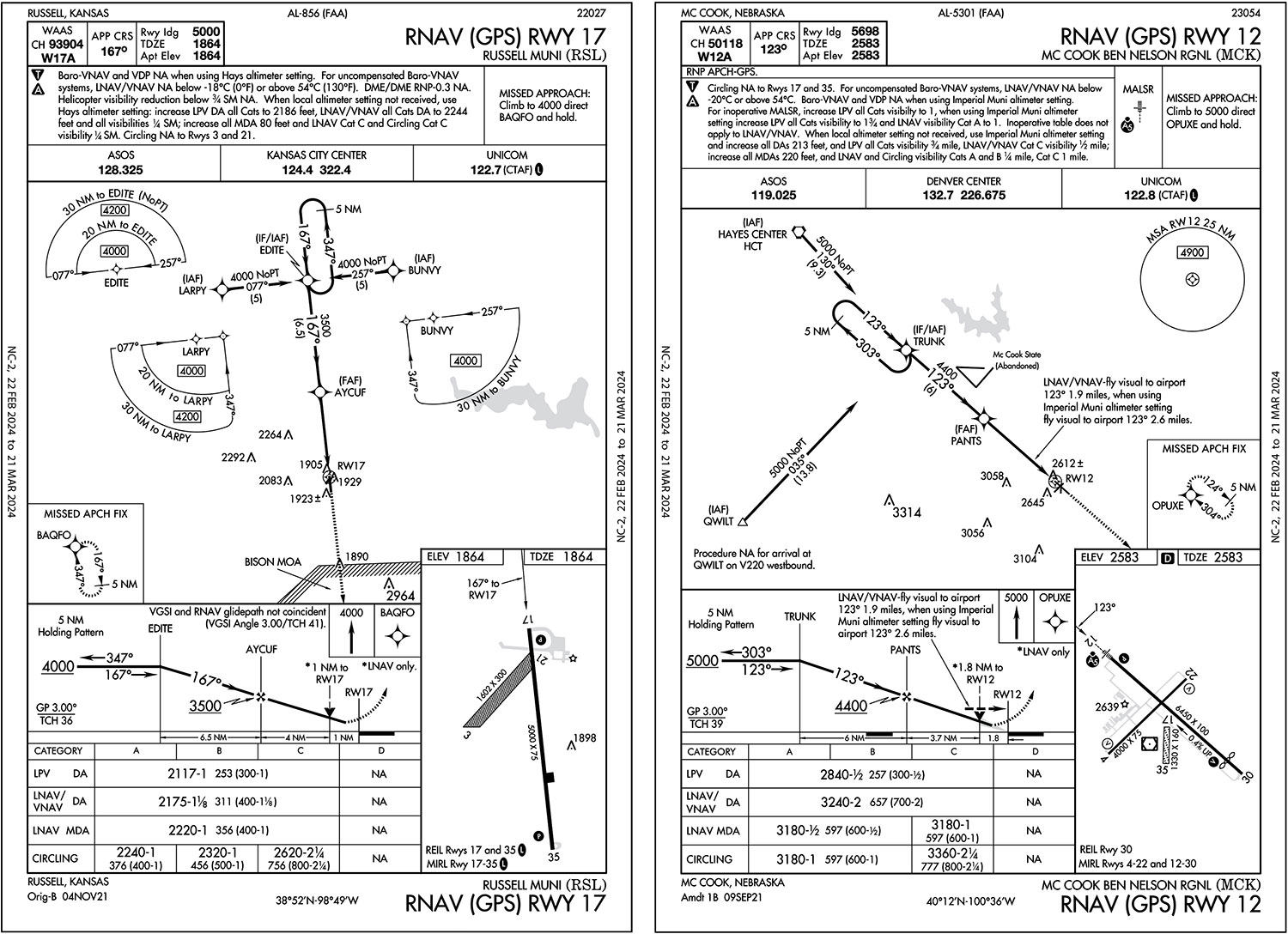
It took more than 20 minutes and about as many pleadings, “C’mon, Sid!” to reach 8000 feet. That left-hand death grip on the yoke loosened up only to analyze the next challenge of making Russell. A half-hour out, it’s 1500-3 in rain and the RNAV 17 approach will be fine, although some pin-thin towers near the runway will be tough to spot. Zoom in on the three obstacles illustrated on the chart—two close-in at airport, plus one to the south near the missed approach path (which goes straight out to BAQFO at 4000 feet.) 

On short final, the first obstruction (1905 feet) will be about 41 feet. The next obstruction is taller, 1929 feet just east of the runway. The third, just southwest of the departure end, is 1923 feet ±, which in chart language is the word-of-the-day, “doubtful.” In any case, the AIM warns that all charted obstacles can have inaccuracies, so keep an eye outside when visual and stick to the clearance or procedure.

Things got too busy flying to look around for towers on approach, but you lined up perfectly and saw the runway three miles out. After vowing to remember the rain gear next time, you’re wet, fueled up, and lighter than the last leg. Russell, elevation 1864 feet, has a departure procedure for Runway 17: “climb via heading 167˚ to 3400 before turning east.” You could turn either way on departure, but again you called ATC before takeoff to get a clearance, a release and an okay for a right turn to the northwest. That completely avoids two obstacles near a straight-out path from 17, including a 1123-foot transmission tower shown on the approach chart.

At McCook, it’ll be Runway 12, but it’s gusting to 15 knots from the south, 2000-2 in more rain. The ILS is NOTAM’d out of service, so confirm you want the RNAV approach. For this you can use the LPV to 2840-½. There’s the matter of a two-mile-wide storm cell that will beat you to the airport. To get behind it, you request headings to make a wide path to the northwest. This plus slowing down will let the cell pass. ATC has your back with safe altitudes and lateral guidance, but beware numerous obstacles like the power lines (421 feet tall) to the west of the final approach path that do not appear on the IFR charts.

While your LPV capability will have you blissfully ignorant of close-in obstacles on a precision glidepath, it’s up to you to fly it well in a bumpy, rainy crosswind. But there’s an unusual note appearing twice on the chart, so maybe it’s important. It says the LNAV/VNAV line, if in use, requires a “fly visual to airport 123˚ 1.9 miles.” Rounded up, there’s a pretty high visibility minimum of two miles to spot a close-in obstacle on final of doubtful status, ± 2612 feet (about 29 feet AGL). 

Like the VCOA, the visual segment is another occasional obstacle workaround. While most navigators can do better than the LNAV/VNAV line, something like a “Fly Visual” segment is a clue that everyone, including the LPV crowd, flies by the same obstacles. You can use the same idea and with visibility allowing, keep the tower in check and by all means do not let the wind drift you left. If Sid is good at anything, it’s crosswinds, and so are you. The hours of fretting your way through heat and rain and clouds took away your appetite for lunch, but not for long. Maybe it’s easier to keep obstacles outta sight, outta mind, but maybe knowing is better—for those times when you don’t want them to surprise you in visual conditions down low. 


Elaine Kauh is a CFII in eastern Wisconsin, where summer is ice cream and barbecue season, and anything deep-fried on the side is mandatory.

Ready to Sell Your Aircraft?

List your airplane on AircraftForSale.com and reach qualified buyers.

List Your Aircraft
AircraftForSale Logo | FLYING Logo
Pilot in aircraft
Sign-up for newsletters & special offers!

Get the latest stories & special offers delivered directly to your inbox.

SUBSCRIBE
