













Mixing It Up

Combining IFR and VFR modes in one trip can happen in a number of ways for your flying convenience. Just know how to work the options to stay legal and safe.

Gemini Sparkle

Key Takeaways:

  • Pilots can strategically mix IFR and VFR flight rules during a trip by utilizing in-flight cancellation of IFR to transition to VFR for flexibility (e.g., scenic routes) or by picking up IFR clearances in the air.
  • Proper flight plan management is crucial, requiring separate filings for distinct IFR and VFR segments or multiple destinations, as ATC cannot accommodate "composite" plans or multiple stops on a single IFR clearance.
  • Decisions to transition between IFR and VFR, or to obtain an IFR clearance on the ground versus in the air, should account for weather conditions, airspace requirements, potential ground delays, and local traffic.
See a mistake? Contact us.

Cancelling IFR doesn’t always signify the conclusion of a trip, although that’s what happens most of the time. Stepping out of the system can be an in-flight tool to help fit the mission, so long as you have the appropriate plan: Stay in VFR conditions until you land, or initiate a new IFR flight plan, or receive a clearance for a filed plan at a predetermined point. Or, try on all three for size.

Flight Plan(s)

You mocked up a three-day getaway from Griffin, Georgia, to Ocean Isle Beach, North Carolina, in your personal single-engine. It won’t exactly be an A-to-B mission, though. The plan is to fly through the low, rainy IFR weather from Griffin (6A2) eastbound to the coast. From there, you’re hoping the forecasted visual weather awaits so you can treat your passenger to the scenic views.


The final destination is Odell Williamson Muni at Ocean Isle Beach. That airport, 60J, doesn’t have IFR approaches, but if ceilings get upwards of 2500 feet, it’ll work fine. You’ll use Charleston Exec (KJZI) in South Carolina, as an initial quick stop on the way to assess.

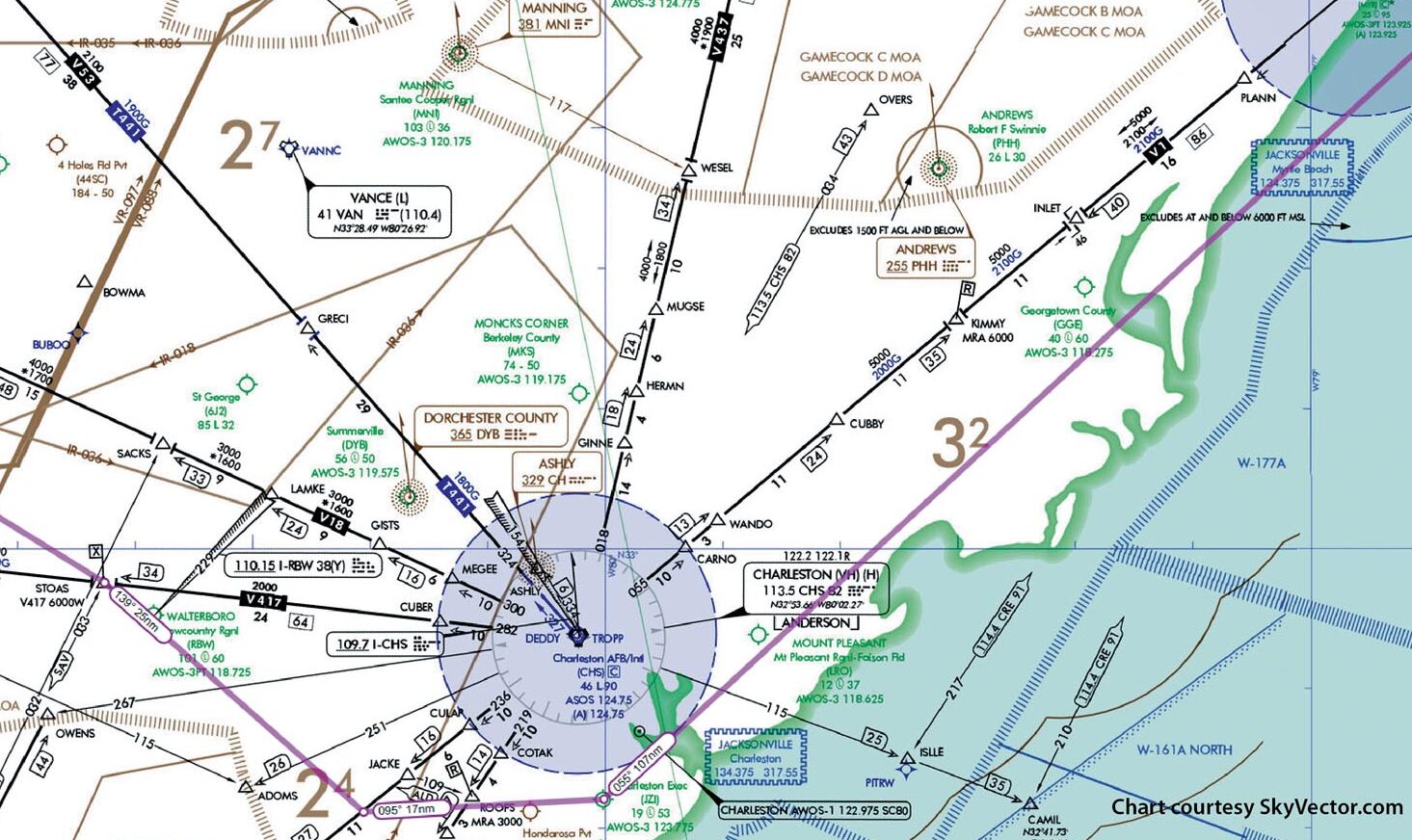
That’s further down the task list, though. For now, the clearance from Griffin is different from what you filed due to an ATC-preferred route to bypass the Bulldog MOA. Instead of flying around the southern end hopping from airport to airport, you’re put on a northern route through Augusta, followed by a jog back to the southeast around more military airspace. Then on to STOAS intersection, then DDENA direct KJZI. Since the stop at Charleston will be quick and you don’t need fuel, you simply extended the flight plan from KJZI direct to 60J. If the weather turns out great, just cancel IFR after Charleston.

But wait—this trip should be filed as two flight plans, not one. Even if Charlotte was just a pass-through for filing purposes this is still two destinations. And even if you had just one destination filed but wanted to swap from IFR to VFR over Charleston, that requires one of two actions: Cancelling IFR part way, or filing two flight plans, not a “composite” the pre-ICAO forms once accommodated by checking both VFR and IFR boxes. The AIM (see 5-1-9) addresses all this under “Single Flights Conducted With Both VFR and IFR Flight Plans.” There’s no mechanism for ATC to manage hybrid flight plans, and they’ve also gotten away from allowing multiple airport stops in one route. So make each leg a separate flight plan and you’ll simplify everything on both ends.

Even so, the other wrinkle to the desired VFR scenic flight is routing. There’s a nice stretch of airway available via V1, which runs from Charleston and gets pretty close to 60J. But it doesn’t let you fly close enough to the shoreline for the entire route. Plus, you want the flexibility to fly lower than IFR altitudes, which bottom out around 2000 feet.

So how about cancelling at Myrtle Beach and continuing on your own? Or, file IFR to PLANN, 11NM southwest of Myrtle Beach. Use the destination box in the flight plan form to put in the ending fix, which will serve as the clearance limit. If you want a VFR flight plan from there, though, be sure to have that already filed so you can quickly open it in the air at PLANN. If not, you can still go VFR at the fix and request flight following for traffic advisories. You’ll keep working the radios to get guidance around or even through the Class C and D airspaces around Myrtle Beach. That plan would work best in clear skies, though, so with some ceilings present most of the way, you decide to hold on to IFR for the entire route.

Amending, Again

The first leg to Charleston went without a hitch, but the marginal VFR ceilings persisted into South Carolina, keeping you in IFR mode. After STOAS, you got busy on the Baggy Three arrival, and in the meantime tapped out a new route: BAGGY DDENA JAISN KJZI. There was also a runway switch and now you’ll weave into the arrival for the RNAV 27 approach. LPV mins are available, so you load this into the navigator. Interesting—this approach keeps you out over the ocean for the first six miles of a long final. It also runs right on the edge of the offshore Warning Area. Since you were not prepared for over-water flying, you request vectors as close to SUVAE as possible and you stayed up at 2500 feet until getting within a mile from land, then with the airport comfortably in sight, you cancelled on a three-mile final.

After a 20-minute regroup, the ceiling at Myrtle Beach hadn’t gone up much but was definitely breaking apart into scattered clouds. In the interest of continuing on to Ocean Isle Beach, you decided to proceed IFR to 60J and save the scenic flight for the next day. Start with the V1 airway at 3000 feet, and have ATC route you through the airport airspace. At the Grand Strand navaid/airport, less than 16 miles from 60J, it’s decision time: Continue IFR by getting a new clearance to Wilmington, the filed alternate, or cancel and continue VFR to 60J.

VFR will work if you can descend from the airway under §91.155. So be sure you can remain 2000 feet laterally from the clouds as you descend, then remain 500 feet below them while in Class E. At 60J, it’s the typical Class E-to-G transition for a VFR airport, with the floor of controlled airspace at 1200 feet AGL. The MEA on V1 (using RNAV) is 2100 feet; the area elevation is just above sea level.

For a bit of margin, you decide you won’t cancel unless the ceiling is at least 1500 feet. However, this was easier said than done. You’d been flying in IMC most of the way and the scattered clouds at your altitude didn’t allow you to spot 60J or any visual checkpoints leading to it, so you weren’t sure about leaving the airway VFR. Wilmington it is, which ironically was advertising visual approaches.

It took a refueling session plus 30 minutes on the ground for another crack at 60J. In that time, the clouds finally went to 2500 scattered and with the third (fourth?) flight plan of the day, you departed IFR from Wilmington, cleared direct 60J. Since alternates are required to file to VFR airports regardless of weather, you kept KSUT, Oak Island/Cape Fear Regional on hand. After a descent to 2000 feet you could see 60J in sight 10 miles away and cancel IFR.

Escape the Crowds

That VFR scenic flight the next day in clear skies was a nice break from the day before. It required no flight plan, but due to the volume of local traffic you did obtain flight following during the scenic flight (happens all the time).

But when it came time to head home the third day, which was again crystal-clear, you couldn’t wait to get that IFR clearance back to Griffin. Naturally, there are options to sort out. There are hordes of VFR aircraft around—all the more reason to go IFR? Well, maybe.

It’s a quick phone call to Myrtle Beach Approach from the ground for a clearance and void-off time. But the radar protection doesn’t start right away; at low altitudes nobody’s seeing this traffic except for those who have ADS-B In. And getting an IFR clearance on the ground will lock you into a route and altitude. Sure, if you have doubts about getting off on time due to traffic, call ’em back on the land line for a new clearance. But the delays could be on their end, in which case you’ll get a “hold for release” and must stay put until you call again for a green light.

Or, file and depart VFR, then contact ATC for the clearance. Just know that if you get cleared on the ground and especially when told to “hold for release,” you must resist the temptation to blast off VFR. Yes, it’s legal to do so, but with caveats. As the AIM explains, you’re supposed to first call ATC and cancel the IFR clearance, which “may not be available after departure…” If you don’t cancel, and sneak out, ATC still thinks you’re waiting at the line. Imagine their dismayed surprise if you show up at 3000 feet asking to be let into the system.

Since there’s a local note that departing traffic must share the runway exit and yield to landing traffic, you figure it’s best to wait your turn at the runway without any time pressure. So you pull out the clearance-in-the-air with a twist: File IFR starting at the nearby Grand Strand navaid, so you can pick up the clearance from there. This worked out to be the best time to use that VFR-to-IFR trick, followed by great weather for the trip home.


Elaine Kauh is a CFII in eastern Wisconsin. She never minds a hold-for-release delay since it means a few minutes for an extra granola bar before takeoff.

Ready to Sell Your Aircraft?

List your airplane on AircraftForSale.com and reach qualified buyers.

List Your Aircraft
AircraftForSale Logo | FLYING Logo
Pilot in aircraft
Sign-up for newsletters & special offers!

Get the latest stories & special offers delivered directly to your inbox.

SUBSCRIBE