













Werent TAAs Supposed To Improve Things?

On November 8, 2014, the NTSB presented the fifth in a series of safety seminars focused on U.S. general aviation accidents. This event highlighted knowledge gained from NTSB accident investigations involving technically advanced aircraft (TAAs) and explored current government and industry efforts to prevent them, and the resources available to the pilot community.According to the NTSB, In recent years, the cockpits of many general aviation aircraft have undergone a transition from conventional analog flight instruments…

Gemini Sparkle

Key Takeaways:

  • The NTSB's 2014 seminar focused on U.S. general aviation accidents involving technically advanced aircraft (TAAs) and the challenges pilots face with "glass cockpits."
  • An NTSB safety study concluded that while glass cockpit aircraft have a lower total accident rate, they exhibit a higher fatal accident rate compared to aircraft with conventional analog instrumentation.
  • Accidents involving glass cockpits are more often associated with loss of control, collision with terrain, and weather encounters, frequently occurring during climb, cruise, or approach.
  • Pilots in these accidents are typically older, more experienced, and flying more personal/business, IMC, and IFR flights, but with fewer instructional flight hours in TAAs.
See a mistake? Contact us.

On November 8, 2014, the NTSB presented the fifth in a series of safety seminars focused on U.S. general aviation accidents. This event highlighted knowledge gained from NTSB accident investigations involving technically advanced aircraft (TAAs) and explored current government and industry efforts to prevent them, and the resources available to the pilot community.

According to the NTSB, In recent years, the cockpits of many general aviation aircraft have undergone a transition from conventional analog flight instruments to digital-based electronic displays, or glass cockpits. While these glass cockpits represent a significant change and potential improvement, they also represent challenges for pilots in the GA community.


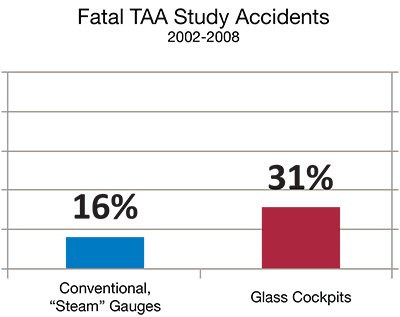
An NTSB safety study completed in 2010 concluded that glass cockpit aircraft experience a lower total accident rate, but a higher fatal accident rate, than the same type of aircraft equipped with conventional analog instrumentation. Data from an associated presentation is captured in the bar graph above.

Yes, the advent of TAAs was supposed to improve things. It many ways, it didnt. When compared to their steam-gauge counterparts-earlier, same-model airframes lacking glass panels-these are some of the on-average characteristics of glass-cockpit aircraft:

More often involved in accidents during climb, cruise and approach
More often in accidents resulting from loss of control in flight, collision with terrain, and weather encounters
More personal/business flights
Fewer total hours flown per aircraft
Fewer instructional flight hours
Higher percentage of hours flown in IMC
Longer flights
More IFR
Accident pilots were older, with more flight hours and higher certificates/ratings

Ready to Sell Your Aircraft?

List your airplane on AircraftForSale.com and reach qualified buyers.

List Your Aircraft
AircraftForSale Logo | FLYING Logo
Pilot in aircraft
Sign-up for newsletters & special offers!

Get the latest stories & special offers delivered directly to your inbox.

SUBSCRIBE