













CRM And Single Pilots

Cockpit resource management isn’t limited to crews. Planning and situational awareness are key for single pilots. 

Undergraduate pilot training in the USAF didn’t really focus on teamwork, in large part because of the competition among trainees to fly single-seat aircraft. Finding themselves assigned to a crewed aircraft forced them to work as a team.
Gemini Sparkle

Key Takeaways:

  • The author's early pilot training fostered a highly competitive, solo-oriented mindset, creating initial resistance to Cockpit Resource Management (CRM) when transitioning to crewed aircraft.
  • Effective CRM, involving clear roles, communication, and teamwork, was eventually recognized as crucial for safe and efficient multi-crew operations, contrasting with negative experiences under "tyrannical" commanders.
  • The article emphasizes that CRM principles are equally vital for single pilots, requiring the management of resources like automation, ATC, information, and personal decision-making to enhance safety and situational awareness.
  • Good CRM, whether crewed or single-pilot, requires deliberate effort, strong communication, and honest self-assessment to overcome competitive instincts and inherent challenges like stress management.
See a mistake? Contact us.

My class at the U.S. Air Force’s undergraduate pilot training (UPT) numbered about 50 students, 43 of whom were USAF Academy graduates, with seven ROTC graduates. I had no idea how competitive the academy grads were until one of them took me aside to explain. I thought he was kidding. He wasn’t.

So for a full year, I was around dozens of competitive student pilots who really had little incentive to work with each other, although we ROTC student pilots studied together, implementing the “cooperate and graduate” idea. In general, though, UPT was dog-eat-dog, with each student trying to one-up the others. If a student pilot started to flail, people stayed away from that pilot, hoping whatever was afflicting the failing student was not contagious: “Pilots eat their own,” I heard once.


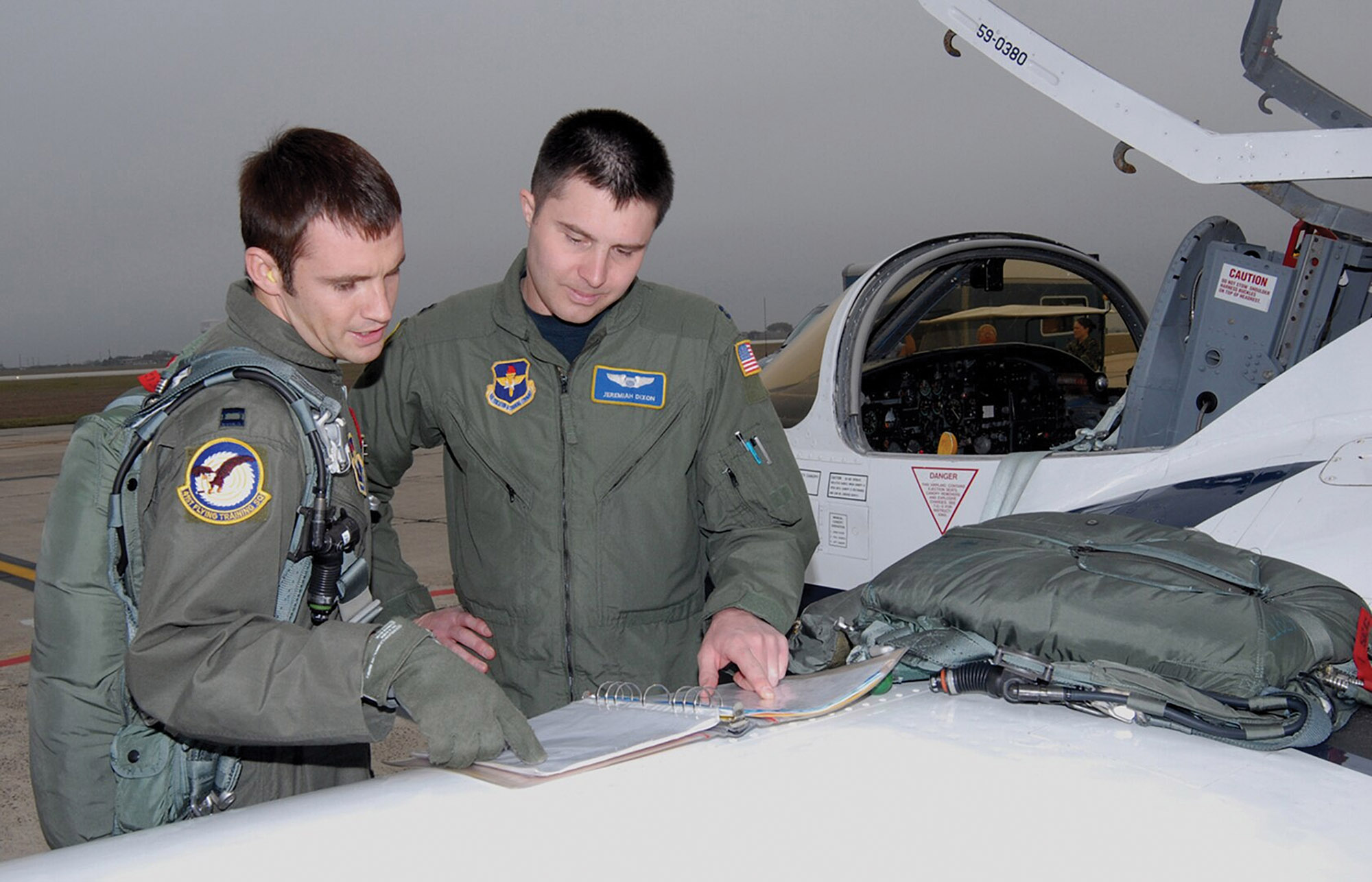
We flew two different aircraft in UPT, the T-37 and the T-38, both of which were single-pilot capable. And we student pilots did fly solo. Or, if there were two pilots on board, then one pilot did all the work as if they were solo, the instructor (IP) speaking when necessary. There was no CRM, no “I got the radios, you got the blah, blah, blah,” though we did practice positive aircraft control transfer.

Teamwork? What’s That?

After UPT, I was sent off to Beale AFB, to be a co-pilot in the KC-135Q, one of four people on a crew. One fine day, my “ancient” 40-year-old aircraft commander patiently tried to “sell” me on the cockpit resource management (CRM) concept, since my attitude toward it was poor. This was before the term “CRM” was common. You can’t go anywhere near a crewed airplane training program nowadays without hearing the term, but you could back then.

But that does the rest of us a disservice, since what we’re really aiming for is single-pilot cockpit resource management. 

Anyway, the whole idea of teamwork in the cockpit of the KC-135Q was new to me, and I resisted it fiercely. I felt like it “wasn’t really flying” to sit in the right seat of a modified Boeing 707 and be part of a “crew,” and have to talk to other crewmembers on the interphone. Two of them, the navigator and the boom operator, weren’t even pilots, for heaven’s sake! They didn’t go to a one-year-plus pilot training course: “Why are they my ‘equals’ on the crew?” I thought.

My first aircraft commander patiently said to me one day, “When you get a crew that is all working together, it’s beauuuutiful!” The way he said it—sold it—got me interested in crewed CRM and teamwork. I thought back to my grade-school baseball team: We knew each other well, and played and practiced together a lot. And we also won a lot.

Tyranny

A few KC-135 aircraft commanders (ACs) weren’t very good at crewed CRM. “Who needs a copilot?” was their attitude. Tyrants. After my first AC went to the airlines, I flew with one of those tyrants. My former AC made sure I got him as an AC—he knew I needed a “firm hand.” My new AC had gone through a couple of co-pilots—chewed them up, spit ‘em out like a wood chipper—before I joined his crew and stuck with him for a year. He once said, “Everyone loves a pilot—except his crew.”

I found out what he meant. Sometimes, the aircraft commander has to be “short” or “direct,” and that kind of talk can hurt people’s feelings. If a person is afraid to speak up when they see something wrong, all kinds of bad stuff can happen.

A Beautiful Thing?

But good crewed CRM is a beautiful thing, like my old aircraft commander said. With good CRM, there is no doubt as to who is going to raise the landing gear, who will make the radio calls, who will call out the checklist, who will brief the approach, who will turn on or off what switches, and when. It’s not a grabfest of hands reaching out for switches, or a goatrope of missed radio calls. 

We had a good crew, two pilots, a boom operator and a navigator, on our tanker. The Air Force, because of some crashes, changed their policy, and forced all KC-135s to fly with the same crew. “Hard crews,” they called it, no rotation or changing of people, like the airlines do. 

Years later, as a T-38 Instructor Pilot, I noticed hyper-competitive no-CRM flying. Many of the young T-38 IPs wanted to become fighter jocks in their next assignment—fly single-seat fighter aircraft—so they were competing with each other in the air, on the radio, on the ground, every day, all day. Anything to make yourself look good, and the other guy not good.

Single-Pilot CRM?

As a result, I have to work at good crewed CRM. Seems like it’s part art and part science. I’m either “part of the problem, or part of the solution” in a crewed aircraft. I’m either helping or hurting. Good CRM, whether crewed or single-pilot, doesn’t come naturally for me, but neither does playing guitar.

Single-pilot cockpit resource management might seem to be something of an oxymoron, since the single pilot doesn’t have a crew to manage. But he or she still can deploy many elements of crewed CRM. Perhaps the single pilot’s key among the seven fundamentals presented above is situational awareness (SA). Not only can establishing and keeping good SA help with things like when to descend to the destination from cruise flight and knowing where traffic is and will be, it also involves knowing the airplane’s capabilities and deficiencies, if any. Planning is important, and SA is a key component of good planning.

Good communication is a no-brainer CRM skill, too, as ATC won’t know what you want/need if you don’t let them know. Neither will your passengers. Good interpersonal skills count for a lot here, too. Problem solving, decision-making and exercising good judgment are always key to safe, reliable and predictable flight operations, crewed or single-pilot.

Two things single pilots probably aren’t very good at are stress management and critiquing themselves. Stress management isn’t something the typical pilot can readily teach themselves, except to invoke the “fly the airplane” mantra. Of course, one key to stress management is to not get stressed. That’s a skill we learn throughout life, one which has obvious value both in and outside the cockpit.

Critiquing our performance can be rife with rationalizations. Don’t fall into that trap. Ask yourself why you missed that ATC call, or why you forgot to switch tanks on time. Why are you a dot below the glideslope? Is it because you’re task-saturated and/or because you started down early? Honest solid self-assessment here can help you find the answer. So can more practice.

Many of us often have non-pilot passengers. At first blush, using them to meet CRM goals might seem futile. But there are things you can delegate to them, like watching for traffic. Reminding them to keep their hands and, especially feet, away from the flight controls always comes in handy.

Single-pilot CRM comes in many flavors but it’s primarily an organized way to accomplish a series of complex tasks. And managing cockpit resources meets that definition.

Ready to Sell Your Aircraft?

List your airplane on AircraftForSale.com and reach qualified buyers.

List Your Aircraft
AircraftForSale Logo | FLYING Logo
Pilot in aircraft
Sign-up for newsletters & special offers!

Get the latest stories & special offers delivered directly to your inbox.

SUBSCRIBE