













Foreign Affairs

Away from the warm embrace of North Dakota, our hero takes on foreign ATC, poorly marked pavement, U.S. Customs and even Florida. Along the way, lessons were learned. 

Gemini Sparkle

Key Takeaways:

  • Pilots flying internationally must be prepared for communication challenges with foreign air traffic control, requiring clear, concise English and adaptability to accents and unfamiliar radio chatter.
  • Thorough pre-flight study and adaptability are crucial for navigating international airports, which may feature different layouts, lighting, and operational procedures than those in the U.S.
  • Crossing international borders involves significant bureaucratic hurdles, including specific paperwork, fees, aircraft equipment requirements, and strict customs protocols that pilots must understand and respect.
See a mistake? Contact us.

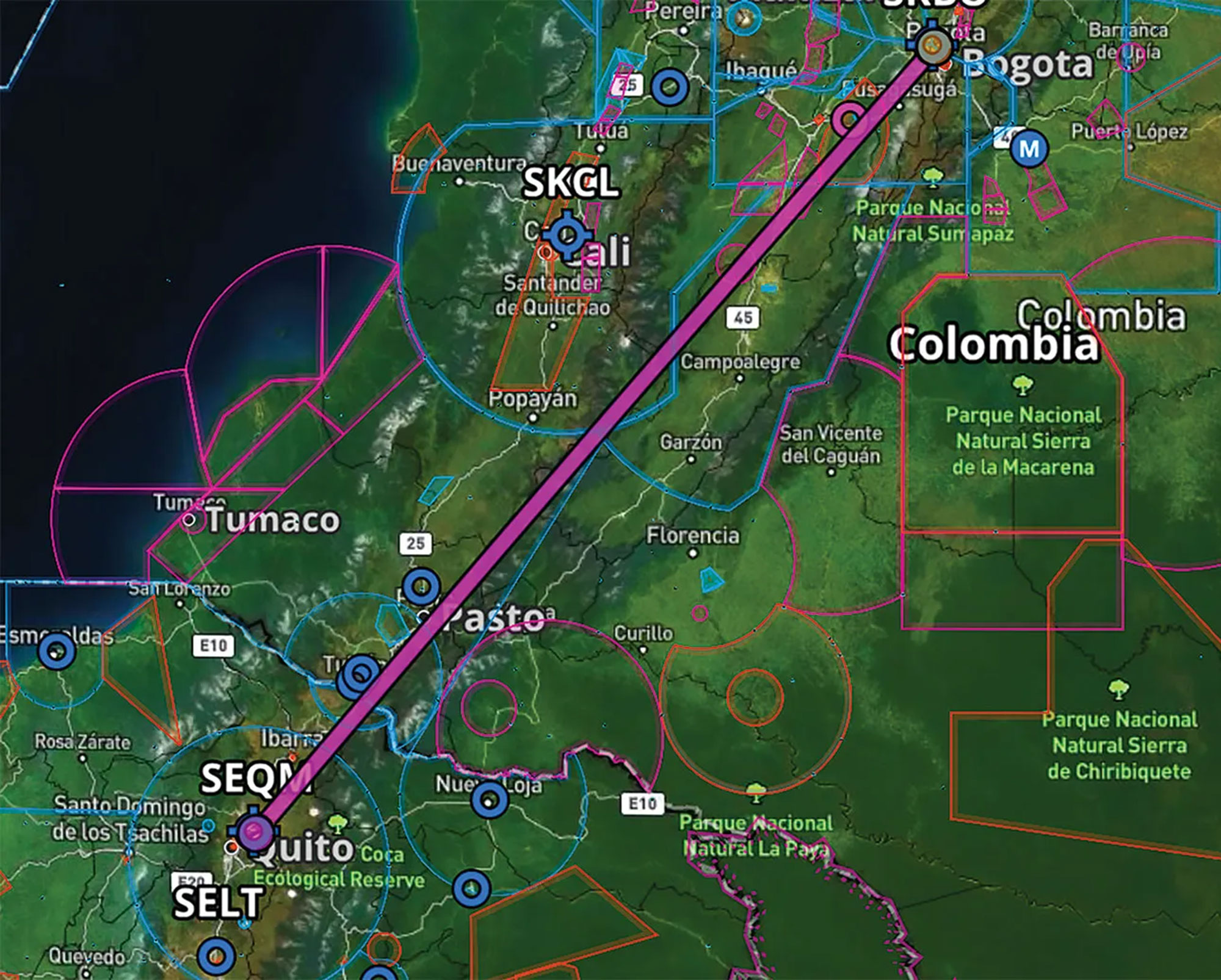
We listened very intently to the Spanish-speaking air traffic controller, coming in “double-broken”: broken radio transmission, broken English. The woman’s voice in Spanish in our earphones that night, high over Bogota, Colombia. It just sounds “high,” since the field elevation at Bogota is about 8400 feet, so they bring you in at like 13,000 feet on an initial leg for the approach.

Turns out 13,000 feet is lower there than 13,000 feet in Fargo, North Dakota, my home plate, thanks to mountainous terrain. I’m told this is because of the Coriolis effect, but I’m not sure about that.


Viva La Diferencia

The controller spoke rapid-fire to other aircraft in Spanish, those pilots responding in Spanish. I could make out some of the numbers—“Cuatro, Cuatro, Ocho”—but that was about it. Then occasionally she’d speak to us in English, sometimes mangling our call sign a bit to keep us on our toes.

The Wright Brothers invented the airplane in December 1903, and now, just a short 121 years later, I found out Colombian ATC invented “Rolling R English,” which sounds like a brand for a Texas cattle ranch, but isn’t.

“Citation 12345, turn rrrrrrright, heading one, two, thrrrrrree.” I didn’t actually time it, but each “R-word” she spoke lasted an estimated 14 seconds.

But enough about the nice Colombian ATC lady, who was quite prrrrrrrofessional—how about the Ecuadorian air traffic controller? He would say things like, “Citation 12345, report asklfvahsossh,” and we’d say, “Citation 12345, please say again,” and he’d say, “Again.” In the background, we heard what sounded like cackling in Spanish, and I think I heard the words “gringo” and “loco.” No, that didn’t happen. He’d repeat his transmission, of course, but it sometimes took multiple repeats to get it right.

Lesson for me: I should speak to ATC in short, easy-to-understand English phrases everywhere I go, but especially where English is a second language, a red-headed stepchild of a language.

We had success when we said things like, “Wilco, report San Cristobal Island, Citation 12345,” instead of, “I’m sorry, sir, did you tell us to report San Cristobal Island, or report our distance from San Cristobal Island, Citation 12345?” If we blathered all that English on the radio, we’d hear back, “Jes.”

If we spoke short phrases, the controller could understand us, and if we were wrong, we’d get corrected. If we were right, we’d hear silence, which was weird, but we learned to live with it. Chopping down our English into short bursts, to sort of save ammo, was the lesson there.

Adapting

We were told, at one airport, to “keep your speed up to 150 knots, there’s an Airbus behind you, three miles.” At night, at a strange airport, flying 150 knots all the way to quite near the runway. What could go wrong? 

Of course, the idea was the tower controller wanted us to land and get off the runway expeditiously, but the high-speed turnoffs were not well-lit—but the centerline was really, really well-lit, like Las Vegas. The little taxiway signs were dimly lit and set back from the runway, the lead-in lines dim, so we blew by two of those, finally getting off on a taxiway that we could actually see.

The Airbus had to go around, and the tower scolded us, but hey; who is going to turn toward a taxiway they can’t see, dude? Lesson: A little (or a lot) more pre-study of the airport diagram would have helped. The two turnoffs came sort of fast and furious in the dark, plus the helpful centerline lights were kinda night-vision-killers, once you’re on the ground. 

Taxi-Back International

Ever fly from a towered airport that has no taxiways? The ground/tower controller at this particular isolated strip gives you a clearance to “taxi to runway one-seven, back taxi to runway three five,” and off you go, hunting for the runway. There were ever-so-faint taxi lines—two of them—leading to the runways, the runway obscured from view by a big row of bushes (isn’t nature great?), so all you can do is follow a dim curving yellow line and then—bam!—you’re on the active runway, with its own dim lines. Just taxi to the end, turn around because you have no choice, tell them you’re ready for takeoff and go.

Back In The US

We get back to the United States and land in what to me is technically another foreign country—Florida. The customs guy came out to check our plane, hand-carrying a big contraption looking like an old Kodak slide projector and a Waring blender got married and had a child. I asked, “Does that machine detect gunpowder or drugs?” He looked at me closely with his Customs-agent eyes, and asked, “Why, do you have gunpowder and drugs?” No, he didn’t say that. He said, “It detects radioactivity. We had a jet come through here in I think 2008 that had radioactive material on it. Turned out to be harmless, but now we use this Kodak-Waring device.” 

After some initial hesitation, I engaged the CBP officer with some witty banter. He laughed, then looked at me very seriously and said, “Arms straight out to the sides.” He then ran the machine over my entire body four times, and had his German shepherd give me its full attention.

Lesson: Don’t joke with customs officers. Or their dogs.

Speaking of, in Grand Cayman, one of our guys wanted to pet the drug dog. I said to him in a loud whisper, “No, bad! Bad! Down, boy,” but it was too late. He petted the dog, who only chewed off a small portion of his arm, illustrating to me nature’s “redundancy rule,” humans having two arms and stuff. But then the dog became very suspicious of me, and sniffed me for half an hour. I could tell he didn’t trust me, because he boarded the plane and flew back to Fargo in the jumpseat, watching my every move, taking notes and talking into a little voice recorder.

Home Again

When we landed in Fargo, North Dakota, we parked on what looked like a skating rink, and me without my crampons! The temperature in Bogota, Colombia, was 57 degrees, the temperature in Florida 85 and the temperature in Fargo 19 Fahrenlow.

Lessons learned: bring clothes for the climates you’ll land at, study the approach plates, listen up closely and communicate clearly on the radios. And don’t pet the customs dog.


Ready to Sell Your Aircraft?

List your airplane on AircraftForSale.com and reach qualified buyers.

List Your Aircraft
AircraftForSale Logo | FLYING Logo
Pilot in aircraft
Sign-up for newsletters & special offers!

Get the latest stories & special offers delivered directly to your inbox.

SUBSCRIBE