












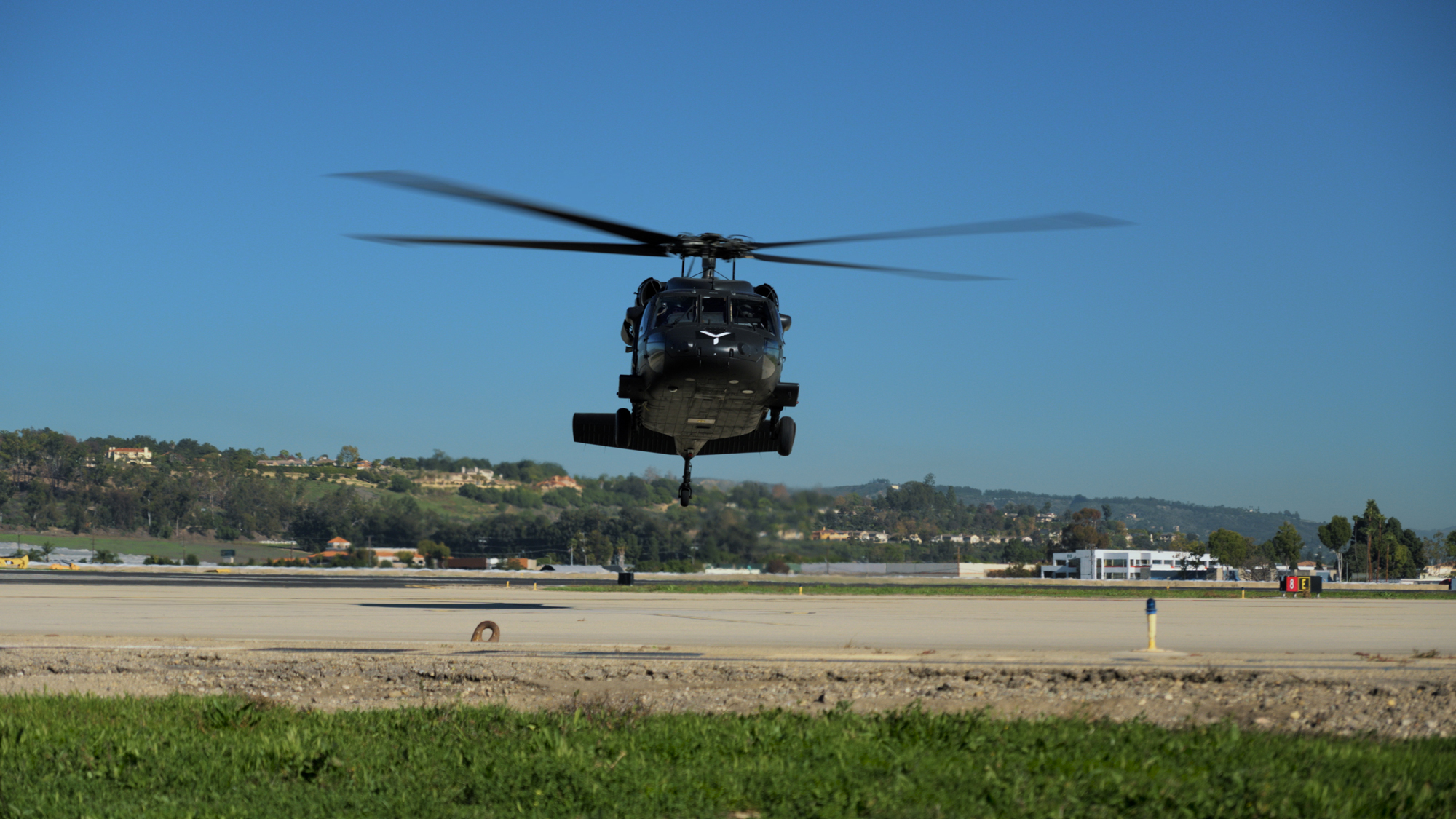


A UH-60 Black Hawk helicopter designed to take off or touch down with the swipe of a finger has made its first flight.
Skyryse, which began integrating its SkyOS universal flight operating system on the Black Hawk three months ago, on Tuesday announced the helicopter’s inaugural flight. It completed an automated pickup, hover, and touchdown, performing “precision flight maneuvers” with a single joystick while in the air, Skyryse said.

“Today, SkyOS demonstrated its maturity and precision on a military-grade aircraft,” said Mark Groden, founder and CEO of Skyryse. “The Black Hawk is one of the most proven, versatile aircraft in history, and while it’s still the same airframe that many operators know and trust, Black Hawk with SkyOS is a fundamentally different aircraft in its capabilities, flexibility, and safety.”
Skyryse said the core objective of the flight was to validate SkyOS’ performance, including handling, in real-world conditions, testing it against behavior predicted by simulator and ground testing. The company said it has flown more than 10,000 simulated hours and 2,800 hours with pilots commanding SkyOS-equipped aircraft.
One of the key capabilities demonstrated by Skyryse test pilot Eric Stierna during the flight was SkyOS’ take off and touch down mechanism. The system does away with conventional cyclic, collective, and throttle controls in favor of touchscreen displays and a fly-by-wire system.
“I swiped my finger and climbed into a completely stable hover,” said Stierna, who the company said has flown many hours on conventional Black Hawks. “I swiped again and descended into a perfect setdown.”
Skyryse first demonstrated a finger-swipe landing using a conforming production aircraft in February. It achieved a finger-swipe take off with the Skyryse One—a SkyOS-equipped, single control stick, IFR-certified Robinson R66—the month prior.
The California-based company isn’t the only one who believes automation could unlock new capabilities for the Black Hawk.
UH-60 manufacturer Sikorsky, for example, is developing an optionally piloted variant of the helicopter equipped with its Matrix autonomy system. Boeing partners Honeywell and Near Earth Autonomy are similarly working with the U.S. Army to retrofit Black Hawks.
Beyond the Black Hawk
The Black Hawk is one of the first airframes Skyryse is targeting. The company has a partnership with the Army for the potential integration of the system on its fleet of more than 2,400 helicopters. It is retrofitting additional Black Hawks for reseller Ace Aeronautics.
Skyryse said its optionally piloted Black Hawk—designed for operations with two, one, or zero onboard pilots—is “easier, safer, and more intuitive to fly” than the original.
The helicopter uses simplified flight controls and human-machine interfaces that are intended to reduce pilot workload. Per Skyryse, it offers improved visibility with a “streamlined” cockpit and performs better in limited visibility. In the air, SkyOS continuously monitors terrain, obstacles, and other aircraft to provide real-time safety alerts, though it lacks wire strike protection.
But SkyOS is designed to automate any platform—not just the Black Hawk. To install it, Skyryse takes out the instrument panel, flight instruments, avionics, controls, and pedals, replacing them with digital displays and its fly-by-wire system.
The company removed more than 100 parts to install SkyOS on the R66 to create its Skyryse One, which it claims is the first fly-by-wire helicopter controlled using a single control stick and pair of touchscreens. The four-axis joystick sits between the two front seats, accessible to either occupant. Pushing the stick forward or back adjusts speed. Twisting it rotates the airframe. And moving it side to side alters the bank angle, which is limited by SkyOS.
Alternatively, pilots can adjust speed, altitude, and heading by dragging sliders or entering values on the touchscreen. Letting the control stick go makes the helicopter fly straight and level at its target airspeed—a consideration designed to prevent loss of control in flight.
“This capability alone would eliminate many helicopter loss-of-control accidents,” said FLYING contributor Max Trescott, who covered his visit to Skyryse’s California facility in the February 2025 issue.
Another feature billed as a safety improvement is SkyOS’ finger-swipe mechanism. Swiping up initiates lift and brings the aircraft to a hover at about five feet. Pushing and holding a thumb lever on the joystick sets the climb rate.
During takeoff, SkyOS prevents hot and hung starts and prevents the engine from overheating or overspeeding. If the helicopter is descending too quickly, SkyOS will stop it at hover altitude. A swipe down initiates touchdown.
The system is also capable of automated autorotation, which Skyryse in 2023 became the first company to achieve.
Skyryse One received a special airworthiness certificate in 2024 and is in for-credit testing with the FAA. The company hopes to obtain supplemental type certification next year and start deliveries soon after.
The company said it began integrating and testing SkyOS on helicopters because they are less stable than fixed-wing airframes and more complicated for pilots to fly. But it believes the exact same user interface—a single control stick and digital displays—could be used to fly fixed-wing aircraft.
“We’re bringing automation to every existing aircraft, including the Black Hawk, in a way that offers unmatched reliability and flexibility,” said Groden.
In addition to the Black Hawk, Skyryse has integrated SkyOS on a Cirrus SR-22, which made its first flight in October. The company is working on additional integrations for the Airbus H-125 and H-130, Bell 407 and Pilatus PC-12, and Beechcraft King Air for customers United Rotorcraft, Air Methods, and Dynamic Aviation, respectively. The King Airs are ultimately intended for the military.
In addition, the company has a partnership with the California Department of Forestry and Fire Protection (Cal Fire), the world’s largest civil aerial firefighting operator, to automate its fleet—and, potentially, introduce Skyryse One.

