Register

Search Results for: maintaining your airplane

Airmanship

Engine-Out Energy Management

Moreover, the FAAs Airman Certification Standards (ACS) for private and commercial certificates specify that pilots are to have knowledge of EM concepts for many maneuvers. They include emergency approach and landing, soft-field/rough-field landing, normal approach and landing, short-field landing, various types of water landings, power-off 180-degree accuracy approach and landing and go-around/rejected landing. The word knowledge implies pilots should have, at least, a basic understanding of EM concepts and be able to apply these concepts to tasks in the FAAs ACS.

Read More »
Aircraft Analysis

Managing Risk In Aircraft Certification

Most of my articles for this journal focus on managing the risk of flying piston-powered general aviation aircraft, with examples of good and poor risk management. But risk management is at least equally critical in the world of operating airliners and turbine-powered transport category aircraft. Recent air carrier accidents provide illustration and lessons relevant to operating small general aviation aircraft, especially when designing and certifying them. In fact, and just as during flight operations, the job of managing risk in the design and certification is to identify, assess and mitigate that risk. These procedures apply even more objectively when using rigid design criteria, especially when they involve transport category aircraft.

Read More »
Avionics and Gear

Sneak in the Side Door

Before you get a contact approach, some more boxes need to be checked, starting with weather minimums on par with Special VFR and Class G airspace. AIM 5-4-25 kicks off with them: Pilots operating in accordance with an IFR flight plan, provided they are clear of clouds and have at least one mile flight visibility and can reasonably expect to continue to the destination airport in those conditions, may request ATC authorization for a contact approach.

Read More »
Another Look

Power And Pitch

If youre like me, youve been watching the ongoing saga of Boeing and its 737 MAX. The gist of it for our purposes is that the new MAX versions of the 737 are powered by larger-diameter engines than the type was originally designed to accommodate. Since the 1980s-when Boeing switched from the types original low-bypass Pratt & Whitney JT8D engines to the CFM International CFM56-the reduced ground clearance when mounting high-bypass powerplants featuring improved fuel economy has required flattening the bottom of the cowlings. It was cheaper and easier than redesigning the landing gear, which is too short to accommodate the larger engines.

Read More »
Accident Probes

Five Reasons Not To Fly A Coupled Approach

And like every other technology, autopilots have their limitations. For one, they have to be set up correctly-along with the navigation equipment-to reliably follow a heading and descend along a glidepath. Details like when to take over from the autopilot, how you might handle an equipment failure-if you notice it-and even whether to let Otto fly the missed approach or do it yourself need to be worked out ahead of time. Thats the short version of why we might want to consider hand-flying the approach. Lets expand on them.

Read More »
Accident Probes

The Transactional Pilot

I tap on a location I observe to be free of obstructions, offering a clear approach corridor and suitable landing surface, and after I get the dot on my apps chart, I change its name to an approach course, e.g., like F17, or G18, and use those designators (you can make up any letter/number you wish), as Field/Approach 170 degrees, or for the other as Grass/Approach 180 degrees. The letters can be for road, crop, highway or water, or whatever looks better-as always, the closer to roads, the better for emergency services access.

Read More »
Aircraft

How To Keep a ‘Bargain Jet’ Flying

There are plenty of reasons to want to own and fly a jet. Jets are made for capable, reliable transportation. They come equipped ready to do the job with pressurization, anti-icing and deicing, and substantial turbine-style cockpit displays and avionics. Most important, they come with jet engines. There is nothing better than jet engines. They […]

Read More »
Charts & Plates

Circling Uncertainty

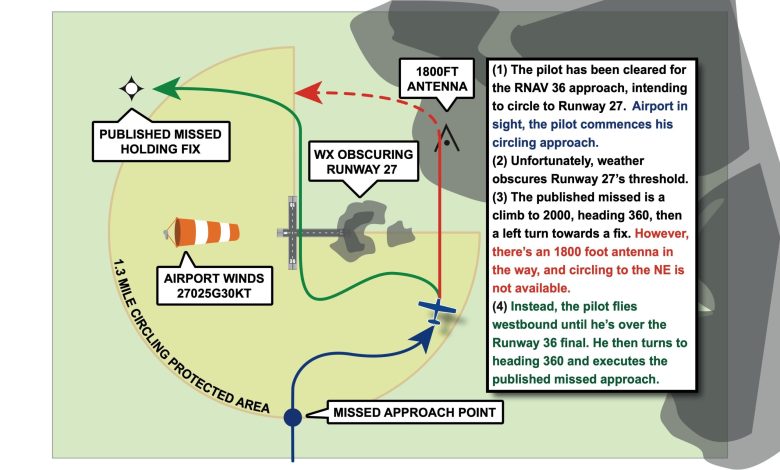
Your home field is non-towered, and the AWOS says the winds are fierce out of the west. If it was VFR, Runway 27 would rock. However, theres nasty precipitation starting five miles east of the airport. The RNAV 27 approach would drive you right through it. Youve already been beaten up enough for one day. Instead, the reported 800 foot ceiling inspires you request an RNAV approach to Runway 36 with a circle to Runway 27. The circling mins are 600 feet for your aircraft category. Youll stay close to the airport and once you get underneath, you can bring it around to land into the wind on 27.

Read More »
Aircraft

Aviation Insurance is Changing

“Let the good times roll” may have been an appropriate mantra for aviation-insurance consumers during the past 10 to 12 years, but the party might finally be over. While the total cost of aircraft ownership — i.e. hangar leases, fuel, maintenance costs, FBO fees and so on — have gone up substantially for the past […]

Read More »
Airmanship

Survive Inadvertent IMC The Old-Fashioned Way

if youve been around general aviation for any time at all, by now you should not be surprised to learn that attempted VFR flight into instrument metereological conditions (IMC) and its close cousin, loss of visual references at night, consistently rank as the most lethal type of GA accidents. Although the numbers (thank goodness!) have recently begun to decline, about seven out of every eight-nearly 90 percent-of those accidents are still fatal. Thats largely because, as current NTSB Vice Chairman Bruce Landsberg puts it, they tend to end in flight into terrain, either controlled or (more often) uncontrolled. In both cases, prospects for survival are meager.

Read More »
Pilot in aircraft
Sign-up for newsletters & special offers!

Get the latest stories & special offers delivered directly to your inbox.

SUBSCRIBE