













Register

Reading the Fine Print

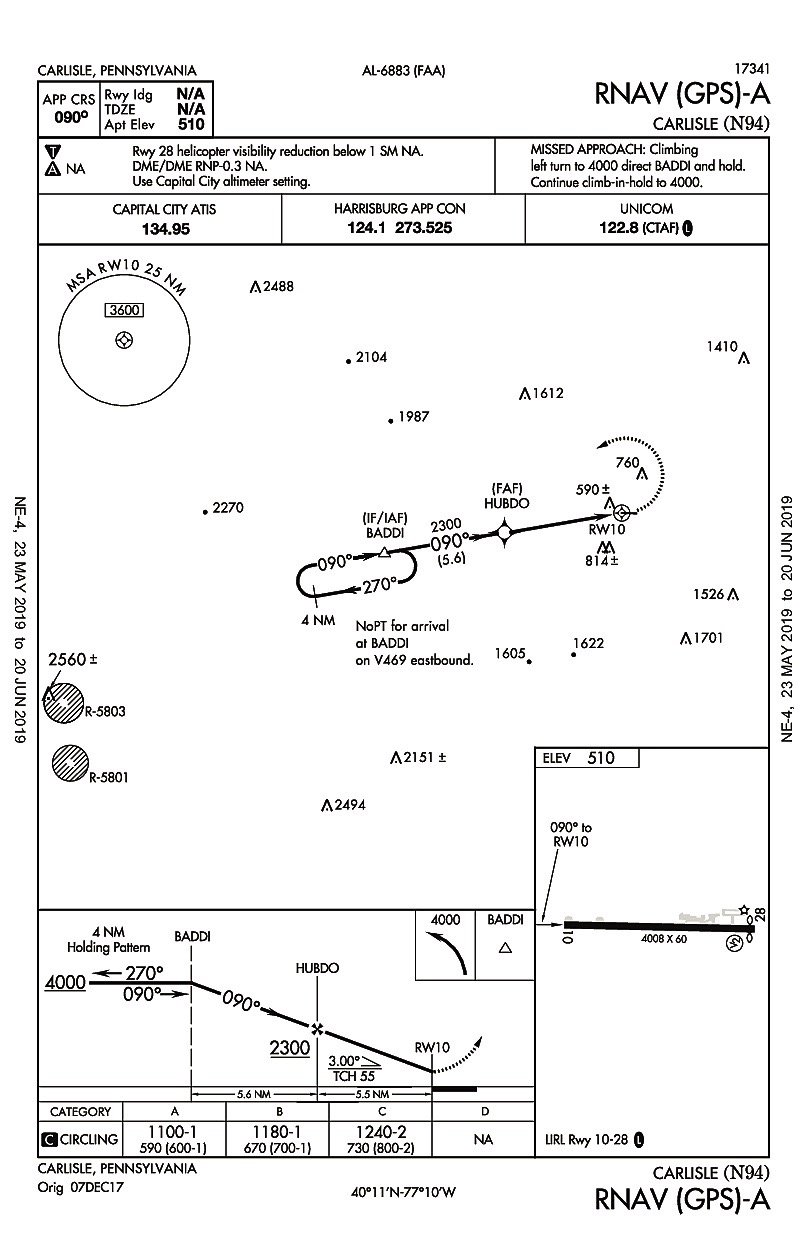
Recently, we heard from a reader with a question about an approach into Carlisle, Pennsylvania (N94). The RNAV (GPS)-A approach has a final approach course thats offset from the runway by around 12 degrees and a standard three-degree descent angle. Approaches are usually published with only circling minimums when the final approach course alignment relative to the runway exceeds 30 degrees (for most procedure types) or the descent angle is greater than 3.77 degrees (for Category C and below). Since neither of these reasons apply to this approach, why doesnt it have straight-in minimums?

Gemini Sparkle

Key Takeaways:

  • Subtle details, such as basic runway markings, can dictate an approach's minimums (e.g., only circling minimums), even when standard alignment or descent angle criteria are met.
  • Approach chart notes and missing features (e.g., "NA at night," absence of VDP/VDA) are critical indicators of safety limitations, often due to obstacle penetrations in the visual segment, requiring careful pilot consideration.
  • Pilots bear the sole responsibility for thoroughly understanding and adhering to all chart limitations, including adjustments for inoperative equipment, as these details are crucial for safe instrument approach procedures.
See a mistake? Contact us.

Recently, we heard from a reader with a question about an approach into Carlisle, Pennsylvania (N94). The RNAV (GPS)-A approach has a final approach course that’s offset from the runway by around 12 degrees and a standard three-degree descent angle. Approaches are usually published with only circling minimums when the final approach course alignment relative to the runway exceeds 30 degrees (for most procedure types) or the descent angle is greater than 3.77 degrees (for Category C and below). Since neither of these reasons apply to this approach, why doesn’t it have straight-in minimums?

It turns out that the reason this procedure has only circling minimums has to do with the runway markings, of all things. The runway at Carlisle has basic, visual, runway markings; airport design standards call for at least non-precision instrument markings in order to publish straight-in minimums. This little detail isn’t found on the chart, the Airport/Facility Directory, or most EFBs, but can be found in online sources, such as Airnav.com, which include FAA airport survey data. If not for the visual runway markings, lower minimums might be possible since LP, LNAV/VNAV or LPV lines of minimums could be considered.


Ready to Sell Your Aircraft?

List your airplane on AircraftForSale.com and reach qualified buyers.

List Your Aircraft
AircraftForSale Logo | FLYING Logo
Pilot in aircraft
Sign-up for newsletters & special offers!

Get the latest stories & special offers delivered directly to your inbox.

SUBSCRIBE