











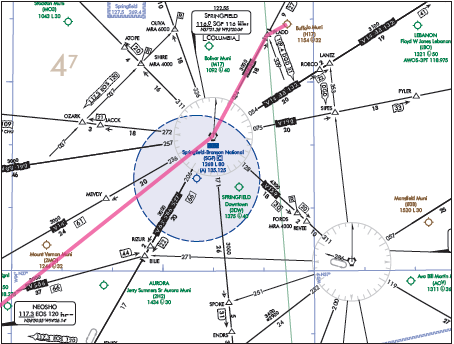


Unless you’re one of those lucky pilots who fly only from big, comfy airports with at least a part-time tower, copying and canceling IFR clearances while airborne are routine. And while it’s not as common to file IFR to a destination with no instrument procedures, there are plenty of such airports scattered around, so it does happen. You might find yourself heading to one, too. It’s not all that tricky; just know which rules apply and where.
Buffalo or Bust
Here’s how it might come about. You’ve agreed to fly a friend from home base at KADM (Ardmore, Oklahoma) to Buffalo, Missouri to check out a vintage airplane for sale. It’s a perfect excuse to fire up the GPS-equipped fourseater and go somewhere new. You notice right off that the destination, H17, has no tower and (gulp!) no approaches. Guess they still have those, despite the growing numbers of cost-efficient RNAV procedures. Spoiled by IFR (“I File Regardless”) even on short, blue-sky hops, you prefer landing somewhere with LPVs. “Let’s land at Springfield, Missouri,” you suggest. “It’s right on the way and we can drive from there.” Your friend responds, “That’s no fun. Besides, there are fees, rental car costs, extra time…” You relent. “Okay, Buffalo Municipal it is. But let’s wait ‘til weather improves enough to do this VFR stuff. Agreed?” After confirming H17 has a paved runway of adequate length (4/22, 3220 x 50) and lights (LIRL), you spend a rainy afternoon brushing up on how to get there with as much IFR as possible. It’s really a matter of satisfying a couple of requirements. Digging up §91.169, , you see that item (a)(2) says an IFR flight plan must have an alternate, unless both (b)(1)and(2) apply: An IAP to the destination airport, and weather at least as good as the 1-2- 3 rule (ceiling 2000 feet, visibility 3 SM at ETA, plus or minus one hour). Buffalo doesn’t meet (b)(1), so regardless of the weather, an alternate’s required. Since you like Springfield, that’d be more than adequate. You plan the route starting with the Ardmore VORTAC and decide on ADM – V161 – OKM – SGF – PLADD – H17. You could decide at PLADD, just 3.6NM away, if the weather is good enough to cancel IFR and go on in. If not, you at least have a fix to use for holding, in case of weather, traffic, a new clearance, lost comms, etc. Or, if the weather gets marginal before departure, you could amend the plan and fly to a nearby airport, like Bolivar, Missouri, (M17) just to the west. You could start an approach from the SGF navaid, which is the initial fix for the RNAV 36. Then, assuming you can switch to VFR on descent, cancel and hop over to Buffalo. If not, land at M17 and wait until the conditions improve.

