














NASA’s Quiet Supersonic X-59 Nears First Flight

Medium- and high-speed taxiing marks the final phase of ground testing for the experimental design.

NASA Lockheed Martin Skunk Works X-59 supersonic aircraft
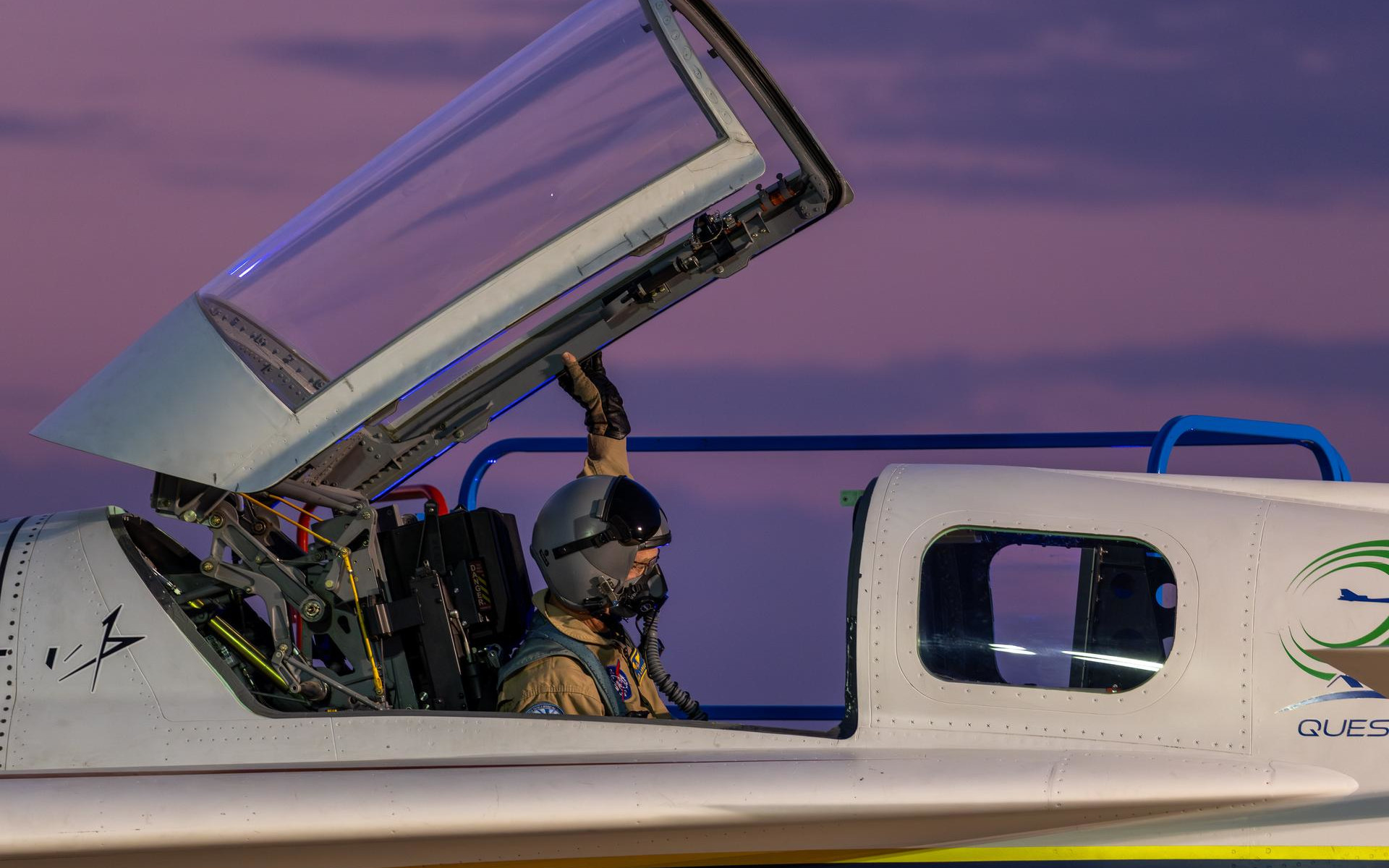
NASA test pilot Nils Larson gets in the cockpit for X-59 ground testing at Lockheed Martin’s Skunk Works facility in California. [Courtesy: Lockheed Martin]
Gemini Sparkle

Key Takeaways:

  • NASA and Lockheed Martin's X-59 experimental supersonic aircraft, designed to transform loud sonic booms into quiet "thumps," is nearing its maiden flight after completing preliminary taxi tests.
  • The X-59 features innovative designs, such as a tapered nose, top-mounted engine, and an external vision system instead of a forward window, all aimed at suppressing noise during supersonic flight.
  • Its test flights will collect crucial community noise data, which will be used to help U.S. and international regulators establish new standards, potentially leading to the lifting of the decades-old ban on civil supersonic flight over land.
See a mistake? Contact us.

NASA and Lockheed Martin’s supersonic X-59 aircraft—which moved under its own power for the first time in July—is nearing its maiden flight.

The space agency on Tuesday said it is “about to begin” medium- and high-speed X-59 taxi tests, the final step before takeoff. The linchpin of NASA’s Quiet SuperSonic Technology (QUESST) effort, X-59 test flights will help U.S. and international regulators create noise standards for civil supersonic flight over land, which the FAA has banned since 1973.


Lockheed’s secretive Skunk Works unit unveiled the X-59 design in early 2024. It has a projected speed of about 925 mph, or 1.4 times the speed of sound. But it is designed to reduce loud sonic booms to quiet “thumps,” akin to a car door closing in the distance.

A quick glance at the X-59 will tell you that it is not a typical aircraft. For example, its cockpit lacks a forward-facing window. Instead, the pilot relies on an external vision system comprising an array of sensors that feeds a high-resolution monitor. The design choice is one of many intended to suppress noise.

The X-59’s thin, tapered nose—spanning about one-third of its nearly 100-foot length—is engineered to break up shock waves in front of the aircraft. Its modified F414-GE-100 engine is top-mounted, creating a smooth underside that prevents shock waves from merging in its wake. The airframe is composed primarily of aluminum, and its paint scheme is designed to protect against moisture and corrosion.

X-59 on the Move

Skunk Works has spent close to a decade refining the design. But with low-speed taxi tests at the company’s Palmdale, California facility in the books, first flight is on the horizon.

In the upcoming taxi tests, personnel will gauge braking, steering, stability, and sensor performance at high speeds. They will also assess the external vision system.

The X-59’s initial one-hour flight will depart from Palmdale and land at NASA’s Armstrong Flight Research Center in Edwards, California. It is expected to reach a top speed of 240 mph and altitude of 12,000 feet.

During the flight, the partners will evaluate engine performance, control systems, instrumentation, autopilot, and a host of other aspects. Subsequent flights will increase the aircraft’s speed and altitude.

The first phase of flight testing is intended to validate the model’s airworthiness and safety. Following envelope expansion flights, NASA will formally take delivery of the aircraft for validation on a supersonic test range at Armstrong and Edwards Air Force Base (KEDW).

Later, pilots will fly it over communities and gather feedback on noise below the flight path. These survey flights will generate valuable data that the FAA could use to open the floodgates for civil supersonic flight.

As new capabilities are unlocked, the regulator faces pressure to modernize. Boom Supersonic, for example, earlier this year completed a series of demonstration flights that created sonic booms inaudible to microphones below the flight path. NASA took part in the effort, snapping photos to visualize shock waves as Boom test pilot Tristan “Geppetto” Brandenburg whizzed by.

The company plans to integrate the capability—which it calls “boomless cruise”—on its flagship Overture, billed as the first civil supersonic airliner since Concorde.

“Basically, [the rule] says ‘thou shalt not exceed Mach 1,’” Boom CEO Blake Scholl told FLYING in February. “And what it should say is, ‘thou shalt not make loud noises.’”

Scholl’s philosophy has gained traction on Capitol Hill. In May, a group of lawmakers introduced a bill to lift restrictions on supersonic flight over land, provided no sonic booms reach the ground. In March, President Donald Trump ordered the FAA to reverse the ban, arguing that it stifles innovation.

The International Civil Aviation Organization (ICAO) in February agreed to new global supersonic aircraft noise standards, which could open the door to high-speed cross-border flights.

Like this story? We think you’ll also like the Future of FLYING newsletter sent every Thursday afternoon. Sign up now.

Jack Daleo

Jack is a staff writer covering advanced air mobility, including everything from drones to unmanned aircraft systems to space travel—and a whole lot more. He spent close to two years reporting on drone delivery for FreightWaves, covering the biggest news and developments in the space and connecting with industry executives and experts. Jack is also a basketball aficionado, a frequent traveler and a lover of all things logistics.

Ready to Sell Your Aircraft?

List your airplane on AircraftForSale.com and reach qualified buyers.

List Your Aircraft
AircraftForSale Logo | FLYING Logo
Pilot in aircraft
Sign-up for newsletters & special offers!

Get the latest stories & special offers delivered directly to your inbox.

SUBSCRIBE
