











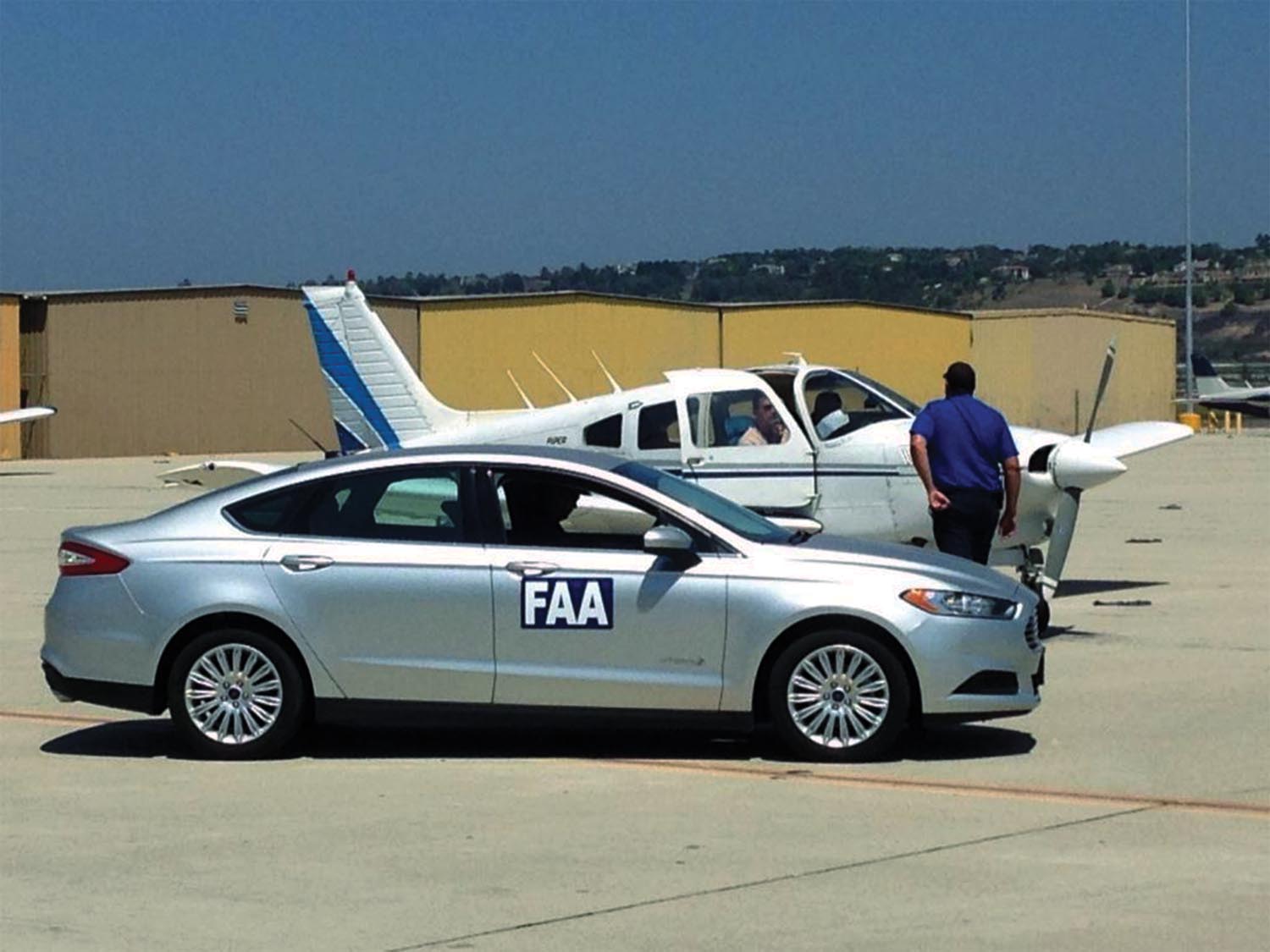


Imagine you’ve just landed, taxied off the runway and hear the tower controller say to you, “Possible pilot deviation. Advise you contact (the ATC facility) at (phone number).” Following that exchange, you dutifully copy the phone number with the anxiety of having to make a dreaded phone call to an ATC supervisor. You then ask yourself, “Pilot deviation? What is that and what did I do wrong?”
A pilot deviation (PD) occurs when a pilot takes some action that violates ATC instructions, a FAR or an Air Defense Identification Zone (ADIZ). A PD can range from an unintentional, innocuous mistake to an intentional, deliberate pilot action resulting in a serious matter. If found culpable, and depending on circumstances, pilot penalties for a PD can include remedial flight instruction from a flight instructor, a “709” checkride (re-examination of pilot skills) and enforcement actions (certificate suspension or revocation). The phrase “possible pilot deviation” is a Brasher Notification, putting the pilot on notice of a possible violation. The sidebar on the opposite page has more on Brasher Notifications.

Pilot Deviation Categories
Pilot deviations are categorized into two groups: ground or surface, and airborne. A ground PD can happen by not complying with an assigned taxi clearance, committing a runway incursion, and taking off or landing without a clearance. Ground PDs were responsible for 60 percent of U.S. runway incursions in 2023.
A wrong surface event (WSE) PD is when an aircraft lands or departs on the wrong runway, taxiway or wrong airport. General aviation pilots were responsible for 85 percent of WSEs as reported by the National Air Traffic Controllers Association in 2017. Airports with parallel aligned runways are predisposed to a WSE PD due, in part, to the immediate proximity of the parallel runways. For example, Cecil Airport, a Class D airport and former military base just southwest of Jacksonville, Florida, has two sets of parallel runways, with staggered thresholds for Runways 36L and 36R. A WSE PD at Cecil is likely enough that I’ve witnessed one: a Cirrus SR22 was cleared for 36L, flew through the approach corridor of 36L while on base, and then lined up and landed on 36R.
Failing to hold short of an assigned clearance limit as required for land and hold short operations (LAHSO) also constitutes a ground PD. A LAHSO clearance is an ATC procedure designed to increase airport capacity while maintaining runway safety. After accepting a LAHSO clearance, a pilot is required to complete the landing roll-out within the limited available landing distance specified for the runway and then hold short of an intersecting runway, an intersecting taxiway, or another designated point on a runway.
Airborne PDs mainly occur when a pilot strays from an assigned heading and altitude, violates or disregards instructions from ATC, like flying an instrument approach that is different than cleared, or penetrates various types of airspace without a clearance. For example, entering Class B airspace while trying to circumnavigate it, or blowing through a stadium TFR without talking to ATC.
Causal Factors, Mitigation
As with other aspects of aircraft operations, risk management can be applied to PDs. For example, in-cockpit conversation, a powerful distractor, contributed to the crew of Comair Flight 5191 losing situational awareness while taxiing at the Blue Grass Airport in Lexington, Kentucky. As a result, they taxied to the wrong runway, attempted to take off from the too-short surface, ran off the end and crashed with 49 fatalities.
Sterile cockpit procedure (no non-essential conversation during taxi, takeoff, climb or descent for landing and landing itself) is a RM control that could have mitigated the distraction associated with this accident. Being overly preoccupied and distracted by things like unfamiliar equipment or conflicting traffic also contribute to airborne PDs like inadvertently flying into restricted airspace without a clearance or straying from an assigned altitude. We can also put the heading bug on the wrong setting, like wanting 015 degrees but entering 150.
A mitigation is obtaining training to gain proficiency in operating newer, complex avionics, including autopilots. Another mitigation is to employ a crew member or passenger to help visually search for traffic.
Active Listening
Miscommunication is perhaps the leading cause of airborne PDs. One mitigation is what I call active listening—paying full attention to what is being said. Concentrate to understand the message, and do not allow anything to distract you from listening. Write down and read back clearances to ensure you have the correct information, and ask questions for clarification.
Also, understand expectation bias: When someone “hears” or “sees” something they expect to hear or see rather than what actually may be occurring. For example, a pilot expects the tower controller to state, “Cleared for takeoff,” when the controller actually said, “Hold for takeoff.”
Poor Planning
Inadequate preflight planning and lack of understanding an airport’s taxiway and runway layout contribute greatly to PDs. Mitigations include reviewing the airport’s taxiways prior to taxi and having the airport diagram available. You also can use a device to provide your position in real time, down to the taxiway intersection, and other tools include automation like Garmin’s SafeTaxi. Pay attention signage to verify your location with the automation. Request progressive taxi instructions at unfamiliar airports. Finally, actively listen for a clear understanding of taxi instructions.
Inadequate preflight planning also contributes to committing airborne PDs, of course. For example, poor planning leads to insufficient information about various airspace, TFRs and Notams along the route. One mitigation is to take time to carefully review all en route airspace and weather. Another is getting VFR flight-following or going IFR to help avoid flying through a TFR.
Hazardous Attitudes
With the foregoing operational mitigations on the record, let’s talk about an elephant in the room: hazardous pilot attitudes contributing to PDs. For example, we all should be familiar with the five hazardous attitudes have been described leading to poor pilot judgement and inability to make safe decisions: anti-authority, impulsivity, invulnerability, macho and resignation.
For example, a pilot with a strong anti-authority attitude—“Don’t tell me what to do; rules are for other pilots”—is predisposed to flagrantly disregarding an ATC clearance and doing what they please. Not only is this a great way to commit a PD, it’s also something that will argue against you if it comes to enforcement.
For mitigation, learning to self-recognize hazardous attitudes can be difficult, which means mitigations are, too. Following the FARs is probably the best all-around mitigation, but these kinds of attitudes don’t lend themselves to a pilot’s success.
A final word: Help mitigate a Brasher Notification by getting legal representation.


