












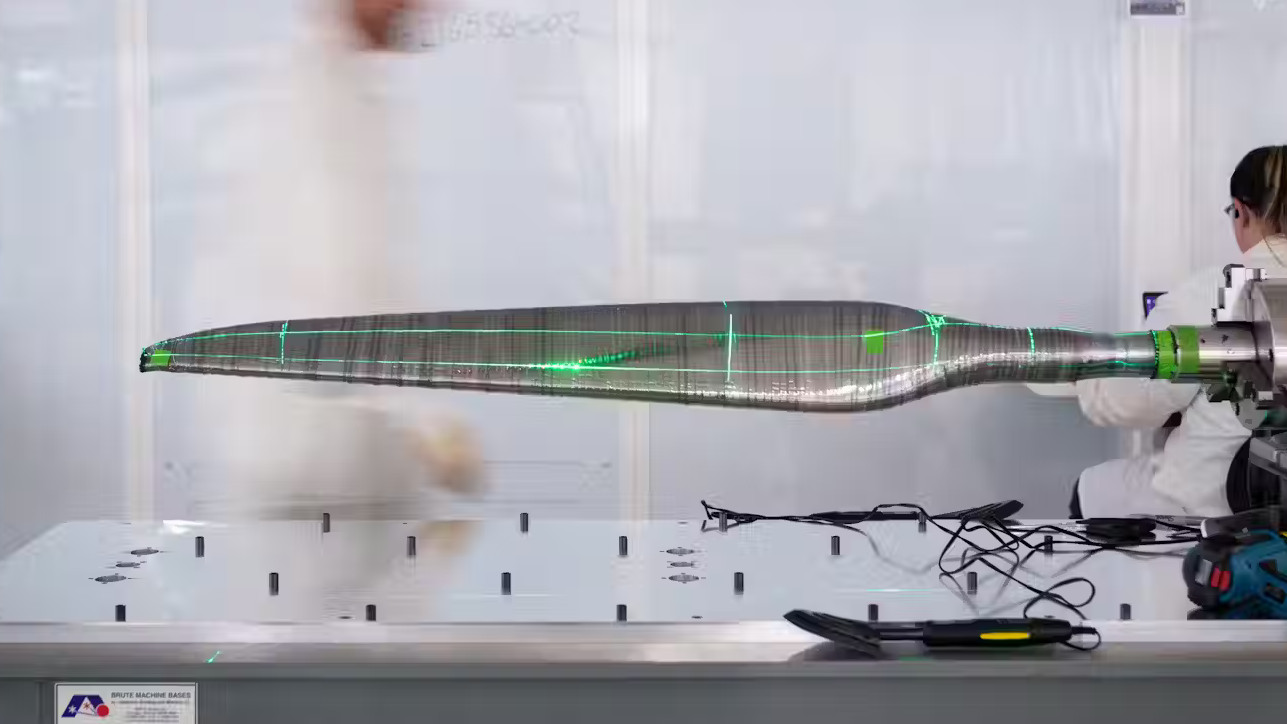


Electric vertical takeoff and landing (eVTOL) air taxi developer Joby Aviation has begun building propeller blades that it claims will meet requirements for FAA certification.
The company on Friday said it aims to churn out as many as 15,000 blades per year from its 140-acre site at Dayton International Airport (KDAY) in Ohio, acquired in 2023 to serve as its core manufacturing plant. Conforming blades are expected to be completed next month and installed on aircraft for flight testing in 2026.

“Dayton gives us the resources, talent, and speed to scale one of the most technically demanding parts of our aircraft,” Eric Allison, Joby’s chief product officer, said in a statement. “Joby’s propeller blades are a key part of what makes our aircraft special—central to its low acoustic profile and the result of a decade of complex engineering.”
Joby’s flagship air taxi is all-electric and built for a pilot to fly as many as four passengers. The company has a partnership with Delta Air Lines through which it will offer short, home-to-airport trips in cities such as New York and Los Angeles, cruising at up to 200 mph.
The aircraft’s most striking feature is its combination of fixed wings and tilting propellers, which support both hover and forward flight. Its six tilt-props—four on the conventional wing and two on a V-tail—receive power from electric batteries and are expected to produce a fraction of the noise of rotorcraft.
Each propeller is five-bladed, with variable speed and pitch. According to Joby, design choices such as the number and shape of the blades, tip speed, and disc loading were made with noise reduction in mind. Per its own assessment, the aircraft produces about 45 dBA of noise when cruising at 1,640 feet—somewhere between the volume of rustling leaves and typical conversation.
Joby expects to one day produce 500 air taxis per year in Dayton, where it said “nearly every component” required for propeller blade production is “available within a 30-minute radius.” Each of those aircraft would require 30 blades, for a total of 15,000. The first conforming blades will be sent to Joby’s pilot production line in Marina, California, where it builds flight test aircraft.
Getting those conforming blades in the sky will be a critical step for Joby, which is working toward full-aircraft type inspection authorization (TIA) testing with the FAA. Those assessments will validate the air taxi’s safety and airworthiness and are one of the final steps in the type certification process.
Joby in August said its first TIA-conforming aircraft was ready for final assembly and could begin flying this year. Earlier this year, it achieved a piloted transition from hover to forward flight, becoming the first to do so with a tilt-rotor eVTOL prototype.
Joby’s activities in recent months reflect those of a company that believes it is approaching commercial readiness.
In July, for example, it announced an expansion to its Marina facility that doubled its annual capacity from 12 aircraft to 24. That followed a half-billion dollar investment from manufacturing partner Toyota, which is supporting production in both Marina and Dayton.
In August, Joby acquired the passenger division of helicopter charter operator Blade Air Mobility for $125 million. The move netted it Blade terminals in New York, one of its planned launch markets, that could be outfitted with electric chargers. The following month, Blade partnered with Uber, with plans to make Joby’s air taxi available on the platform following certification.
SMG Consulting, which tracks progress toward eVTOL entry into service through its Advanced Air Mobility (AAM) Reality Index, forecasts Joby’s U.S. commercial launch in mid-2027. Ramping up testing with conforming components is one way the company could look to accelerate that timeline.

